Category
page 1Free content from United Nations Environment Programme

agriculture
thumb|Modern agriculture: a center pivot irrigation system on a field

soil
thumb|upright=1.25|Surface-water-Gley soil|gley developed in [[glacial till in Northern Ireland]]

plastic
thumb|upright=1.35|Household items made of various types of plastics
Plastics are a wide range of synthetic or semisynthetic materials composed primarily of polymers. Their defining characteristic, plasticity, allows them to be molded, extruded, or pressed into a diverse range of solid forms. This adaptability, combined with a wide range of other properties such as low weight, durability, flexibility, chemical resistance, low toxicity, and low-cost production, has led to their widespread use around the world. While most plastics are produced from natural gas and petroleum, a growing minority a

fishing
Fishing is the activity of trying to catch fish. Fish are often caught as wildlife from the natural environment (freshwater or marine), but may also be caught from stocked bodies of water such as ponds, canals, park wetlands and reservoirs. Fishing techniques include trawling, longlining, jigging, hand-gathering, spearing, netting, angling, shooting and trapping, as well as more destructive and often illegal techniques such as electrocution, blasting and poisoning.
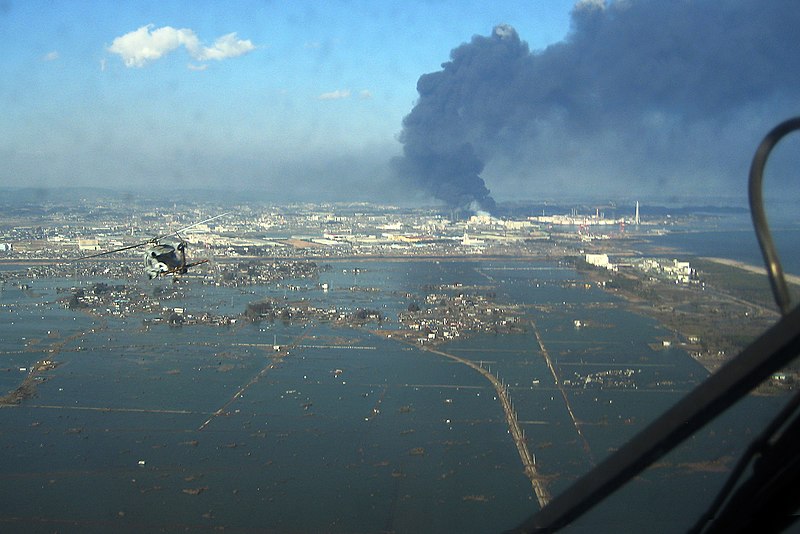
2011 Tōhoku earthquake and tsunami
megathrust earthquake off the east coast of Japan

2010 Haiti earthquake
12 January 2010 magnitude 7.0 Mw earthquake

aquaculture
thumb|300px|Aquaculture fish farming in the fjords south of Castro, Chile

polystyrene
thumb|Expanded polystyrene packaging
thumb|A polystyrene yogurt container
thumb|Bottom of a vacuum forming|vacuum-formed cup; fine details such as the glass and fork [[food contact materials symbol and the resin identification code symbol are easily molded]]

plastic pollution
contamination of the natural environment with plastic products

microplastics
thumb|upright=1.3|Micro plastics of diverse shapes in sediments from four rivers in white arrowheads indicate aluminium, glass and sand (white bars represent 1mm for scale)
thumb|upright=1.3|Photodegraded plastic straw. A light touch breaks larger straw into microplastics.

Basel Convention
international treaty to prevent transfer of hazardous waste from developed to less developed countries
plastic recycling
process of recovering scrap or waste plastic for reprocessing
disposable product
product designed for a single use
marine plastic pollution
environmental pollution by plastics
impact of the COVID-19 pandemic on the environment
impact of coronavirus outbreak on environmental issues