Category
page 1Fruit morphology

fruit
botanical term for the mature ovary or ovaries of one or more flowers. For foods commonly known as fruit, use Q3314483

nut
in botany, type of dry indehiscent fruit

legume
thumb|upright=0.9|A selection of dried pulses and fresh legumes
berry
botanical fruit with fleshy pericarp, containing one or many seeds

drupe
250px|thumb|Diagram of a typical drupe (peach), showing both [[fruit and seed]]
right|thumb|300px|The development sequence of a typical drupe, a smooth-skinned (Peach#Nectarines|nectarine) type of peach (Prunus persica) over a -month period, from bud formation in early winter to fruit ripening in midsummer

berry
{|style="width: 300px; height: 300px; float:right; text-align: center;"
|
File:Berberis thunbergii berries.jpg|Japanese barberries
File:Norwegian blueberry.jpg|Bilberry
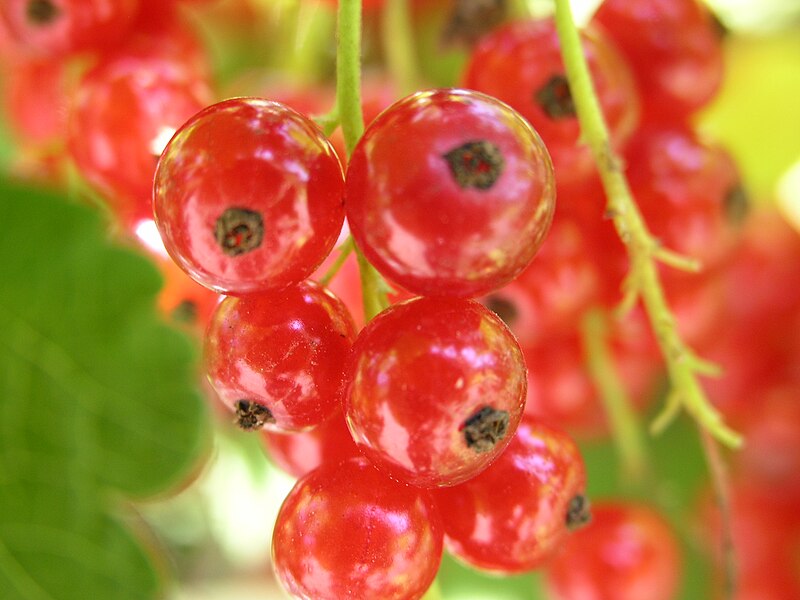
File:Ribes rubrum2005-07-17.JPG|Redcurrants
File:Lonicera coerulea a3.jpg|Honeysuckle
File:Stachelbeere (Ribes uva-crispa).jpg|Gooseberries
File:Rubus chamaemorus close-up.JPG|Cloudberry
File:Vaccinium corymbosum a2.jpg|Highbush blueberries
File:Black Butte blackberry.jpg|Blackberries
|}
A berry is a small, pulpy, and often edible fruit. Typically, berries are juicy, rounded, brightly colored, sweet, sour or tart, and do not h

achene
thumb|Rosa hypanthium encircling separate achene fruits
An achene (; ), also sometimes called akene and occasionally achenium or achenocarp, is a type of simple dry fruit produced by many species of flowering plants. Achenes are monocarpellate (formed from one carpel) and indehiscent (they do not open at maturity). Achenes contain a single seed that nearly fills the pericarp, but does not adhere to it. In many species, what is called the "seed" is an achene, a fruit containing the seed. The seed-like appearance is owed to the hardening of the fruit wall (pericarp), which encloses the solitary
capsule
type of simple, dry rarely fleshy, dehiscent fruit
rose hip
accessory fruit of the Rosa plant genus

caryopsis
thumb|An assortment of different caryopses.
thumb|Wheat spikelet with the three anthers sticking out.|right
thumb|Caryopsis cross-section.|right
In botany, a caryopsis () is a type of simple fruit—one that is monocarpellate (formed from a single carpel) and indehiscent (not opening at maturity) and resembles an achene, except that in a caryopsis the pericarp is fused with the thin seed coat.

silique
thumb|Siliquae of Cardamine impatiens

pome
thumb|right|Anatomy of apple pome compared to a pea pod. Botanically, a fruit is derived from a [[carpel; apples normally have five carpels, while a pea pod is a single carpel. The flesh of the apple is derived from the swollen receptacle that surrounds the carpels.]]
samara
type of non-opening dry fruit with a flattened wing of fibrous, papery tissue
follicle
dehiscing by a suture in order to release seeds
accessory fruit
botanical category of fruit
.jpg)
schizocarp
thumb|The indehiscent (remaining closed) schizocarps of the parsnip (Pastinaca sativa), like that of the carrot, will split into two parts
thumb|The indehiscent schizocarp of Malva_moschata|musk mallow (Malva moschata) will later split into segments called mericarps

hesperidium
thumb|upright=1.35|Structure of a Citrus hesperidium
Calybium and cupule
parts of accessory fruit of certain plants
multiple fruit
fruiting bodies formed from a cluster of fruiting flowers (inflorescence)
.jpg)
syconium
thumb|right|Cross-section of the syconium of a female creeping fig. The receptacle forms a hollow chamber, its inner wall (white) covered by a shell of [[rufous florets. Their long and curled, white styles occupy the centre. Each floret will produce a fruit and seed. The green, bract-lined ostiole, below, admits wasp pollinators.]]

elaiosome
thumb|Afzelia africana seeds bearing orange elaiosomes
thumb|Trillium recurvatum seeds
Elaiosomes ( élaion "oil" + sóma "body") are fleshy structures that are attached to the seeds of many plant species. The elaiosome is rich in lipids and proteins, and may be variously shaped. Many plants have elaiosomes that attract ants, which take the seed to their nest and feed the elaiosome to their larvae. After the larvae have consumed the elaiosome, the ants take the seed to their waste disposal area, which is rich in nutrients from the ant frass and dead bodies, where the seeds germinate. This type o
aggregate fruit
category of fruit
dehiscence
splitting at maturity along a built-in line of weakness in a plant structure in order to release its contents, and is common among fruits, anthers and sporangia
compound fruit
type of fruit composed of two or more similar parts
infructescence
In botany, infructescence (fruiting head) is defined as the ensemble of fruits derived from the ovaries of an inflorescence. It usually retains the size and structure of the inflorescence.

sarcotesta
thumb|right|Pomegranate seeds have a red sarcotesta.
thumb|right|Some cycads, such as this Macrozamia communis, produce seeds with a sarcotesta.
mast
fruit of forest trees like acorns and other nuts

loment
250px|thumb|Loments of Hedysarum hedysaroides
A loment (or lomentum) is a part of certain legume plants. It is a type of dehiscent fruit that breaks apart at the constrictions occurring between segments, so that each segment contains only one seed. It is a type of schizocarp.
seedless fruit
fruit modified to not contain seeds