Category
page 1Fungal diseases

candidiasis
fungal infectious disease
disease caused by fungi to animals or humans

aspergillosis
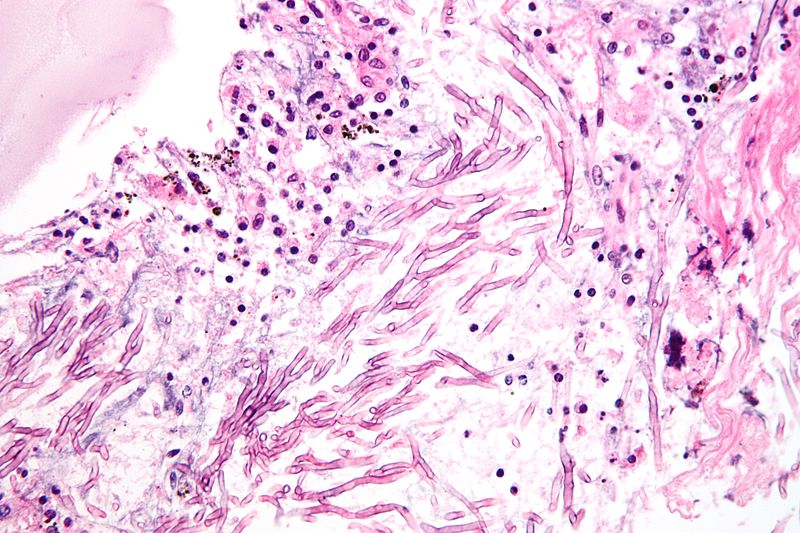
Aspergillosis is a fungal infection of usually the lungs, caused by the genus Aspergillus, a common mold that is breathed in frequently from the air, but does not usually affect most people. It generally occurs in people with lung diseases such as asthma, cystic fibrosis or tuberculosis, or those who are immunocompromised such as those who have had a stem cell or organ transplant or those who take medications such as steroids and some cancer treatments which suppress the immune system. Rarely, it can affect skin.
vulvovaginal candidiasis
excessive growth of yeast in the vagina that results in irritation

mucormycosis
Mucormycosis, also known as black fungus, is a severe fungal infection that may cause fulminant fungal sinusitis, usually in people who are immunocompromised. It is mostly curable when diagnosed early. Symptoms depend on where in the body the infection occurs. It most commonly infects the nose, sinuses, eyes and brain resulting in a runny nose, one-sided facial swelling and pain, headache, fever, blurred vision, bulging or displacement of the eye (proptosis), and tissue death. Other sites of infection may include the lungs, stomach and intestines, and skin. It tends to progress rapidly and is

histoplasmosis
Histoplasmosis is a fungal infection caused by Histoplasma capsulatum. Symptoms of this infection vary greatly, but the disease affects primarily the lungs. Occasionally, other organs are affected; called disseminated histoplasmosis, it can be fatal if left untreated.
%20blastomycosis.jpg)
blastomycosis
Blastomycosis, also known as '''Gilchrist's disease''', is a fungal infection, typically of the lungs, which can spread to brain, stomach, intestine and skin, where it appears as crusting purplish warty plaques with a roundish bumpy edge and central depression. Around half of the people with the disease have symptoms, which can include fever, cough, night sweats, muscle pains, weight loss, chest pain, and fatigue. Symptoms usually develop between three weeks and three months after breathing in the spores. In 25% to 40% of cases, the infection also spreads to other parts of the body, such as th

cryptococcosis
Cryptococcosis is a potentially fatal fungal infection of mainly the lungs, presenting as a pneumonia, and in the brain, where it appears as a meningitis. Coughing, difficulty breathing, chest pain and fever are seen when the lungs are infected. When the brain is infected, symptoms include headache, fever, neck pain, nausea and vomiting, light sensitivity and confusion or changes in behavior. It can also affect other parts of the body including skin, where it may appear as several fluid-filled nodules with dead tissue.

sporotrichosis
Sporotrichosis, also known as '''rose handler's disease', is a fungal infection that may be localised to skin, lungs, bone and joint, or become systemic. It presents with firm painless nodules that later ulcerate. Following initial exposure to Sporothrix schenckii'', the disease typically progresses over a period of a week to several months. Serious complications may develop in people who have a weakened immune system.
oral candidiasis
fungal infection of the mucous membrane of the mouth by Candida species

coccidioidomycosis
Coccidioidomycosis (, ) is a mammalian fungal disease caused by Coccidioides immitis or Coccidioides posadasii. It is commonly known as cocci, Valley fever, or San Joaquin Valley fever. Coccidioidomycosis is endemic in certain parts of the United States in Arizona, California, Nevada, New Mexico, Texas, Utah, and northern Mexico.
pneumocystis pneumonia
pneumonia caused by Pneumocystis jirovecii, common among AIDS patients
pathogenic fungus
fungus that causes disease in humans or other organisms

mycetoma
Mycetoma is a chronic infection in the skin caused by either bacteria (actinomycetoma) or fungi (eumycetoma), typically resulting in a triad of painless firm skin lumps, the formation of weeping sinuses, and a discharge that contains grains. 80% occur in feet.

chromoblastomycosis
Chromoblastomycosis is a long-term fungal infection of the skin and subcutaneous tissue (a chronic subcutaneous mycosis).

paracoccidioidomycosis
Paracoccidioidomycosis (PCM), also known as South American blastomycosis, is a fungal infection that can occur as a mouth and skin type, lymphangitic type, multi-organ involvement type (particularly lungs), or mixed type. If there are mouth ulcers or skin lesions, the disease is likely to be widespread. There may be no symptoms, or it may present with fever, sepsis, weight loss, large glands, or a large liver and spleen.
eumycotic mycetoma
fungal pneumonia
human disease
pneumocystosis
Pneumocystosis is a fungal infection that most often presents as Pneumocystis pneumonia in people with HIV/AIDS or poor immunity. It usually causes cough, difficulty breathing and fever, and can lead to respiratory failure. Involvement outside the lungs is rare but, can occur as a disseminated type affecting lymph nodes, spleen, liver, bone marrow, eyes, kidneys, thyroid, gastrointestinal tract or other organs. If occurring in the skin, it usually presents as nodular growths in the ear canals or underarms.
Cystobasidium
Cystobasidium is a genus of fungi in the order Cystobasidiales. The type species is a fungal parasite forming small gelatinous basidiocarps (fruit bodies) on various ascomycetous fungi (including Lasiobolus and Thelebolus spp) on dung. Microscopically, it has auricularioid (laterally septate) basidia producing basidiospores that germinate by budding off yeast cells. Other species are known only from their yeast states. The yeasts Cystobasidium minutum and C. calyptogenae are rare but known human pathogens.
penicilliosis
Talaromycosis is a fungal infection that presents with painless skin lesions of the face and neck, as well as an associated fever, anaemia, and enlargement of the lymph glands and liver.
chronic pulmonary aspergillosis
fungal infection