Category
page 1Gemology

emerald
thumb|Main emerald producing countries

gemstone
thumb|upright=1.1|Group of precious and semiprecious stones—both uncut and faceted—including (clockwise from top left) diamond, uncut synthetic [[sapphire, ruby, uncut emerald, and amethyst crystal cluster.]]

beryl

corundum
Corundum is a crystalline form of aluminium oxide () typically containing traces of iron, titanium, vanadium, and chromium. It is a rock-forming mineral. It is a naturally transparent material, but can have different colors depending on the presence of transition metal impurities in its crystalline structure. Corundum has two primary gem varieties: ruby and sapphire. Rubies are red due to the presence of chromium, and sapphires exhibit a range of colors depending on what transition metal is present. A rare type of sapphire, padparadscha sapphire, is pink-orange.
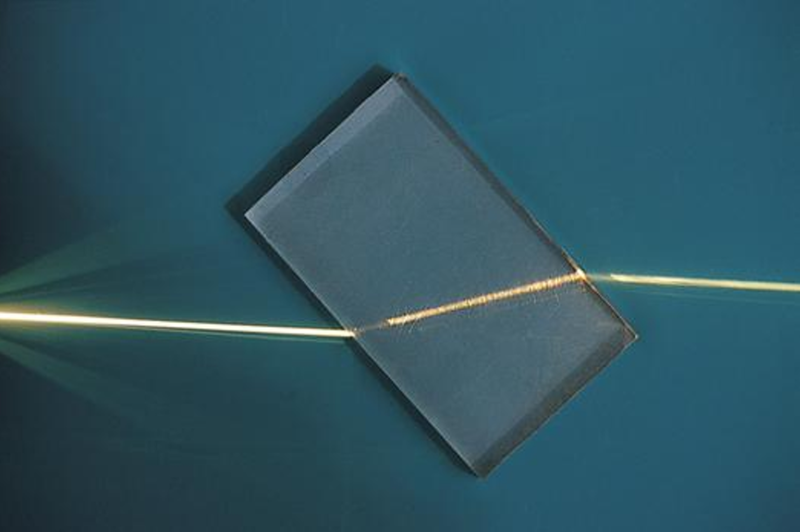
refractive index
ratio of the speed of light in vacuum to that in the medium

birefringence
right|thumb|A calcite crystal laid upon a graph paper with blue lines showing the double refraction
right|thumb|In this example, optic axis along the surface is shown perpendicular to plane of incidence. Incoming light in the polarization (which means perpendicular to plane of incidence – and so in this example becomes "parallel polarisation" to optic axis, thus is called extraordinary ray) sees a greater refractive index than light in the polarization (which becomes ordinary ray because "perpendicular polarisation" to optic axis) and so polarization ray is undergoing greater refraction on ent

gemology
thumb|upright=1.25|Examining a pink sapphire under a gemmological microscope
Gemology or gemmology is the science dealing with natural and artificial gemstone materials. It is a specific interdisciplinary branch of mineralogy. Some jewelers (and many non-jewelers) are academically trained gemologists and are qualified to identify and evaluate gems.

crystal polymorphism
ability of a solid material to exist in more than one form or crystal structure

pleochroism
thumb|Pleochroism of cordierite shown by rotating a polarizing filter on the lens of the camera
thumb|Pleochroism of tourmaline shown by rotating a polarizing filter on the lens of the camera
inclusion
any material trapped inside a mineral during its formation

chatoyancy
thumb|right|Tiger's eye
thumb|right|Tiger's eye
asterism
star-shaped concentration of light reflected or refracted from a gemstone

facet
thumb|A faceted amethyst
Facets () are flat faces on geometric shapes. The organization of naturally occurring facets was key to early developments in crystallography, since they reflect the underlying symmetry of the crystal structure. Gemstones commonly have facets cut into them in order to improve their appearance by allowing them to reflect light. The earliest diamond cutting techniques were simply to polish the natural shape of rough diamonds, often octahedral crystals. It wasn't until the 14th century that faceting, the process of cutting and polishing a gemstone to create multiple flat
Gemological Institute of America
research institute in Carlsbad, California
Template:Gemstone
Wikimedia template
Verneuil process
manufacturing process of synthetic gemstones
lapidary
medieval treatise on the properties of stones
dichroscope
A dichroscope is a pocket instrument used in the field of gemology, and can be used to test transparent gemstones (crystals). Experienced gemologists, observing the pleochroism of some gems, can successfully detect gemstones from other artificial stones using this instrument.
diamond clarity
relating to the appearance of internal and surface defects in diamond
diamond color
color due to impurities or crystal lattice defects in diamond
Gemstones of Pakistan
types of Gemstone found in Pakistan
glyptology
Glyptology is the study of engraved gems, or of engravings on gems.