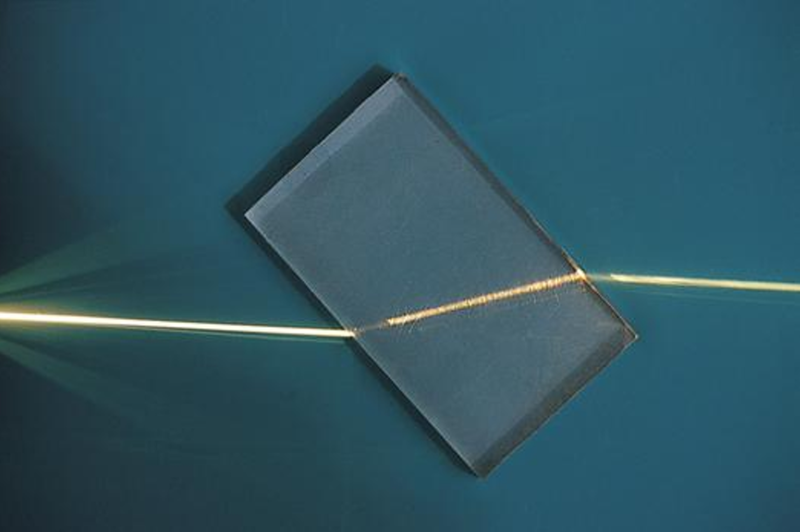
File:Refraction_photo.png · Wikimedia Commons · See Wikimedia Commons
refractive index
Sign in to saveAlso known as index of refraction, IOR
ratio of the speed of light in vacuum to that in the medium
The refractive index is a number that describes how much a material slows down light compared to how fast light travels in empty space. It matters because it determines how much light bends when entering a material, which is why objects look different underwater or through glass than they do in air.
AI-generated from the Wikipedia summary — may contain errors.
Wikidata facts
- Subclass of
- index number
- Image
- Snells law wavefronts.gif
Show 5 more facts
- Commons category
- Refraction
- recommended unit of measurement
- 1
- quantity symbol (string)
- n
- on focus list of Wikimedia project
- Wikipedia:Vital articles/Level/4
- maintained by WikiProject
- WikiProject Mathematics
via Wikidata · CC0
~40 min read
Encyclopedic overview
A ray of light being refracted through a glass slab Refraction of a light ray
In optics, the refractive index (also called refraction index or index of refraction), often denoted n, is the ratio of the speed of light in vacuum (c) to the speed of light in a given optical medium (v), n=c/v. The refractive index determines how much the path of light is bent, or refracted, when entering a material, as described by Snell's law of refraction, n1 sin θ1 = n2 sin θ2, where θ1 and θ2 are the angle of incidence and angle of refraction, respectively, of a ray crossing the interface between two media with refractive indices n1 and n2. The refractive indices also determine the amount of light that is reflected when reaching the interface, as well as the critical angle for total internal reflection, their intensity (Fresnel equations) and Brewster's angle.
Excerpted from Wikipedia’s “refractive index” article, available under the CC BY-SA 4.0 licence.
Gallery (12)
Available in 70 languages
- Español
- Français
- Deutsch
- 中文
- 日本語
- Русский
- Português
- Italiano
- العربية
- हिन्दी
- Afrikaans
- Armenian
- Asturian
- Azerbaijani
- Bahasa Indonesia
- Bangla
- Basque
- Belarusian
Show 51 more
- Bosnian
- Bulgarian
- Catalan
- Chuvash
- Croatian
- Czech
- Danish
- Esperanto
- Estonian
- Finnish
- Galician
- Greek
- Hebrew
- Hungarian
- Irish
- Kannada
- Kazakh
- Latvian
- Lithuanian
- Macedonian
- Malay
- Malayalam
- Marathi
- Mongolian
- Nederlands
- Northern Frisian
- Norwegian
- Norwegian Nynorsk
- Occitan
- Polski
- Punjabi
- Romanian
- Saterland Frisian
- Scots
- Serbian
- Serbian (Latin)
- Slovak
- Slovenian
- Svenska
- Tamil
- Telugu
- Tiếng Việt
- Türkçe
- Ukrainian
- Urdu
- Welsh
- Wu Chinese
- zh_yue
- فارسی
- ไทย
- 한국어
via Wikidata sitelinks · CC0