Category
page 1Genetics

genetics
Genetics is the study of genes, genetic variation, and heredity in organisms. It is an important branch in biology because heredity is vital to organisms' evolution. Gregor Mendel, a Moravian Augustinian friar working in the 19th century in Brno, was the first to study genetics scientifically. Mendel studied "trait inheritance", patterns in the way traits are handed down from parents to offspring over time. He observed that organisms (pea plants) inherit traits by way of discrete "units of inheritance". This term, still used today, is a somewhat ambiguous definition of what is referred to as a

gene
In biology, the word gene has two meanings. The Mendelian gene is a basic unit of heredity. The molecular gene is a sequence of nucleotides in DNA that is transcribed to produce RNA. There are two types of molecular genes: protein-coding genes and non-coding genes. During gene expression (the synthesis of RNA or protein from a gene), DNA is first copied into RNA. RNA can be directly functional or be the intermediate template for the synthesis of a protein.

blood type
classification of blood based on antibodies and antigens on red blood cell surfaces

heredity
Heredity, also called inheritance or biological inheritance, is the passing on of traits from parents to their offspring; either through asexual reproduction or sexual reproduction, the offspring cells or organisms acquire the genetic information of their parents. Through heredity, variations between individuals can accumulate and cause species to evolve by natural selection. The study of heredity in biology is genetics.

genotype
The genotype of an organism is its complete set of genetic material. Genotype can also be used to refer to the alleles or variants an individual carries in a particular gene or genetic location. The number of alleles an individual can have in a specific gene depends on the number of copies of each chromosome found in that species, also referred to as ploidy. In diploid species like humans, two full sets of chromosomes are present, meaning each individual has two alleles for any given gene. If both alleles are the same, the genotype is referred to as homozygous. If the alleles are different, th

standard genetic code
rules by which information encoded within genetic material is translated into proteins
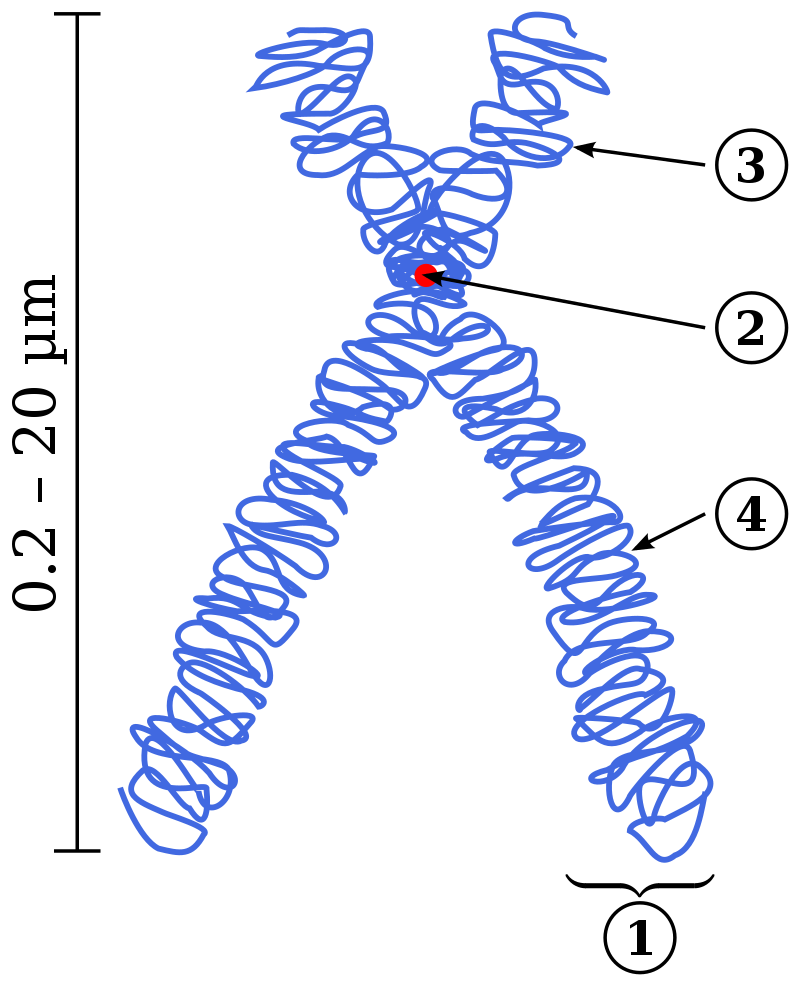
locus
location of a gene at a chromosome

oogenesis
Oogenesis () or ovogenesis is the differentiation of the ovum (egg cell) into a cell competent to further develop when fertilized. It is developed from the primary oocyte by maturation. Oogenesis is initiated during embryonic development.

atavism
thumb|Early embryos of various species display some ancestral features, like the tail on this human embryo. These features normally disappear in later development, but it may not happen if the animal has an atavism.

prophase
thumb|upright=1.35|Prophase is the first step of cell division in mitosis. As it occurs after G2 of interphase, DNA has been already replicated when prophase begins.
thumb|right|200px|Fluorescence microscope image of two mouse cell nuclei in prophase (scale bar is 5 μm).
memetics
Memetics, or the study of memes, is an emerging discipline in cultural evolution, based on the idea that culture can be reduced to the study of cultural units, called memes: ideas, behaviors, beliefs, and expressions that spread from person to person in a culture through imitation. The term "meme" was coined by biologist Richard Dawkins in his 1976 book The Selfish Gene, to illustrate the principle that he later called "Universal Darwinism". All evolutionary processes depend on information being copied, varied, and selected, a process also known as variation with selective retention. The conve
Barr body
structure found in a female mammalian cell containing an unpaired X chromosome that has become densely heterochromatic, silenced and localized at the nuclear periphery

microsatellite
A microsatellite is a tract of repetitive DNA that consists of a particular sequence of base pairs repeated a large number of times. Microsatellites occur at thousands of locations within an organism's genome. They have a higher mutation rate than other areas of DNA leading to high genetic diversity. Microsatellites are often referred to as short tandem repeats (STRs) by forensic geneticists and in genetic genealogy, or as simple sequence repeats (SSRs) by plant geneticists.
.jpg)
X-inactivation
thumb|right|The coloration of tortoiseshell cats is a visible manifestation of X-inactivation. The black and orange [[alleles of a fur coloration gene reside on the X chromosome. For any given patch of fur, the inactivation of an X chromosome that carries one allele results in the fur color of the other, active allele.]]
thumb|The process and possible outcomes of random X-chromosome inactivation in female human embryonic cells undergoing [[mitosis.
1.Early stage embryonic cell of a female human
2.Maternal X chromosome
3.Paternal X chromosome
4.Mitosis and random X-chromosome inactivation e
mosaicism
presence of two or more populations of cells with different genotypes in one individual who has developed from a single fertilized egg
Nagoya Protocol
global treaty on biological diversity
phenotypic plasticity
the ability of an organism to change its phenotype in response to the environment
Hayflick limit
number of times a normal human cell population will divide until cell division stops; (in culture) phenomenon, when fibroblasts can reach a maximum of 50 cell divisions before becoming senescent
chiasma
connection formed between chromatids, visible during meiosis, thought to be the point of the interchange involved in crossing-over
centimorgan
In genetics, a centimorgan (abbreviated cM) or map unit (m.u.) is a unit for measuring genetic linkage. It is defined as the distance between chromosome positions (also termed loci or markers) for which the expected average number of intervening chromosomal crossovers in a single generation is 0.01. It is often used to infer distance along a chromosome. However, it is not a true physical distance.
sex linkage
the sex-specific patterns of inheritance and presentation when a gene mutation is present on a sex chromosome rather than a non-sex chromosome
reproductive isolation
evolutionary mechanism for speciation
history of genetics
aspect of history
penetrance
thumb|Illustration of the degree of penetrance
Penetrance in genetics is the proportion of individuals carrying a particular variant (or allele) of a gene (genotype) that also expresses an associated trait (phenotype). In medical genetics, the penetrance of a disease-causing mutation is the proportion of individuals with the mutation that exhibit clinical symptoms among all individuals with such mutation. For example: If a mutation in the gene responsible for a particular autosomal dominant disorder has 95% penetrance, then 95% of those with the mutation will go on to develop the disease, show

backcrossing
Backcrossing is a crossing of a hybrid with one of its parents or an individual genetically similar to its parent, to achieve offspring with a genetic identity closer to that of the parent. It is used in horticulture, animal breeding, and production of gene knockout organisms.
%20(1905)%20(14597875770).jpg)
dermatoglyphics
thumb|Guide to fingerprint identification
Dermatoglyphics (from Ancient Greek derma, "skin", and glyph, "carving") is the scientific study of fingerprints, lines, mounts and shapes of hands, as distinct from the superficially similar pseudoscience of palmistry.
introduction to genetics
non-technical introduction to the subject of genetics
reading frame
which divides a sequence of nucleotides into a set of consecutive, non-overlapping triplets
sterility
physiological inability to effect sexual reproduction in a living thing, members of whose kind have been produced sexually

Polyphenism
thumb|right|Biston betularia caterpillars on birch (left) and willow (right), demonstrating a color polyphenism.
A polyphenic trait is a trait for which multiple, discrete phenotypes can arise from a single genotype as a result of differing environmental conditions. It is therefore a special case of phenotypic plasticity.

exome
The exome is composed of all of the exons within the genome, the sequences which, when transcribed, remain within the mature RNA after introns are removed by RNA splicing. This includes untranslated regions of messenger RNA (mRNA), and coding regions. Exome sequencing has proven to be an efficient method of determining the genetic basis of more than two dozen Mendelian or single gene disorders.

Phenocopy
thumb|alt=Himalayan rabbit|right|Chocolate-colored male Himalayan rabbit
In phenomics, a phenocopy is a variation in phenotype (generally referring to a single trait) which is caused by environmental conditions (often, but not necessarily, during the organism's development), such that the organism's phenotype matches a phenotype which is determined by genetic factors. It is not a type of mutation, as it is non-hereditary.
genetic variant
subtype of a microorganism. An organism with one or more new mutations is referred to as a “variant” of the original organism if not sufficiently different to be termed a distinct strain
genetic mapping
methods used to identify the locus of a gene and the distances between genes

reassortant viruses
300px|thumb|Performing reassortment with flu viruses
Reassortment is the mixing of the genetic material of a species into new combinations in different individuals. The product of reassortment is called a reassortant. It is particularly used when two similar viruses that are infecting the same cell exchange genetic material. More specifically, it refers to the swapping of entire segments of the genome, which only occurs between viruses with segmented genomes. (All known viruses with segmented genomes are RNA viruses.)
genetic predisposition
genetic characteristic which influences the possible phenotypic development of an individual organism within a species or population
Weismann barrier
distinction between germ cell lineages producing gametes and somatic cells

nondisjunction
600px|thumb| The left image at the blue arrow is nondisjunction taking place during meiosis II. The right image at the green arrow is nondisjunction taking place during meiosis I. Nondisjunction is when chromosomes fail to separate normally resulting in a gain or loss of chromosomes.
Nondisjunction is the failure of homologous chromosomes or sister chromatids to separate properly during cell division (mitosis/meiosis). There are three forms of nondisjunction: failure of a pair of homologous chromosomes to separate in meiosis I, failure of sister chromatids to separate during meiosis II, and fa

Generation of Animals
work by Aristotle

integrons
Integrons are genetic mechanisms that allow bacteria to adapt and evolve rapidly through the stockpiling and expression of new genes. These genes are embedded in a specific genetic structure called gene cassette (a term that is lately changing to integron cassette) that generally carries one promoterless open reading frame (ORF) together with a recombination site (attC). Integron cassettes are incorporated to the attI site of the integron platform by site-specific recombination reactions mediated by the integrase.
extranuclear inheritance
transmission of genes occurring outside the nucleus
DNA replication proofreading
correction of replication errors by DNA polymerase using a 3'-5' exonuclease activity.
immunoglobulin allotypes
allelic variants of the immunoglobulin light or heavy chains, encoded by alleles of immunoglobulin genes

genetic carrier
person or organism that has inherited a genetic trait or mutation, but displays no symptoms
X-linked recessive
mode of inheritance

Pathogenicity island
distinct class of genomic island
antagonistic pleiotropy hypothesis
evolutionary explanation for senescence

neurogenetics
thumb|Human karyogram
Neurogenetics studies the role of genetics in the development and function of the nervous system. It considers neural characteristics as phenotypes (i.e. manifestations, measurable or not, of the genetic make-up of an individual), and is mainly based on the observation that the nervous systems of individuals, even of those belonging to the same species, may not be identical. As the name implies, it draws aspects from both the studies of neuroscience and genetics, focusing in particular how the genetic code an organism carries affects its expressed traits. Mutations in thi
Triangle of U
evolutionary history of Brassica genus
downregulation and upregulation
biological processes
amelogenin
Amelogenins are a group of protein isoforms produced by alternative splicing or proteolysis from the AMELX gene, on the X chromosome, and also the AMELY gene in males, on the Y chromosome. They are involved in amelogenesis, the development of enamel. Amelogenins are type of extracellular matrix protein, which, together with ameloblastins, enamelins and tuftelins, direct the mineralization of enamel to form a highly organized matrix of rods, interrod crystal and proteins.
maternal effect
influence of mother's environment and genotype on offspring's phenotype
hybrid speciation
form of speciation where hybridization between two different species leads to a new species, reproductively isolated from the parent species
deme
local population of polytypic species that actively interbreed with one another and share a distinct gene pool

haploinsufficiency
thumb|Haploinsufficiency model of dominant genetic disorders. A+ is a normal allele. A− is a mutant allele with little or no function. In haplosufficiency (most genes), a single normal allele provides enough function, so A+A− individuals are healthy. In haploinsufficiency, a single normal allele does not provide enough function, so A+A− individuals have a genetic disorder.
Haplogroup Z
mtDNA
somatic mutation
genetic mutation that occurs during the life of an organism, and may not be sexually inherited
marker assisted selection
process
heritability of IQ
percent of variation in IQ scores in a given population associated with genetic variation
endoreduplication
Endoreduplication (also referred to as endoreplication or endocycling) is replication of the nuclear genome in the absence of mitosis, which leads to elevated nuclear gene content and polyploidy. Endoreduplication can be understood simply as a variant form of the mitotic cell cycle (G1-S-G2-M) in which mitosis is circumvented entirely, due to modulation of cyclin-dependent kinase (CDK) activity. Examples of endoreduplication characterised in arthropod, mammalian, and plant species suggest that it is a universal developmental mechanism responsible for the differentiation and morphogenesis of ce