Category
page 1Genetics concepts

ploidy
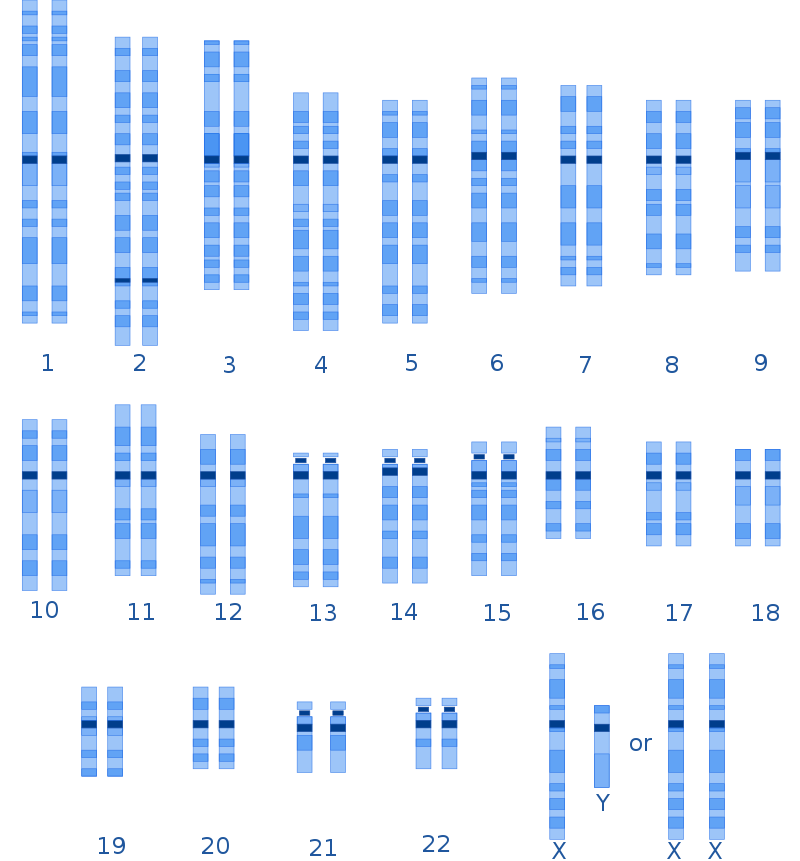
thumb|upright|A haploid set that consists of a single complete set of chromosomes (equal to the monoploid set), as shown in the picture above, must belong to a diploid species. If a haploid set consists of two sets, it must be of a tetraploid (four sets) species.
gene pool
set of all genes in a population

chromosome abnormality
abnormal number or structure of chromosomes
genetic diversity
total number of genetic characteristics in the genetic makeup of a species

epistasis
thumb|350px|An example of epistasis is the interaction between hair colour and baldness. A gene for Alopecia totalis|total baldness would be epistatic to one for [[blond hair or red hair. The hair-colour genes are hypostatic to the baldness gene. The baldness phenotype supersedes genes for hair colour, and so the effects are non-additive.]]
thumb|Example of epistasis in coat colour genetics: If no pigments can be produced the other coat colour genes have no effect on the phenotype, no matter if they are dominant or if the individual is homozygous. Here the genotype "c c" for no pigmentation is

fitness
quantitative representation of natural and sexual selection within evolutionary biology
gene duplication
duplication of a gene sequence within a genome

pleiotropy
thumb|Simple genotype–phenotype map that only shows additive pleiotropy effects. G1, G2, and G3 are different genes that contribute to phenotypic traits P1, P2, and P3.
allele frequency
relative frequency of a variant of a gene at a particular locus in a population
genetic distance
measure between populations of divergence
dominance
interaction of a dominant allele with a recessive allele resulting in complete expression or non-expression of a trait
loss of heterozygosity
in genetics, loss of one allele at a specific locus, caused by a deletion mutation; or loss of a chromosome from a chromosome pair, resulting in abnormal hemizygosity
Muller's ratchet
irreversible accumulation of deleterious mutations in the absence of genetic recombination
Overdominance
Overdominance is a phenomenon in genetics where the phenotype of the heterozygote lies outside the phenotypical range of both homozygous parents. Overdominance can also be described as heterozygote advantage regulated by a single genomic locus, wherein heterozygous individuals have a higher fitness than homozygous individuals. However, not all cases of the heterozygote advantage are considered overdominance, as they may be regulated by multiple genomic regions. Overdominance has been hypothesized as an underlying cause for heterosis (increased fitness of hybrid offspring).
genetic load
measure in population genetics
Genotype frequency
Frequency of genotypes and alleles