Category
page 1Geography of Central Asia

Caspian Sea
largest landlocked salt lake, located between Europe and Asia
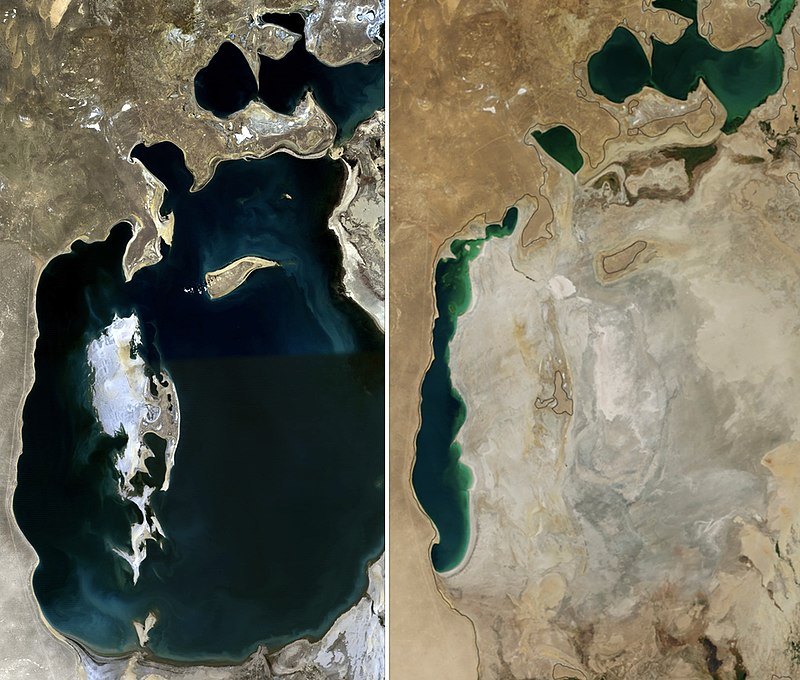
Aral Sea
Formerly a salt lake in Central Asia

Tianshan Mountains
Asian mountain range separating northwest China from Central Asia and Russia

Turkestan
thumb|right|The West Turkestan region is noted on this 1914 map as simply "Turkestan"
Turkestan, also spelled Turkistan, is a historical name for the region of Asia lying between the Caspian Sea to the west, Siberia to the north, the Gobi Desert to the east, and Iran, Afghanistan, Pakistan, and Tibet to the south. Turkestan is primarily inhabited by Turkic peoples, as well as Russian and Tajik-Persian minorities. It is subdivided into West Turkestan, which historically belonged to the Russian Empire and the Soviet Union, and East Turkestan (identified either with the Tarim Basin/Southern Xinji

Transoxiana
thumb|right|340px|Watershed of the Amu Darya|Oxus River in the 8th century, showing Transoxiana and its principal localities to the northeast.
thumb|right|340px|Transoxiana and the neighbouring regions of Greater Khorasan and [[Khwarazm in Central Asia]]

Khorasan
Khorasan is a historical eastern region in the Iranian Plateau in West and Central Asia that encompasses western and northern Afghanistan, northeastern Iran, the eastern halves of Turkmenistan and Uzbekistan, western Tajikistan, and portions of Kyrgyzstan and Kazakhstan.

Eurasian Steppe
steppe ecoregion of grasslands, savannas, and shrublands
Minusinsk Hollow
geographic region of Siberia
history of Central Asia
aspect of history
Tuva Depression
region in Siberia
.jpg)
kishlak
thumb|right|A kishlak near Samarkand of early 1900s
Kishlak or qishlaq (, , , , ), or qıştaq () qıstaw () is a rural settlement of semi-nomadic Turkic peoples of Central Asia and Azerbaijan. The meaning of the term is "wintering place" in Turkic languages (derives from Turkic qış - winter).
Kuznetsk Depression
Iron Gate
Defile in Central Asia
Mount Imeon
ancient name for major Central Asia massif
Nikolai Korzhenevskiy
Russian geographer (1879–1958)

geography of Tibet
geographical situation of Tibet
hamun
A hamun (or hamoun) ( hāmūn) is an inland desert lake or marshland formed as a natural seasonal reservoir in areas adjoining the Helmand basin, found across eastern Iran, southern Afghanistan and western Pakistan. Hamuns form a critical link in the wildlife of the area, aquatic as well as avian and terrestrial.