Category
page 1Glass art

marble
small, hard spherical toy
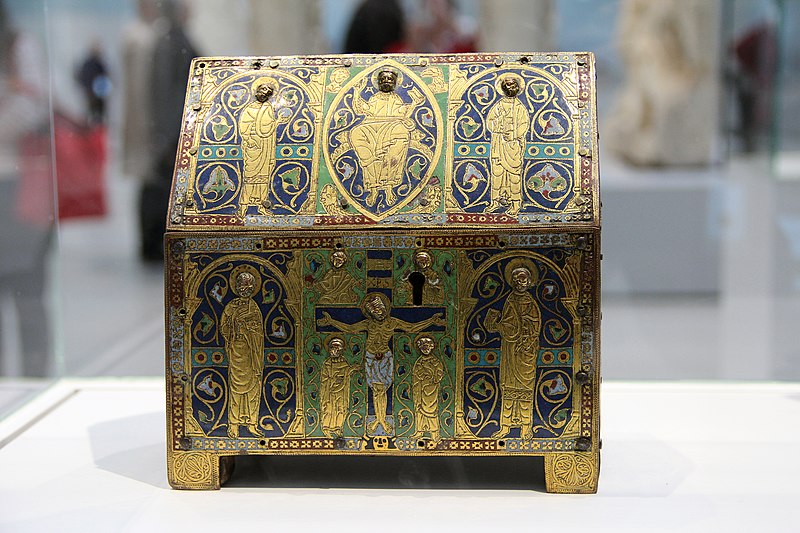
vitreous enamel
material made by fusing powdered glass to a substrate by firing

chandelier
thumb|upright=1.4|Chandeliers in the Hall of Mirrors at Versailles
cameo
small relief carving

grisaille
thumb|270px|Christ and the Woman Taken in Adultery (Bruegel)|Christ and the Woman Taken in Adultery, [[Pieter Bruegel the Elder, 1565, ]]
thumb|270px|Battesimo della gente, one of Andrea del Sarto's gray and brown grisaille [[frescoes in the Chiostro dello Scalzo, Florence (1511-26)]]
Grisaille ( or ; , from gris 'grey') is a painting executed entirely in shades of black and grey or of another neutral greyish colour. It is particularly used in large decorative schemes in imitation of sculpture. Many grisailles include a slightly wider colour range.

glass blowing
thumb|A glassworker blows air into the glass, creating a cavity inside.
Venetian glass
glassmaking tradition from Venice, Italy
glass artwork
work of art which is substantially or wholly made of glass

paperweight
alt=|upright=1.2|thumb|A glass paperweight commemorating the closure of the Princess Margaret Rose Orthopaedic Hospital (2002)
A paperweight is a small solid object heavy enough, when placed on top of papers, to keep them from blowing away in a breeze or from moving under the strokes of a painting brush (as with Chinese calligraphy). While any object, such as a stone, can serve as a paperweight, decorative paperweights of metal, glass, jade or other material are also produced, either by individual artisans or factories.

millefiori
thumb|upright=1.2|Vase (1872) manufactured by the Venice & Murano Glass & Mosaic Co. (Victoria and Albert Museum)
Millefiori () is a glasswork technique which produces distinctive decorative patterns on glassware. The term millefiori is a combination of the Italian words (thousand) and (flowers). Apsley Pellatt in his book Curiosities of Glass Making was the first to use the term "millefiori", which appeared in the Oxford English Dictionary in 1849; prior to that, the beads were called mosaic beads. While the use of this technique long precedes the term "millefiori", it is now most frequently

rhinestone
thumb|Historic rhinestone copy of the Florentine Diamond, made in 1865 in Paris by the L. Saemann company
thumb|Rhinestones on a tiara
thumb|Rowenta enamel rhinestone compact
Bohemia crystal
Potash lime glass
glass fusing
process of joining glass by heating it to a temperature until it melts
Islamic glass
type of glass artifact made in the Islamic world, especially in periods up to the 19th century
glass bead
small decorative glass object, usually with a pierced hole
goldstone
glittering glass made in a low-oxygen reducing atmosphere
cranberry glass
red-colored glass made by adding gold to molten glass

pressed glass
form of glass made by pressing molten glass into a mold
banker's lamp
style of table lamp
Shabaka
stained-glass windows made by Azerbaijani masters
devitrification
Devitrification is the process of crystallization in a formerly crystal-free (amorphous) glass. The term is derived from the Latin vitreus, meaning glassy and transparent.
glass disease
chemical degradation of old glass
Tiffany glass
varied types of glass developed at the Tiffany Studios in New York
Reverse glass painting
painting technique
lampworking
thumb|Lampwork Glass Eye Cabochon Tutorial Boro
thumb|right|Lampwork glass beads
Lampworking is a type of glasswork in which a torch or lamp is used to melt the glass. Once in a molten state, the glass is formed by blowing and shaping with tools and hand movements. It is also known as flameworking or torchworking, as the modern practice no longer uses oil-fueled lamps. Although lack of a precise definition for lampworking makes it difficult to determine when this technique was first developed, the earliest verifiable lampworked glass is probably a collection of beads thought to date to the fif
enamelled glass
glass which has been decorated with vitreous enamel
conservation and restoration of glass objects
activity to extend the life of historical objects
murrine
Murrine (singular: murrina) are colored patterns or images made in a glass cane that are revealed when the cane is cut into thin cross-sections. Murrine can be made in infinite designs from simple circular or square patterns to complex detailed designs to even portraits of people. One familiar style is the flower or star shape which, when used together in large numbers from a number of different canes, is called millefiori.
studio glass
the use of glass as an artistic medium to produce sculptures or three-dimensional artworks
verre églomisé
glass decorating technique
bubblegram
thumb|A laser glass sculpture of a caffeine molecule
cameo glass
glass making technique where glass in different colors are layered
glass etching
Glass embossing technique
gold glass
type of glass with gold leaf between layers of glass
paint-on-glass animation
animation technique

Kosta Boda
Swedish glassmaking company and museum
Cosmovitral
300px|thumb|The Sun Man (stained glass).
The Cosmovitral is a stained glass mural and botanical garden located in Toluca, Mexico. The building takes its name from the mural which is set in the building's huge windows that surround the building and in the ceiling. The building originally was constructed in 1910 as the 16 de Septiembre Market. It was not until 1975 when the first female Mayor of Toluca, Yolanda Sentíes, had the 16 de Septiembre Market reallocated and successfully gauged enough social and political support to transform the building into a space for art. The Cosmovitral was design
glass engraving
form of decorative glasswork that involves engraving a glass surface or object
Preciosa
Czech company
art glass
artwork pieces made of glass since the mid-19th century
glass casting
process for making objects from molten glass
Byzantine enamel
metal and glass-working tradition
diamond simulant
diamond-like object which is not a diamond
mosque lamp
glass vessels of vase shape with a wide flaring neck