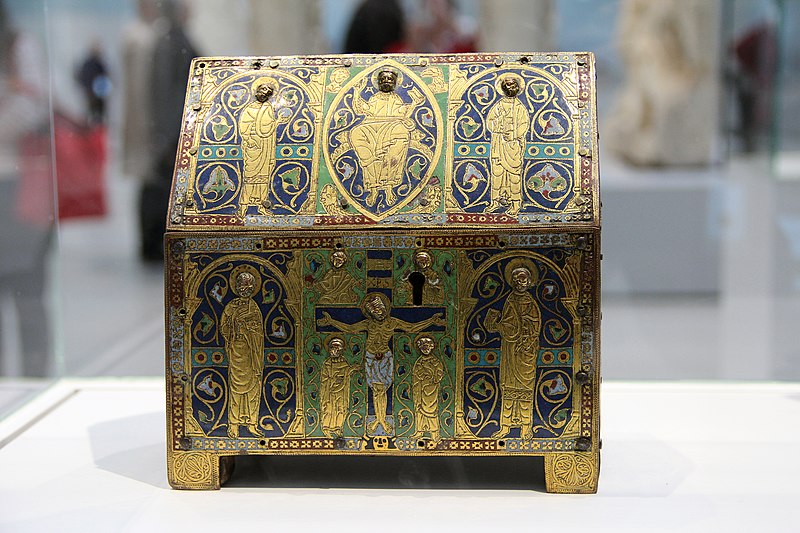
File:0_Reliquaire_grandmontain_-_MR_2648_-_Louvre_(1).JPG · Wikimedia Commons · See Wikimedia Commons
vitreous enamel
Sign in to saveAlso known as porcelain enamel, enamel, vitreous paint
material made by fusing powdered glass to a substrate by firing
Vitreous enamel is a coating made by heating powdered glass until it fuses onto a surface like metal or ceramic. It matters because it creates a hard, glossy, and durable finish that resists wear and corrosion, making it useful for cookware, appliances, and decorative items.
AI-generated from the Wikipedia summary — may contain errors.
Wikidata facts
- Image
- Medallion St Demetrios Louvre OA6457.jpg
- Has use
- goldsmithing
Show 2 more facts
- topic's main category
- Category:Vitreous enamel
- Commons category
- Enamel
Sources (1)
via Wikidata · CC0
~25 min read
Encyclopedic overview
Gothic châsse; 1185–1200; champlevé enamel over copper gilded; height: 17.7 cm (7.0 in), width: 17.4 cm (6.9 in), depth: 10.1 cm (4.0 in)
Vitreous enamel, also called porcelain enamel, is a material made by fusing powdered glass to a substrate by firing, usually between 750 and 850 °C (1,380 and 1,560 °F). The powder melts, flows, and then hardens to a smooth, durable vitreous coating. The word vitreous comes from the Latin vitreus, meaning "glassy".
Excerpted from Wikipedia’s “vitreous enamel” article, available under the CC BY-SA 4.0 licence.
Gallery (12)
Available in 61 languages
- Español
- Français
- Deutsch
- 中文
- 日本語
- Русский
- Português
- Italiano
- العربية
- हिन्दी
- Armenian
- Asturian
- Bahasa Indonesia
- Basque
- Belarusian
- Bosnian
- Bulgarian
- Burmese
Show 42 more
- Catalan
- Croatian
- Czech
- Danish
- Esperanto
- Estonian
- Finnish
- Galician
- Georgian
- Hebrew
- Hungarian
- Ido
- Irish
- Kannada
- Kazakh
- Kyrgyz
- Latvian
- Limburgish
- Lithuanian
- Macedonian
- Neapolitan
- Nederlands
- Norwegian
- Norwegian Nynorsk
- Occitan
- Polski
- Romanian
- Serbian
- Serbian (Latin)
- simple
- Slovak
- Slovenian
- Svenska
- Tiếng Việt
- Türkçe
- Tuvinian
- Ukrainian
- Uzbek
- Wu Chinese
- zh_min_nan
- فارسی
- 한국어
via Wikidata sitelinks · CC0