Category
page 1Gluons

gluon
quark–gluon plasma
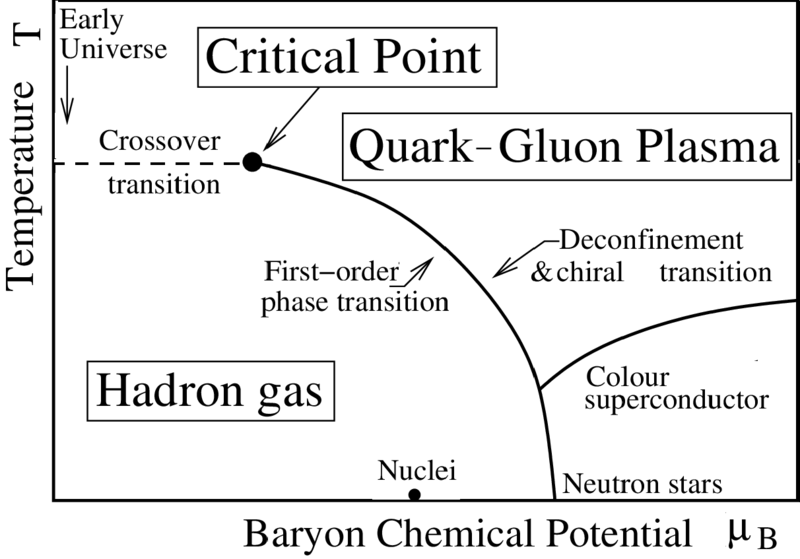
phase of quantum chromodynamics characterised by an assembly of quarks and gluons at thermal and chemical equilibrium
color charge
property of quarks and gluons that is related to the particles’ strong interactions in the theory of quantum chromodynamics
color confinement
phenomenon preventing hadrons (quarks bound by the strong force using gluons) from being separated into free individual quarks

glueball
In particle physics, a glueball (also gluonium, gluon-ball) is a hypothetical composite particle. It consists solely of gluons, without valence quarks. Such a state is possible because gluons carry color charge and experience the strong interaction between themselves. Glueballs are extremely difficult to identify in particle accelerators, because they mix with ordinary meson states. In pure gauge theory, glueballs are the only states of the spectrum and some of them are stable.
gluon field
four-vector field characterizing the propagation of gluons in the strong interaction between quarks
Positron-Electron Tandem Ring Accelerator
particle accelerator
Deconfinement
In physics, deconfinement (in contrast to confinement) is a phase of matter in which certain particles are allowed to exist as free excitations, rather than only within bound states. Essentially like the early universe, "strongly interacting particles at high temperature or density are expected to produce weakly interacting “deconfined” quarks and gluons [...] the famous quarkgluon plasma."
gluon field strength tensor
second order tensor field characterizing the gluon interaction between quarks
Odderon
In particle physics, the odderon corresponds to an elusive family of odd-gluon states, dominated by a three-gluon state. When protons collide elastically with other protons or with anti-protons at high energies, gluons are exchanged. Exchanging an even number of gluons is a crossing-even part of elastic proton–proton and proton–antiproton scattering, while odderon exchange (i.e. exchange of odd number of gluons) corresponds to a crossing-odd term in the elastic scattering amplitude. In turn, the odderon's crossing-odd counterpart is the pomeron.