Category
page 1Golden ratio

golden ratio
ratio between two quantities whose sum is at the same ratio to the larger one
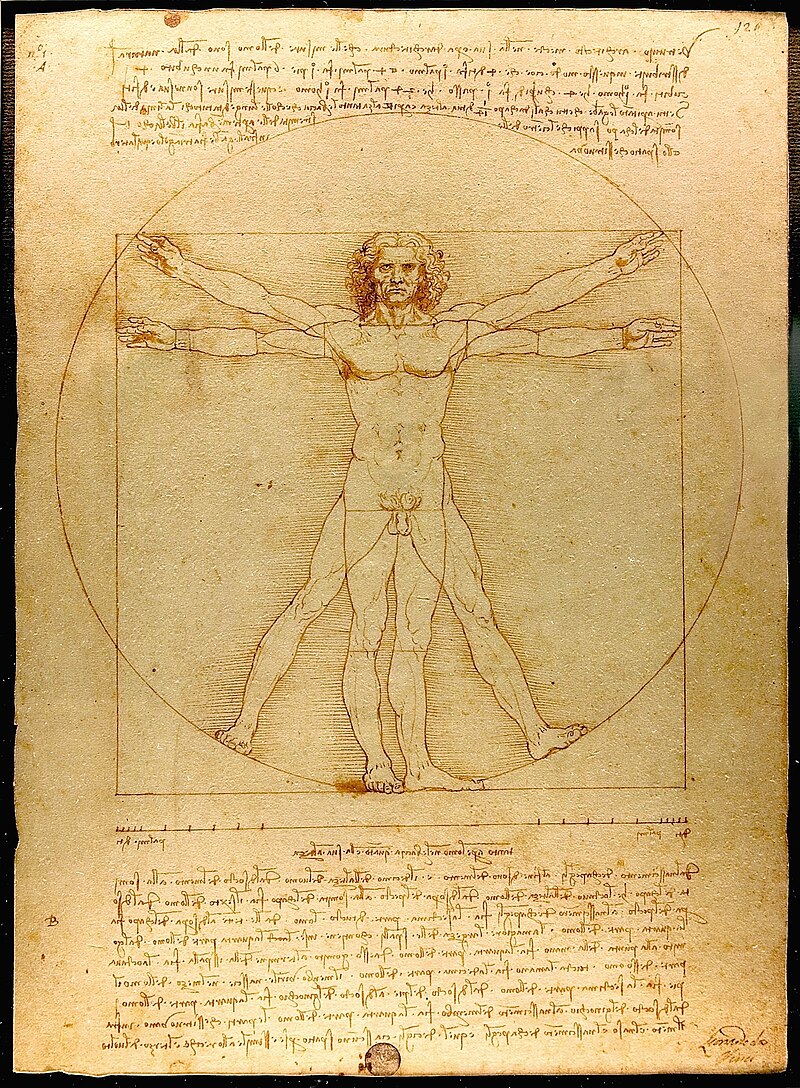
Vitruvian Man
drawing by Leonardo da Vinci

pentagram
thumb|upright=1.2|Pentagram
A pentagram (sometimes known as a pentalpha, pentangle, or star pentagon) is a regular five-pointed star polygon, formed from the diagonal line segments of a convex (or simple, or non-self-intersecting) regular pentagon. Drawing a circle around the five points creates a similar symbol referred to as the pentacle, which is used widely by Wiccans and in paganism, or as a sign of life and connections, but there is also a inverted version.
golden rectangle
Rectangle with side lengths in the golden ratio
Kepler triangle
A right triangle whose edge lengths form a geometric progression
rhombic dodecahedron
Catalan polyhedron
golden triangle
isosceles triangle in which the duplicated side is in the golden ratio to the distinct side
Penrose tiling
non-periodic tiling of the plane
rhombic triacontahedron
Catalan polyhedron
golden spiral
plane curve
golden angle
division of 360° angle into two sub-angles, such that one is 1.618034 times bigger than the other (i.e. the golden ratio or ɸ)
golden rhombus
rhombus whose diagonal lengths are in the golden ratio
golden section search
technique for finding the maximum of a unimodal function by probing a sequence of points whose distances decrease in the golden ratio at each step

supergolden ratio
unique real number solution to the equation x^3-x^2-1=0
Golomb sequence
sequence equivalent to its runs transform
Bilinski dodecahedron
geometrical shape
golden ratio base
positional numeral system
James Mark McGinnis Barr
English-American inventor and polymath (1871–1950)
Lute of Pythagoras
self-similar geometric figure