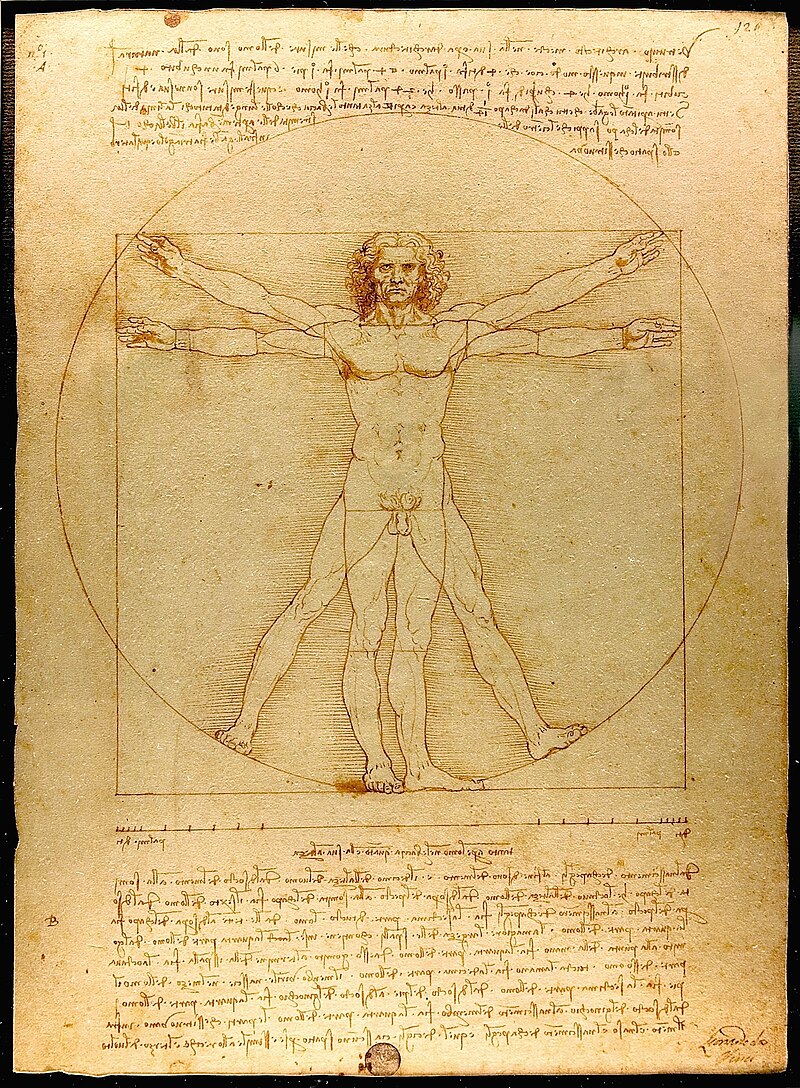
File:Da_Vinci_Vitruve_Luc_Viatour.jpg · Wikimedia Commons · See Wikimedia Commons
Vitruvian Man
Sign in to saveAlso known as Canon of proportions, Man proportions, Human proportions, The Proportions of the Human Figure (after Vitruvius)
drawing by Leonardo da Vinci
"Vitruvian Man" is a famous drawing by Leonardo da Vinci that depicts a nude male figure inscribed within both a circle and a square, accompanied by measurements and notes. The work is considered important because it represents da Vinci's study of human proportions and the relationship between the human body and geometry, reflecting Renaissance ideals about the connection between art, science, and nature.
AI-generated from the Wikipedia summary — may contain errors.
Wikidata facts
- Instance of
- mirror writing
- Named after
- Vitruvius
- Depicts
- square
- Movement
- Italian Renaissance
- Creator
- Leonardo da Vinci
- Collection
- Gallerie dell'Accademia
- Location
- Venice
- Image
- Da Vinci Vitruve Luc Viatour.jpg
- Height
- 34.6
- Width
- 25.5
Show 7 more facts
- inventory number
- 69
- Commons category
- Vitruvian Man by Leonardo da Vinci
- inception
- 1459-00-00
- described at URL
- www.gallerieaccademia.it/node/1582
- catalog code
- 100
- language of work or name
- Italian
- Commons gallery
- Vitruvian Man (Leonardo da Vinci)
Sources (3)
via Wikidata · CC0
~25 min read
Encyclopedic overview
Vitruvian Man (Italian: L'uomo vitruviano) is a drawing by the Italian Renaissance artist and scientist Leonardo da Vinci, dated to c. 1490. Inspired by the Roman architect Vitruvius, it depicts a nude man in two overlapping standing positions, inscribed within a circle and a square. Art historian Carmen C. Bambach described it as "justly ranked among the all-time iconic images of Western civilization". While not the only drawing inspired by Vitruvius, Leonardo's work uniquely combines artistic vision with scientific inquiry and is often considered an archetypal representation of the High Renaissance.
The drawing illustrates Leonardo's study of ideal human proportions, derived from Vitruvius but refined through his own observations, contemporary works, and the treatise De pictura by Leon Battista Alberti. Created in Milan, the Vitruvian Man likely passed to his student Francesco Melzi, and later to Venanzio de Pagave, who encouraged engraver Carlo Giuseppe Gerli to publish an engraving of it, spreading the image widely. It was then owned by Giuseppe Bossi, before being acquired in 1822 by the Gallerie dell'Accademia in Venice, where it remains. Because of its fragility, the drawing is rarely displayed. It was loaned to the Louvre in 2019 for the 500th anniversary of Leonardo's death.
Excerpted from Wikipedia’s “Vitruvian Man” article, available under the CC BY-SA 4.0 licence.
Gallery (7)
Available in 66 languages
- Español
- Français
- Deutsch
- 中文
- 日本語
- Русский
- Português
- Italiano
- العربية
- Afrikaans
- Albanian
- Armenian
- Assamese
- Asturian
- Azerbaijani
- Bahasa Indonesia
- Bangla
- Basque
Show 47 more
- Belarusian
- Bosnian
- Bulgarian
- Catalan
- Chuvash
- Croatian
- Czech
- Danish
- Esperanto
- Filipino
- Finnish
- Galician
- Georgian
- Greek
- Hebrew
- Hungarian
- Icelandic
- Latin
- Latvian
- Lithuanian
- Macedonian
- Malay
- Malayalam
- Moroccan Arabic
- Nederlands
- Norwegian
- Occitan
- Polski
- Romanian
- Serbian
- Serbian (Latin)
- simple
- Slovak
- Slovenian
- Svenska
- syl
- Tamil
- Tiếng Việt
- Türkçe
- Ukrainian
- Waray
- Welsh
- Wu Chinese
- Zulu
- فارسی
- ไทย
- 한국어
via Wikidata sitelinks · CC0