Category
page 1Gothic architecture
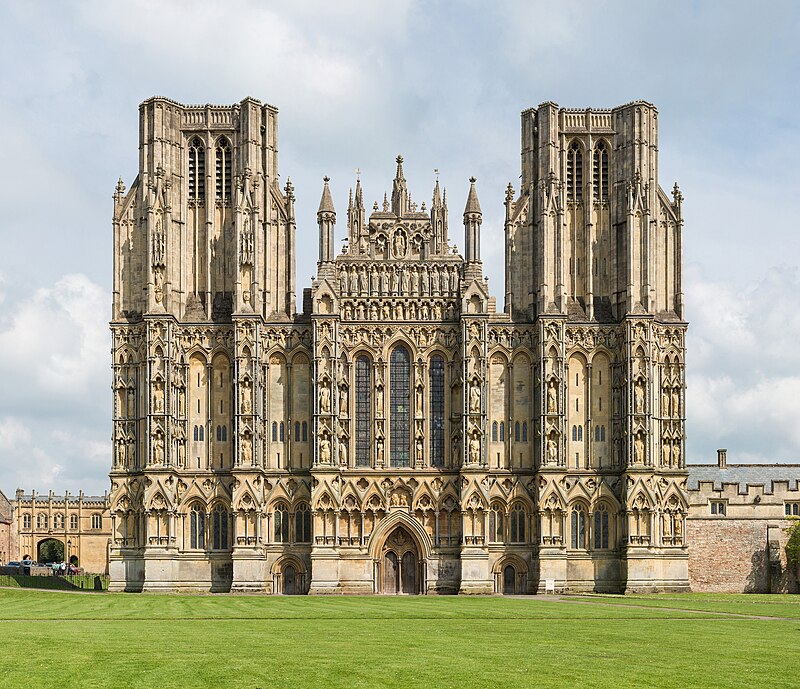
Gothic architecture
style of architecture

gargoyle
thumb|Gargoyles of Notre-Dame de Paris
thumb|Dragon-headed gargoyle of the Tallinn Town Hall, [[Estonia]]
thumb|Gargoyle of the Vasa Chapel at Wawel in [[Kraków, Poland]]

transept
thumb|300x300px|Cathedral ground plan. The shaded area is the transept; the darker shading at the centre represents the Crossing (architecture)|crossing.
thumb|South transept at Kilcooly Abbey, [[County Tipperary, Ireland]]
flying buttress
ramping arch from the top of a wall to support a higher pier
%20Notre-Dame%20020.jpg)
Flamboyant
Flamboyant () is a lavishly decorated style of Gothic architecture that appeared in France and Spain in the 15th century, and lasted until the mid-sixteenth century and the beginning of the Renaissance. Elaborate stone tracery covered both the exterior and the interior. Windows were decorated with a characteristic s-shaped curve. Masonry wall space was reduced further as windows grew even larger. Major examples included the northern spire of Chartres Cathedral, Trinity Abbey, Vendôme, and Burgos Cathedral and Segovia Cathedral in Spain. It was gradually replaced by Renaissance architecture in
International Gothic
art style

tracery
Tracery is an architectural device by which windows (or screens, panels, and vaults) are divided into sections of various proportions by stone bars or ribs of moulding. Most commonly, it refers to the stonework elements that support the glass in a window. The purpose of the device is practical as well as decorative, because the increasingly large windows of Gothic buildings needed maximum support against the wind. The term probably derives from the tracing floors on which the complex patterns of windows were laid out in late Gothic architecture. Tracery can be found on the exterior of building
pointed arch
history and construction of pointed arch

gable
thumb|Early Gothic wimperg with pinnacles above the west portal of the Bad Hersfeld town church (around 1330)
thumb|Oriel window with wimperg and pinnacles on the Imperial Hall of the Old Town Hall in Regensburg in [[Bavaria, Germany]]
In Gothic architecture, a wimperg is a gable-like crowning over portals and windows and is also called an ornamental gable. Outside of immediate architecture, the wimperg is also found as a motif in Gothic carving.
English Gothic architecture
architectural style in Britain
Belarusian Gothic
architectural style of ecclesiastical buildings constructed during the 15th and 16th centuries in parts of modern Belarus, Lithuania and eastern Poland

Rayonnant
Rayonnant was a very refined style of Gothic Architecture which appeared in France in the 13th century. It was the defining style of the High Gothic period, and is often described as the high point of French Gothic architecture.
French architects turned their attention from building cathedrals of greater size and height towards bringing greater light into the cathedral interiors and adding more extensive decoration. The architects made the vertical columns and supports thinner, made extensive use of pinnacles and moldings. They combined the triforium gallery and the clerestory into single spa
Lombard band
decorative architectural element
Perpendicular Gothic
third historical division of English Gothic architecture
lancet window
very narrow pointed window
Isabelline
late-Gothic architectural style in the Spain of Ferdinand and Isabella

Brabantine Gothic
variant of Gothic architecture typical for the Low Countries
diamond vault
Form of vault church architecture
Romano-Gothic
thumb|300px|Interior of the Alcobaça Monastery. The Alcobaça Monastery is one of the most important early Gothic monasteries in [[Portugal.]]
In architecture, "Romano-Gothic" is a term (rarely used in writing in English) for an architectural style, part of Early Gothic architecture, which evolved in Europe in the 12th century CE from the Romanesque style, and was an early style in Gothic architecture. In England "Early English Gothic" remains the usual term. The style is characterized by rounded and pointed arches on a vertical plane. Flying buttresses were used, but are mainly undecorated. Ro
compound pier
clustered column or pier which consists of a centre mass or newel
Sondergotik
thumb|St. Barbara's Church, Kutná Hora|Saint Barbara Church in [[Kutná Hora, Czech Republic]]
Sondergotik (; Special Gothic) is the style of Late Gothic architecture prevalent in Austria, Bavaria, Swabia, Saxony, Alsace, Rhineland, Switzerland, Bohemia and Silesia between 1350 and 1550. The term was invented by art historian Kurt Gerstenberg in his 1913 work Deutsche Sondergotik, in which he argued that the Late Gothic had a special expression in Germany (especially the South and the Rhineland) marked by the use of the hall church or Hallenkirche. At the same time the style forms part of the I
Meridional Gothic
architectural style from the South of France
Hexafoil
thumb|A geometrical hexafoil
Organ landscape of East Frisia
one of the richest Orgellandschaften in the world
International Gothic art in Italy
aspects of International Gothic art in Italy