Category
page 1Gottfried Wilhelm Leibniz
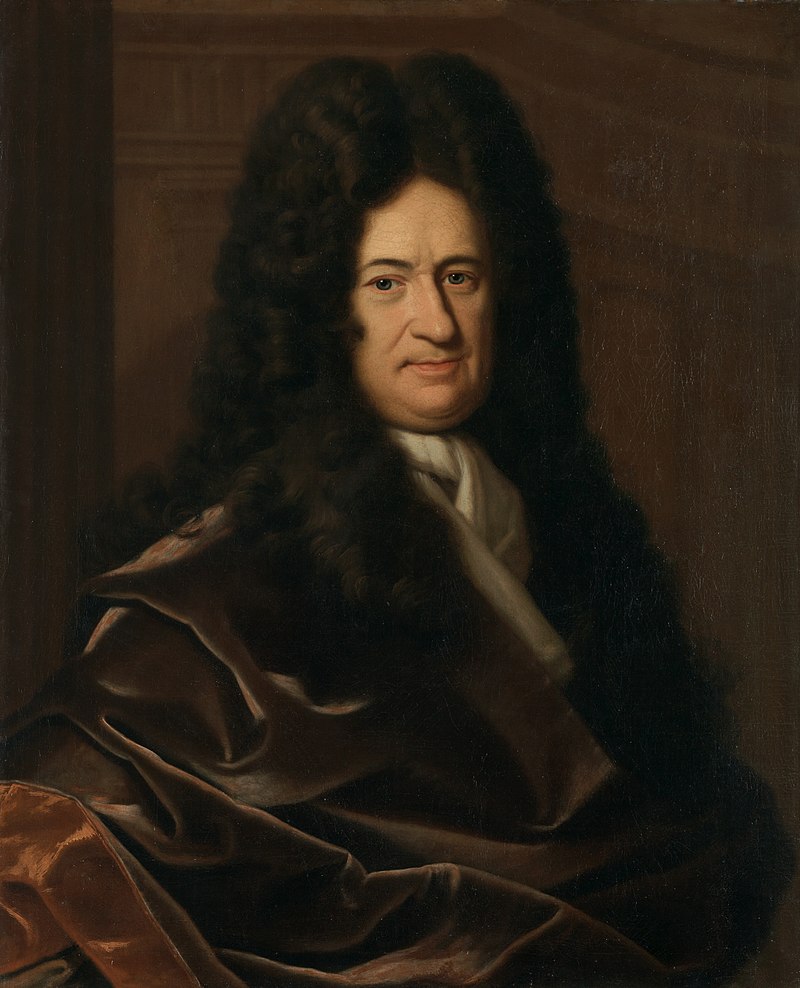
Gottfried Wilhelm Leibniz
German mathematician and philosopher (1646–1716)

binary numeral system
system that represents numeric values using two symbols; 0 or 1

theodicy
thumb|Gottfried Leibniz coined the term theodicy to justify God's existence in light of the apparent imperfections of the world.
binary code
information represented using the binary number system
principle of sufficient reason
principle that everything must have a reason or a cause
alternating series test
method used to show that an alternating series is convergent
Leibniz formula for π
alternating series which converges to π/4
Entscheidungsproblem
In mathematics and computer science, the ; ) is a challenge posed by David Hilbert and Wilhelm Ackermann in 1928. It asks for an algorithm that considers an inputted statement and answers "yes" or "no" according to whether it is universally valid, i.e., valid in every structure. Such an algorithm was proven to be impossible by Alonzo Church and Alan Turing in 1936.
difference
set of properties by which one entity is distinguished from another
identity of indiscernibles
impossibility for separate objects to have all their properties in common
Leibniz integral rule
differentiation under the integral sign formula
Leibniz's notation
mathematical notation
vis viva
physical quantity, historically invented by G. Leibniz, equivalent to (in modern terminology) twice the kinetic energy
general Leibniz rule
generalization of the product rule in calculus
integral symbol
mathematical symbol used to denote integrals and antiderivatives
Gottfried Wilhelm Leibniz Prize
research prize awarded by the Deutsche Forschungsgemeinschaft
characteristica universalis
universal and formal language imagined by the German polymathic genius, mathematician, scientist and philosopher Gottfried Leibniz able to express mathematical, scientific, and metaphysical concepts
best of all possible worlds
the doctrine or belief that in the system of things all that happens, the undesirable no less than the desirable, is for the best
Leibniz–Newton calculus controversy
argument between Isaac Newton and Gottfried Wilhelm Leibniz over who had first invented calculus
dynamism
philosophical system in which matter consists essentially of simple and indivisible units, substances, or forces; esp. one that reduces to matter to force
Leibniz harmonic triangle
triangular arrangement L(r,c) of unit fractions, where (r,c) are row and column numbers, such that L(r, 1) = 1/r and L(r, c) = L(r − 1, c − 1) − L(r, c − 1)
Leibniz formula for determinants
mathematics formula

Leibniz wheel
cylinder with a set of teeth of incremental lengths
Stepped Reckoner
digital mechanical calculator
Mathesis universalis
hypothetical universal science modeled on mathematics

Leibniz-Keks
thumb|200px|Leibniz-Keks
thumb|200px|Choco Leibniz
The Leibniz-Keks or Choco Leibniz is a German brand of biscuit or cookie produced by the Bahlsen food company since 1891. It was created by the firm as a rival to a similar French biscuit, the Petit-Beurre.
Compossibility
Compossibility is a philosophical concept from Gottfried Wilhelm Leibniz. According to Leibniz, a complete individual thing (for example a person) is characterized by all its properties, and these determine its relations with other individuals. The existence of one individual may negate the possibility of the existence of another. A possible world is made up of individuals that are compossible—that is, individuals that can exist together.
calculus ratiocinator
theoretical universal logical calculation framework
list of things named after Gottfried Leibniz
Wikimedia list article
alphabet of human thought
Hypothetical language created by Gottfried Wilhelm Leibniz
Law of Continuity
principle that whatever succeeds for the finite also succeeds for the infinite