Category
page 1Grammar

grammar
In linguistics, grammar is the system of rules that governs how a natural language is structured and used, as evidenced by its speakers or writers. Grammar rules may concern the use of clauses, phrases, and words. The term may also refer to the study of such rules, a subject that includes phonology, morphology, and syntax, together with phonetics, semantics, and pragmatics. There are in effect two different ways to study grammar: traditional grammar and theoretical grammar.

noun
In grammar, a noun is a word that represents a concrete or abstract thing, like living creatures, places, actions, qualities, states of existence, and ideas. To summarize this, Nouns signify an object or idea. A noun may serve as an object or subject within a phrase, clause, or sentence.

syntax
In linguistics, syntax ( ) is the study of how words and morphemes well-formed combine to form larger units such as phrases and sentences. Central concerns with syntax include word order, grammatical relations, hierarchical sentence structure (constituency), agreement, the nature of crosslinguistic variation, and the relationship between form and meaning (semantics). Diverse approaches, such as generative grammar and functional grammar, offer unique perspectives on syntax, reflecting its complexity and centrality to understanding human language.

morphology
identification, analysis and description of the structure of a given language's morphemes and other linguistic units

conjunction
part of speech that connects two words, sentences, phrases, or clauses

semantics
thumb|alt=Diagram of the relation between word, object, and thought|A central topic in semantics concerns the relation between language, world, and mental concepts.|class=skin-invert-image
Semantics is the study of linguistic meaning. It examines what meaning is, how words get their meaning, and how the meaning of a complex expression depends on its parts. Part of this process involves the distinction between sense and reference. Sense is given by the ideas and concepts associated with an expression while reference is the object to which an expression points. Semantics contrasts with syntax, w

part of speech
category of words based on shared grammatical properties in a clause

nominative case
grammatical case

question
thumb|right|alt=A question mark made of smaller question marks|A question mark made of smaller question marks

article
word used with a noun to indicate the type of reference being made by the noun; one of word classes
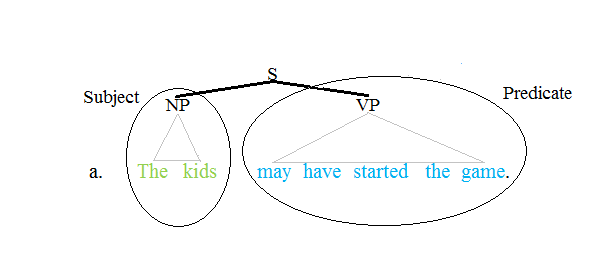
predicate
sentence constituent
declension
In linguistics, declension (verb: to decline) is the changing of the form of a word, generally to express its syntactic function in the sentence by way of an inflection. Declension may apply to nouns, pronouns, adjectives, adverbs, and determiners. It serves to indicate number (e.g. singular, dual, plural), case (e.g. nominative, accusative, genitive, or dative), gender (e.g. masculine, feminine, or neuter), and a number of other grammatical categories. Inflectional change of verbs is called conjugation.

voice
grammatical category for verbs

inflection
thumb|upright=0.8|Inflection of the Scottish Gaelic [[lexeme for 'dog', which is for singular, for dual with the number ('two'), and for plural|class=skin-invert-image]]
ellipsis
omission from a clause of one or more words that are nevertheless understood in the context of the remaining elements

Buffalo buffalo Buffalo buffalo buffalo buffalo Buffalo buffalo.
language-based puzzle in English

reduplication
thumb|220x124px | right | Occurrence of reduplication across world languages
In linguistics, reduplication is a morphological process in which the root or stem of a word, part of that, or the whole word is repeated exactly or with a slight change.
register
form of language used for a particular purpose or in a particular communicative situation
generative grammar
theory in linguistics
polysynthetic language
highly inflected language with many morphemes per word
apposition
Apposition is a grammatical construction in which two elements, normally noun phrases, are placed side by side so one element identifies the other in a different way. The two elements are said to be "in apposition", and the element identifying the other is called the appositive. The identification of an appositive requires consideration of how the elements are used in a sentence.
barbarism
linguistic deviation
formal grammar
structure of a formal language
function word
words with little/ambiguous lexical meaning that express grammatical relationships or specify the speaker’s attitude/mood of the speaker; e.g. articles, pronouns, adpositions, conjunctions, auxiliary verbs, interjections, particles
determiner
In natural language, a determiner, also called a determinative (abbreviated ''''), is a word or affix that combines with a noun to express its reference. Examples in English include articles (the and a/an), demonstratives (this, that), possessive determiners (my, their), and quantifiers (many, both''). Not all languages have determiners, and not all systems of grammatical description recognize them as a distinct category.
parallelism
literary style of forming sentences of the same grammar structure
grammaticalization
Grammaticalization (also known as grammatization or grammaticization) is
a linguistic process in which words change from representing objects or actions to serving grammatical functions. Grammaticalization can involve content words, such as nouns and verbs, developing into new function words that express grammatical relationships among other words in a sentence. This may happen rather than speakers deriving such new function words from (for example) existing bound, inflectional constructions. For example, the Old English verb 'to want', 'to wish' has become the Modern English auxiliary verb wi
polysyndeton
Polysyndeton (from Ancient Greek and ) is the insertion of repeated conjunctions into a sentence for deliberate effect, especially to slow the rhythm of the prose so as to produce an impressively solemn note.
supine
In grammar, a supine is a form of verbal noun used in some languages. The term is most often used for Latin, where it is one of the four principal parts of a verb.
asyndeton
Asyndeton (, ; from the , sometimes called asyndetism) is a literary scheme in which one or several conjunctions are deliberately omitted from a series of related clauses. Examples include veni, vidi, vici and its English translation "I came, I saw, I conquered". Its use can have the effect of speeding up the rhythm of a passage and making a single idea more memorable. Asyndeton may be contrasted with syndeton (syndetic coordination) and polysyndeton, which describe the use of one or multiple coordinating conjunctions, respectively.
Kleene star
unary operation on sets of strings, used in regular expressions for "zero or more repetitions"
argument
expression that helps complete the meaning of a grammatical predicate
suppletion
In linguistics and etymology, suppletion is traditionally understood as the use of one word as the inflected form of another word when the two words are not cognates. For those learning a language, suppletive forms will be seen as "irregular" or even "highly irregular". For example, go:went is a suppletive paradigm, because go and went are not etymologically related, whereas mouse:mice is irregular but not suppletive, since the two words come from the same Old English ancestor.

self-reference
thumb|The ancient symbol Ouroboros, a dragon that continually consumes itself, denotes self-reference.
plurale tantum
noun that has a plural form, and no corresponding singular form
morphosyntactic alignment
grammatical relationship between arguments
linguistic norm
collectively accepted linguistic practice, basis of the standard language
solecism
A solecism is a phrase that transgresses the rules of grammar. The term is often used in the context of linguistic prescription; it also occurs descriptively in the context of a lack of idiomaticness.
Remigius of Auxerre
French philosopher and theologian
possessive
A possessive or ktetic form (abbreviated or ''''''; from ; ) is a word or grammatical construction indicating a relationship of possession in a broad sense. This can include strict ownership, or a number of other types of relation to a greater or lesser degree analogous to it.
verbosity
Verbosity, or verboseness, is speech or writing that uses more words than necessary. The opposite of verbosity is succinctness.
X-bar theory
in generative grammar, the theory of syntactic category formation that ① phrases may contain intermediate constituents projected from a head X; and that ② this system of projected constituency may be common to more than one category (e.g. N, V, A, P)
lexical aspect
characteristic of the meaning of verbs
parataxis
Parataxis (from , "act of placing side by side"; from παρα, para "beside" + τάξις, táxis "arrangement") is a literary technique in writing or speaking that favors short, simple sentences without conjunctions, or sentences coordinated without the use of subordinating conjunctions. It contrasts with syntaxis and hypotaxis.
usage
usage of linguistic units established in a particular community, accorded widespread or significant acceptance by speakers
active–stative language
type of morphosyntactic alignment in linguistics
adjectival locution
a phrase the head of which is an adjective
split ergativity
feature in the typology of certain languages
counterfactual conditional
conditional with a false "if" clause

elocution
thumb|"An accomplished elocutionist", an illustration of elocutionist performing an open-air recitation, published in The Strand Magazine in 1891|alt=A man in a hat recites with his hand raised upwards. Two children watch.
adverbial phrase
a phrase the head of which is an adverb
double negative
grammatical construction occurring when two forms of negation are used in the same sentence
lexical gap
word or form that does not exist in a language but would be permitted by the grammatical rules of that language
description
Description is any type of communication that aims to make vivid a place, object, person, group, or other physical entity. It is one of four rhetorical modes (also known as modes of discourse), along with exposition, argumentation, and narration.
markedness
In linguistics and social sciences, markedness is the state of standing out as nontypical or divergent as opposed to regular or common. In a marked–unmarked relation, one term of an opposition is the broader, dominant one. The dominant default or minimum-effort form is known as unmarked; the other, secondary one is marked. In other words, markedness involves the characterization of a "normal" linguistic unit against one or more of its possible "irregular" forms.
Grammar Nazi
pejorative term for a person who habitually corrects or criticizes the language usage and spelling of others, demonstrating a strong prescriptivist attitude

grammaticality
In linguistics, grammaticality is conformity to grammar. The notion of grammaticality rose alongside the theory of generative grammar, the goal of which is to formulate rules that define well-formed, grammatical sentences. These rules of grammaticality also provide explanations of ill-formed, ungrammatical sentences.
telicity
In linguistics, telicity (; from Greek τέλος "end, goal") is the property of a verb or verb phrase that presents an action or event as having a specific endpoint. A verb or verb phrase with this property is said to be telic; if the situation it describes is not heading for any particular endpoint, it is said to be atelic.
productivity
degree to which native speakers use a particular grammatical process
Parenthesis (rhetoric)
grammatically optional part inserted into a passage