Category
page 1Greek city-states

Messina
Messina ( , ; ) is a harbour city and the capital of the Italian Metropolitan City of Messina. It is the third largest city on the island of Sicily, and the 13th largest city in Italy, with a population of 217,033 inhabitants in the city proper and 595,948 in the metropolitan city as of 2025. It is located near the northeast corner of Sicily, at the Strait of Messina and it is an important access terminal to Calabria region, Villa San Giovanni, Reggio Calabria on the mainland.

Syracuse
Italian municipality

Rhodes
alt=General view of the village of Lindos, with the acropolis and beaches, island of Rhodes, Greece.|thumb|General view of the village of Lindos, with the acropolis and beaches, island of Rhodes, Greece

Sparta
Sparta was a prominent city-state in Laconia in ancient Greece. In antiquity (pre-800 BCE), the state was known as Lacedaemon (), while "Sparta" referred to its capital, a group of villages in the valley of the Evrotas River in Laconia, in southeastern Peloponnese. Around 650 BC, it rose to become one of the major military powers in Greece, a status it retained until 371 BC.
.png)
Gela
Gela (Sicilian and ; ) is a city and (municipality) in the Autonomous Region of Sicily, Italy; in terms of area and population, it is the largest municipality on the southern coast of Sicily. Gela is part of the Province of Caltanissetta and is one of the few in Italy with a population and area that exceed those of the provincial capital.Gela was founded in 698 BC by Greek colonists from Rhodes and Crete; it was an influential polis of Magna Graecia in the 7th and 6th centuries BC and became one of the most powerful cities until the 5th c. BC. Aeschylus, the famous playwright, lived here and d
.jpg)
Patras
Patras (; ; Katharevousa and ; ) is Greece's third-largest city and the regional capital and largest city of Western Greece, in the northern Peloponnese, west of Athens. The city is built at the foot of Mount Panachaikon, overlooking the Gulf of Patras.
.jpg)
Samsun
Samsun is a city on the north coast of Turkey and a major Black Sea port. The urban area recorded a population of 738,692 in 2022. The city is the capital of Samsun Province which has a population of 1,382,376. The city is home to Ondokuz Mayıs University, several hospitals, three large shopping malls, Samsunspor football club, an opera house and a large and modern manufacturing district. The city is best known as the place where Mustafa Kemal Atatürk began the Turkish War of Independence in 1919.

Chios
Chios (; , traditionally known as Scio in English) is the fifth largest Greek island, situated in the northern Aegean Sea, and the tenth largest island in the Mediterranean Sea. The island is separated from Turkey by the Chios Strait. Chios is notable for its exports of mastic gum and its nickname is "the Mastic Island". Tourist attractions include its medieval villages and the 11th-century monastery of Nea Moni, a UNESCO World Heritage Site.

Naxos Island
Naxos (; , ) is a Greek island belonging to the Cyclades island group. It is the largest island in the group. The largest town and capital of the island is Chora or Naxos City, with 8,897 inhabitants out of the total 20,578 in the island (2021 census). The main villages are Filoti, Apiranthos, Vivlos, Agios Arsenios, Koronos and Glynado. It was an important centre during the Bronze Age Cycladic Culture and in the Ancient Greek Archaic Period. The island is famous as a source of emery, a rock rich in corundum, which until modern times was one of the best abrasives available.
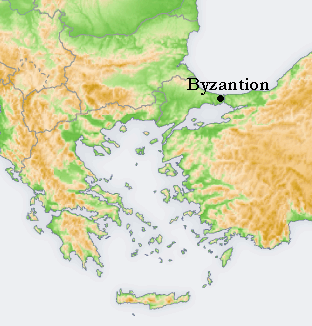
Byzantium
Byzantium () or Byzantion () was an ancient Greek city in classical antiquity that became known as Constantinople in late antiquity and Istanbul in modern times. The Greek name Byzantion and its Latinization Byzantium continued to be used as a name of Constantinople sporadically and to varying degrees during the thousand-year existence of the Eastern Roman Empire, which also became known by the former name of the city as the Byzantine Empire. Byzantium was colonized by Greeks from Megara in the 7th century BCE and remained primarily Greek-speaking until its conquest by the Ottoman Empire in 14

Q189901
city in Argolis, Peloponnese, Greece

polis
Polis (: poleis) means 'city' in Ancient Greek. The ancient word polis had socio-political connotations not possessed by modern usage. For example, Modern Greek πόλη (póli), "city", is located within a (chóra), "country", which is a πατρίδα (patrída) or "native land" for its citizens. In ancient Greece, the polis was the native land; there was no other. It had a constitution and demanded the supreme loyalty of its citizens. Χώρα was only the countryside, not a country. Ancient Greece was not a sovereign country; rather, it was territory occupied by Hellenes, people who claimed as their native

Thebes
modern city in Boeotia, Greece

Rhodes
city on the homonymous island, Greece

Miletus
Miletus () was an influential ancient Greek city on the western coast of Anatolia, near the mouth of the Maeander River in present day Turkey. Renowned in antiquity for its wealth, maritime power, and extensive network of colonies, Miletus was a major center of trade, culture, and innovation from the Bronze Age through the Roman period. The city played a foundational role in the development of early Greek philosophy and science, serving as the home of the Milesian school with thinkers such as Thales, Anaximander, and Anaximenes.

Patmos
Patmos (, ) is a Greek island in the Aegean Sea. It is famous as the place where, according to Christian belief, John of Patmos received the vision found in the Book of Revelation of the New Testament, and where the book was written.

Mykonos
Mykonos (, ; ) is a Greek island, part of the Cyclades, lying between Tinos, Syros, Paros and Naxos. The island has an area of and rises to an elevation of at its highest point. At the 2021 census, there were 10,704 inhabitants, most of whom lived in the largest town, Mykonos, which is on the west coast. The town is also known as Chora (i.e. 'Town' in Greek, following the common practice in Greece when the name of the island itself is the same as the name of the principal town).

Paros
Paros (; ; ) is a Greek island in the central Aegean Sea and part of the Cyclades island group. It lies 8 kilometers (5 miles) west of Naxos, separated by a narrow channel and about south-east of Piraeus. The Municipality of Paros covers about , including numerous uninhabited offshore islets. Its closest neighbor is the municipality of Antiparos, located to the southwest. In ancient Greece, the island was home to the city-state of Paros.

Corfu
capital of the Greek island and municipality of Corfu

Salamis Island
island in the Saronic Gulf near Piraeus, Greece

Mytilene
Mytilene (; ) is the capital of the Greek island of Lesbos, and its port. It is also the capital and administrative center of the North Aegean Region, and hosts the headquarters of the University of the Aegean. It was founded in the 11th century BC.

Q200133
Chalcis (; Ancient Greek and Katharevousa: , ), also called Chalkida or Halkida (Modern Greek: , ), is the chief city of the island of Euboea in Greece, situated on the Euripus Strait at its narrowest point. The name is preserved from antiquity and is derived from the Greek χαλκός (copper, bronze), though there is no trace of any mines in the area. In the Late Middle Ages, it was known as Negropont(e), an Italian name that has also been applied to the entire island of Euboea.

Lentini
Lentini (; ; ; ) is a town and in the Province of Syracuse, southeastern Sicily (Southern Italy), located 35 km (22 miles) north-west of Syracuse.

Megara
Megara (; , ) is a historic town and a municipality in West Attica, Greece. It lies in the northern section of the Isthmus of Corinth opposite the island of Salamis, which belonged to Megara in archaic times, before being taken by Athens. Megara was one of the four districts of Attica, embodied in the four mythic sons of King Pandion II, of whom Nisos was the ruler of Megara. Megara was also a trade port, its people using their ships and wealth as a way to gain leverage on armies of neighboring poleis. Megara specialized in the exportation of wool and other animal products including livestock

Thasos
Thasos ( ) is a Greek island in the northern Aegean Sea. It is the northernmost major Greek island, and 12th largest by area.

Classical Athens
city-state in ancient Greece

Roses
municipality in the comarca of the Alt Empordà in Catalonia, Spain

Ios
thumb|Map of Ios

Bozcaada
Tenedos (; ; ), or Bozcaada in Turkish, is an island of Turkey in the northeastern part of the Aegean Sea. Administratively, the island constitutes the Bozcaada district of Çanakkale Province. With an area of , it is the third-largest Turkish island after Imbros (Gökçeada) and Marmara. In 2022, the district had a population of 3,120 inhabitants. The main industries are tourism, wine production and fishing. The island has been famous for its grapes, wines and red poppies for centuries. It is a former bishopric and presently a Latin Catholic titular see.

Cumae
Cumae ( or or ; ) was the first ancient Greek colony of Magna Graecia on the mainland of Italy and was founded by settlers from Euboea in the 8th century BCE. It became a rich Roman city, the remains of which lie near the modern village of Cuma, a frazione of the comune Bacoli and Pozzuoli in the Metropolitan City of Naples, Campania, Italy. The archaeological museum of the Campi Flegrei in the Aragonese castle contains many finds from Cumae.

Kasos
thumb|right|280px|Kasos Island

Leros
Leros (), also called Lero (from the Italian language), is a Greek island and municipality in the Dodecanese in the southern Aegean Sea. It lies from Athens's port of Piraeus, from which it can be reached by a nine-hour ferry ride or by a 45-minute flight from Athens. It is about from Turkey. Leros is part of the Kalymnos regional unit. It has a population of 7,992 (2021).

Skiathos
Skiathos (, ; , ; and ) is a small Greek island in the northwest Aegean Sea. Skiathos is the westernmost island in the Northern Sporades archipelago, east of the Pelion peninsula in Magnesia on the mainland, and west of the island of Skopelos.

Eretria
thumb|Neighbouring ancient cities
thumb|Plan of the site

Nisyros
Nisyros, also spelled Nisiros (; ), is a volcanic Greek island and municipality located in the Aegean Sea. It is part of the Dodecanese group of islands, situated between the islands of Kos and Tilos.

Selinunte
thumb|300px|Plan of ancient Selinunte showing ancient coastline

Chios
Greek town on the homonymous island

Astypalaia
Astypalaia (Greek: Αστυπάλαια, ), is a Greek island with 1,376 residents (2021 census). It belongs to the Dodecanese, an archipelago of fifteen major islands in the southeastern Aegean Sea. However, many scholars recognize Astypalaia as an extension of the Cyclades, as many cultural and ecological components of the island are more indicative of the Cyclades rather than the Dodecanese.

Kythnos
Kythnos (, ), commonly called Thermia (), is a Greek island and municipality in the Western Cyclades between Kea and Serifos. It is from the Athenian harbor of Piraeus. The municipality Kythnos is in area and has a coastline of about . Mount Kakovolo is island's highest peak (365m).
.jpg)
Sicyon
thumb|260px|Ruins of Sicyon
Sikinos
Sikinos () is a Greek island and municipality in the Cyclades. It is located midway between the islands of Ios and Folegandros. Sikinos is part of the Thira regional unit.
Ancient Corinth
city-state in ancient Greece

Tilos
Tílos (; ) is a small Greek island and municipality located in the Aegean Sea. It is part of the Dodecanese group of islands, and lies midway between Kos and Rhodes. In 2021, the island had a population of 746 people. Along with the uninhabited offshore islets of Antitilos and Gaidaros, it forms the Municipality of Tilos, which has a total land area of . Tilos is part of the Rhodes regional unit.

Kimolos
Kimolos (; ) is a Greek island in the Aegean Sea. It lies on the southwest of the island group of Cyclades, near the bigger island of Milos. Kimolos is the administrative center of the municipality of Kimolos, which also includes the uninhabited islands of Polyaigos, Agios Efstathios and Agios Georgios. The island has a land area of , while the municipality's land area is , and it reported a population of 810 inhabitants in the 2021 census.

Knidos
Knidos or Cnidus (; , , , Knídos) was a Greek city in ancient Caria and part of the Dorian Hexapolis, in south-western Asia Minor, modern-day Turkey. It was situated on the Datça peninsula, which forms the southern side of the Sinus Ceramicus, now known as Gulf of Gökova. By the 4th century BC, Knidos was located at the site of modern Tekir, opposite Triopion Island. But earlier, it was probably at the site of modern Datça (at the half-way point of the peninsula).

Assos
thumb|Map of Assos

Phocaea
Phocaea or Phokaia (Ancient Greek: Φώκαια, Phókaia; modern-day Foça in Turkey) was an ancient Ionian Greek city on the western coast of Anatolia. Greek colonists from Phocaea founded the colony of Massalia (modern-day Marseille, in France) in 600 BC, Emporion (modern-day Empúries, in Catalonia, Spain) in 575 BC and Elea (modern-day Velia, in Campania, Italy) in 540 BC.

Klazomenai
Klazomenai () or Clazomenae was one of the 12 cities of ancient Ionia (the others being Chios, Samos, Phocaea, Erythrae, Teos, Lebedus, Colophon, Ephesus, Priene, Myus, and Miletus). It is located at the south coast of Smyrna Gulf, Ionia, and a member of the Ionian League. It was one of the first cities to issue silver coinage. Its ruins are now located in the modern town Urla near İzmir in İzmir Province, Turkey.
Colophon
ancient city of Ionia, in modern-day Turkey

Teos
Teos () or Teo was an ancient Greek city on the coast of Ionia, on a peninsula between Chytrium and Myonnesus. It was founded by Minyans from Orchomenus, Ionians and Boeotians, but the date of its foundation is unknown. Teos was one of the twelve cities which formed the Ionian League. The city was situated on a low hilly isthmus. Its ruins are located to the south of the modern town of Sığacık in the Seferihisar district of İzmir Province, Turkey.
Kamarina
ancient city on the southern coast of Sicily

Naxos
chief town of Naxos island, Cyclades, Greece
Ancient Abdera
city in ancient Thrace and archaeological site

Empúries
Empúries ( ) was an ancient Greek city on the Mediterranean coast of Catalonia, Spain. Empúries is also known by its Spanish name, Ampurias ( ). The city Ἐμπόριον (, Emporion, meaning "trading place", cf. emporion) was founded in 575 BC by Greeks from Phocaea. The invasion of Gaul from Iberia by Hannibal the Carthaginian general in 218 BC, prompted the Romans to occupy the city (Latin: ), thus initiating the Roman conquest of Hispania. In the Early Middle Ages, the city's exposed coastal position left it open to marauders and it was abandoned.
Phocis
historical region of Greece

Mithymna
Mithymna () (, also sometimes spelled Methymna) is a town and former municipality on the island of Lesbos, North Aegean, Greece. Since the 2019 local government reform it is part of the municipality of West Lesbos, of which it is a municipal unit. Before 1919, its official name was Μόλυβος - Molyvos; that name dates back to the end of the Byzantine Era, but is still in common use today.
Megara Hyblaea
city of ancient Sicily and Italian archaeological site

Phlius
thumb|Location of Phlius
Phlius (; ) or Phleius () was an independent polis (city-state) in the northeastern part of Peloponnesus. Phlius' territory, called Phliasia (), was bounded on the north by Sicyonia, on the west by Arcadia, on the east by Cleonae, and on the south by Argolis. This territory is a small valley about above the level of the sea, surrounded by mountains, from which streams flow down on every side, joining the river Asopus in the middle of the plain. The mountain in the southern part of the plain, from which the principal source of the Asopus springs, was called Carneates (Κ

Lampsacus
Lampsacus (; ) was an ancient Greek city located in modern day Turkey, strategically situated on the eastern side of the Hellespont in the northern Troad. An inhabitant of Lampsacus was called a Lampsacene. The name has been transmitted in the nearby modern town of Lapseki.

Kameiros
Camirus or Kamiros (; ) or Cameirus or Kameiros (Κάμειρος) was a city of ancient Rhodes, in the Dodecanese, Greece. Its site is on the northwest coast of the island, west of the modern village of Kalavarda.