Category
page 1Haplorhini
%20(white%20background)%20(1).jpg)
Simiiformes
The simians, anthropoids, or higher primates are primates of the infraorder Simiiformes () containing all animals traditionally called monkeys and apes. More precisely, they consist of the parvorders Platyrrhini (New World monkeys) and Catarrhini, the latter of which consists of the family Cercopithecidae (Old World monkeys in the stricter sense) and the superfamily Hominoidea (apesincluding humans).
Haplorhini
Haplorhini (), the haplorhines (Greek for "simple-nosed") or the "dry-nosed" primates is a suborder of primates containing the tarsiers and the simians (Simiiformes or anthropoids), as sister of the Strepsirrhini ("moist-nosed"). The name is sometimes spelled Haplorrhini. The simians include catarrhines (Old World monkeys and apes, including humans), and the platyrrhines (New World monkeys).
Tarsiiformes
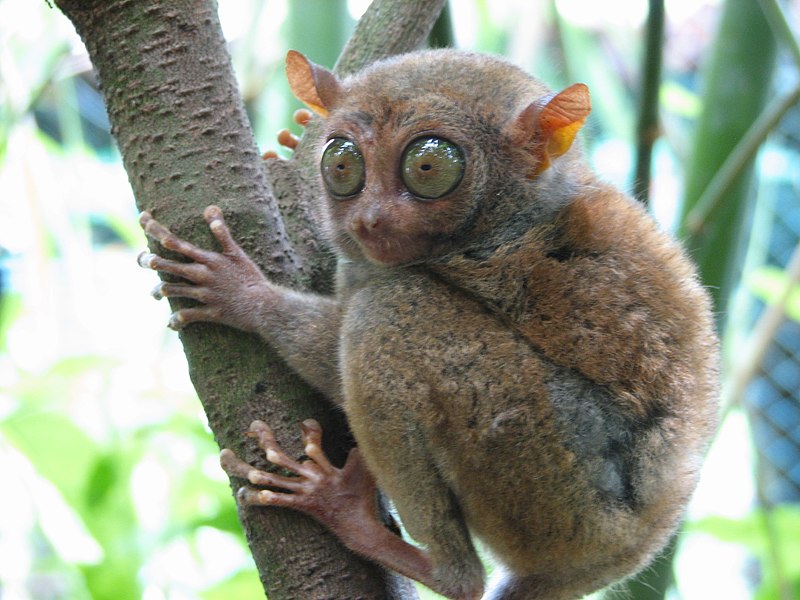
Tarsiiformes are a group of primates that once ranged across Europe, northern Africa, Asia, and North America, but whose extant species are all found in the islands of Southeast Asia. Tarsiers (family Tarsiidae) are the only living members of the infraorder; other members of Tarsiidae include the extinct Tarsius eocaenus from the Eocene, and Tarsius thailandicus from the Miocene. Two extinct genera, Xanthorhysis and Afrotarsius, are considered to be close relatives of the living tarsiers, and are generally classified within Tarsiiformes, with the former grouped within family Tarsiidae, and the

Omomyidae
Omomyidae is a group of early primates that radiated during the Eocene epoch between about (mya). Fossil omomyids are found in North America, Europe & Asia, making it one of two groups of Eocene primates with a geographic distribution spanning holarctic continents, the other being the adapids (family Adapidae). Early representatives of the Omomyidae and Adapidae appear suddenly at the beginning of the Eocene (56 mya) in North America, Europe, and Asia, and are the earliest known crown primates.
Simia Linnaeus, 1758
In his Systema Naturae of 1758, Carl Linnaeus divided the Order Primates within Mammalia into four genera: Homo, Simia, Lemur, and Vespertilio. His Vespertilio included all bats, and has since been moved from Primates to Chiroptera. Homo contained humans, Lemur contained four lemurs and a colugo, and Simia contained the other Primates. Linnaeus did not think that Homo should form a distinct group from Simia, classifying them separately mainly to avoid conflict with religious authorities. If this is taken into account, Simia (including Homo) would be roughly equivalent to the Suborder Haplorhin