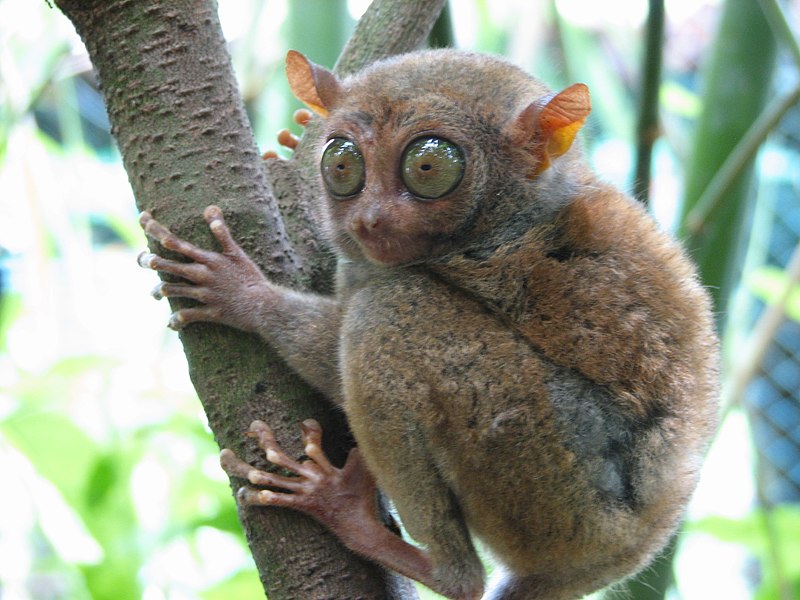
File:Bohol_Tarsier.jpg · Wikimedia Commons · See Wikimedia Commons
Haplorhini
Sign in to saveHaplorhini (), the haplorhines (Greek for "simple-nosed") or the "dry-nosed" primates is a suborder of primates containing the tarsiers and the simians (Simiiformes or anthropoids), as sister of the Strepsirrhini ("moist-nosed"). The name is sometimes spelled Haplorrhini. The simians include catarrhines (Old World monkeys and apes, including humans), and the platyrrhines (New World monkeys).
Haplorhini is a major group of primates that includes tarsiers and simians (which contain monkeys, apes, and humans), distinguished by their dry noses as opposed to the moist-nosed primates. This classification matters because it helps scientists organize primates into their evolutionary relationships and understand how different primate species are related to one another.
AI-generated from the Wikipedia summary — may contain errors.
Species
簡鼻亞目(Haplorrhini)是包括眼鏡猴及所有類人猿的靈長目。 始鏡猴科是已滅絕的原猴亞目,相信與眼鏡猴較為接近,且是最原始的簡鼻亞目。 牠們的上唇並非直接連接鼻子或牙床,故可以做很多面部表情。牠們的腦部與身體比例明顯較原猴的大,而其主要感官是靠視覺。牠們有眼後板。除了眼鏡猴及夜猴外,大部份物種都是白天活動的,且有三原色视觉。牠的手及腳只適合運動,例如長臂猿科及猩猩的鈎狀手,或是人類的雙足。 所有的類人猿都有單一間隔的子宮,而眼鏡猴則像原猴般有雙角形子宮。大部份物種一般每次只會生一胎,但如狨屬及檉柳猴屬則普遍會生孖胎或三胞胎。簡鼻亞目的嬰兒相對較原猴的為大,但較依賴母親,這可能是因牠們複雜的行為及自然歷史。
via
Research
23,601,891 papers- Anthropoid origins.ReviewScience (New York, N.Y.) · 1997Kay RF, Ross C, Williams BADOI: 10.1126/science.275.5301.797
- New middle Eocene omomyines (Primates, Haplorhini) from San Diego County, California.Journal of human evolution · 2018Atwater AL, Kirk ECDOI: 10.1016/j.jhevol.2018.04.010
- Monkeying around.Nature · 2016DOI: 10.1038/532281a
- Human evolution.ReviewBirth defects original article series · 1987Birkenmeier EH
- Staff support.Nature · 2014DOI: 10.1038/513459b
- Conservation of a Chromosome 8 Inversion and Exon Mutations Confirm Common Gulonolactone Oxidase Gene Evolution Among Primates, Including H. Neanderthalensis.Journal of molecular evolution · 2024Mansueto A, Good DJDOI: 10.1007/s00239-024-10165-0
- Reaching for answers.ReviewNeuron · 2002Krauzlis RJDOI: 10.1016/s0896-6273(02)00723-7
- Stem-cell-derived 'embryos' implanted in monkeys.Nature · 2023Conroy GDOI: 10.1038/d41586-023-00996-0
via PubMed
Wikidata facts
- Instance of
- taxon
- Has part
- Simiiformes
- Parent taxon
- primate
- Image
- Totenkopfaeffchen.jpg
Show 4 more facts
- taxon rank
- suborder
- taxon name
- Haplorhini
- Commons category
- Haplorrhini
- start time
- 74000000-0
Sources (2)
via Wikidata · CC0
~9 min read
Encyclopedic overview
5 sectionsContents
- Etymology
- Classification and evolution
- Uncertain placement of extinct early haplorhines
- References
- Literature cited
Haplorhini (), the haplorhines (Greek for "simple-nosed") or the "dry-nosed" primates is a suborder of primates containing the tarsiers and the simians (Simiiformes or anthropoids), as sister of the Strepsirrhini ("moist-nosed"). The name is sometimes spelled Haplorrhini. The simians include catarrhines (Old World monkeys and apes, including humans), and the platyrrhines (New World monkeys).
Haplorhini was proposed by Pocock in 1918 when he realized the tarsiers were actually sister to the monkeys rather than the lemurs, also following findings of Hugh Cuming 80 years earlier and Linnaeus 160 years earlier. For Linnaeus, this ensemble of primates constituted a genus "Simia". For religious reasons, Homo constituted its own genus (which has remained).
Excerpted from Wikipedia’s “Haplorhini” article, available under the CC BY-SA 4.0 licence.
Gallery (9)
Available in 65 languages
- Español
- Français
- Deutsch
- 中文
- 日本語
- Русский
- Português
- Italiano
- العربية
- हिन्दी
- Afrikaans
- Albanian
- Armenian
- Azerbaijani
- Bahasa Indonesia
- Balinese
- Basque
- Bosnian
Show 46 more
- Bulgarian
- Catalan
- Cebuano
- Croatian
- Czech
- Danish
- Egyptian Arabic
- Esperanto
- Estonian
- Filipino
- Finnish
- Galician
- Greek
- Hebrew
- Hungarian
- Ingush
- Javanese
- Latin
- Latvian
- Ligurian
- Macedonian
- Malagasy
- Malay
- Nederlands
- Northern Frisian
- Norwegian
- Norwegian Nynorsk
- Polski
- Romanian
- Scots
- Serbian
- Serbian (Latin)
- simple
- Slovak
- Svenska
- Tiếng Việt
- Türkçe
- Ukrainian
- Waray
- Welsh
- Western Frisian
- Western Panjabi
- Wu Chinese
- zh_yue
- فارسی
- 한국어
via Wikidata sitelinks · CC0