Category
page 1Herod the Great
Herod the Great
king of Judea from 37/6 BCE to 4/1 BCE

Second Temple
Jewish Temple on the Temple Mount in Jerusalem between c. 516 BCE and 70 CE

Massacre of the Innocents
narrative from the Gospel of Matthew
.svg)
Hauran
thumb|upright=1.35|Map of the Hauran region
Antipater the Idumaean
1st century BCE King of Judea

Herodium
The Herodeion (), in Latin: Herodium, in Modern Herodion, known in Arabic as Jabal al-Fureidis () is a fortified desert palace built by Herod the Great, king of Judaea, in the first century BCE. The complex stands atop a hill in the Judaean Desert, approximately south of Jerusalem and southeast of Bethlehem, between Beit Ta'mir, Za'atara to the east and Jannatah, Tekoa and Nokdim to the west. The site is located at an elevation of 758 meters (2,487 ft) above sea level.
Machaerus
Machaerus (Μαχαιροῦς, from [a sword]; ; ) was a Hasmonean hilltop palace and desert fortress, rebuilt by Herod and now in ruins, in the village of Mukawir in modern-day Jordan. The site is located southeast of the mouth of the Jordan River on the eastern side of the Dead Sea.
Antonia Fortress
military barracks in Jerusalem
Matthew 2
Gospel according to Matthew, chapter 2

Iturea
thumb|300px|Map of Roman Judea in the first century; according to Claude Reignier Conder|Conder (1889)
Iturea or Ituraea (, Itouraía) is the Greek name of a Levantine region north of Galilee during the Late Hellenistic and early Roman periods. It extended from Mount Lebanon across the plain of Marsyas to the Anti-Lebanon Mountains in Syria, with its centre in Chalcis ad Libanum.

Gamla
Gamla (), also Gamala, was an ancient Jewish town on the Golan Heights. Believed to have been founded as a Seleucid fort during the Syrian Wars, it transitioned into a predominantly Jewish settlement that came under Hasmonean rule in 81 BCE. The town's name reflects its location on a high, elongated ridge with steep slopes resembling a camel's hump.
Antipater
son of Herod and Doris, heir of Judea
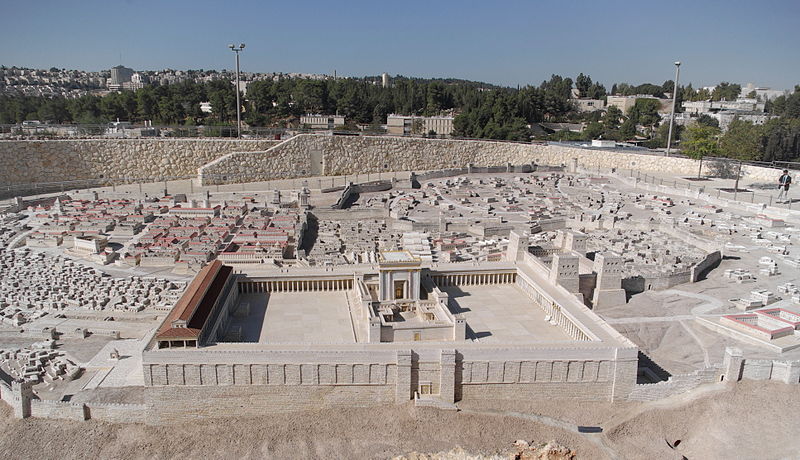
Holyland Model of Jerusalem
model of Old City of Jerusalem

Lajat
thumb|right|Trachonitis on map from Encyclopaedia Biblica (1903)
Marwani Mosque
underground vaulted space within the Temple Mount of Jerusalem, currently as a Muslim prayer hall
Abilene
historical region of the Levant
Herodians
The Herodians (; ) were a sect of Hellenistic Jews mentioned in the New Testament on two occasions – first in Galilee and later in Jerusalem – being hostile to Jesus (, ; ; cf. also , ). In each of these cases their name is coupled with that of the Pharisees.
Zedekiah's Cave
cave in Jerusalem
Mamilla Pool
Mamilla Pool is one of several ancient reservoirs that supplied water to the inhabitants of the Old City of Jerusalem

Batanaea
thumb|250px|right|The Herodian Tetrarchy|tetrarchy of Philip (4 BCE - 34 AD), then kingdom of [[Herod Agrippa I (37 - 44 AD) and Herod Agrippa II (53 - 100 AD): Iturea, Trachonitis, Gaulanitis, Batanea and Auranitis]]
Batanaea or Batanea was an area often mentioned between the first century BCE and the fourth century CE. It is often mixed with the biblical Bashan, the part of the Biblical Holy Land, northeast of the Jordan River, as its Latinized form.
Siege of Jerusalem
37 BCE siege
Hezekiah's Pool
archaeological site in Israel
Robinson's Arch
monumental staircase in Jerusalem
Convent of the Sisters of Zion
church
Herod's Palace at Jerusalem
ancient building destroyed in war

Acme
Jewish slave and personal maid in the service of the Empress Livia Drusilla, wife of Augustus
Royal Stoa
ancient basilica constructed by Herod the Great