Category
page 1Hexactinellida
.jpg)
hexactinellid
thumb|Bolosoma stalked glass sponge
Hexactinellid sponges are sponges with a skeleton made of four- and/or six-pointed siliceous spicules, often referred to as glass sponges. They are usually classified along with other sponges in the phylum Porifera, but some researchers consider them sufficiently distinct to deserve their own phylum, Symplasma. Some experts believe that glass sponges are the longest-lived animals on earth; these scientists tentatively estimate a maximum age of up to 15,000 years.

Venus' Flower Basket
species of sponge

Lyssacinosida
Lyssacinosida (also spelled Lyssacinosa) is an order of glass sponges (Hexactinellida) belonging to the subclass Hexasterophora. These sponges can be recognized by their parenchymal spicules usually being unconnected, unlike in other sponges in the subclass where the spicules form a more or less tightly connected skeleton. Lyssacine sponges have existed since the Upper Ordovician, and three families (four including Aulocalycidae) are still alive today. The Venus' flower basket (Euplectella aspergillum) is one of the most well-known and culturally significant of the glass sponges.

Euplectellidae
Euplectellidae is a family of glass sponges (Hexactinellids) belonging to the order Lyssacinosa, first represented in the Ordovician fossil record, substantially older than molecular estimates of the clade's age.
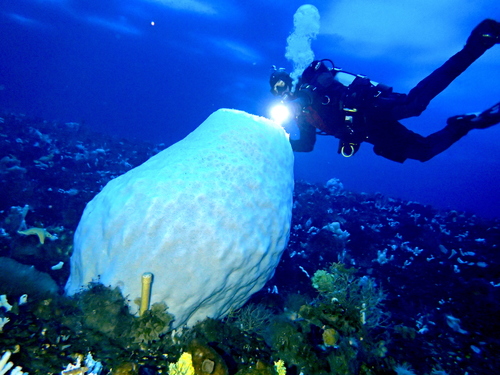
Anoxycalyx joubini
species of sponge
Euplectella
Euplectella is a genus of glass sponges which includes the well-known Venus' Flower Basket. Glass sponges have a skeleton made up of silica spicules that can form geometric patterns. These animals are most commonly found on muddy sea bottoms in the Western Pacific and Indian Oceans. They are sessile organisms and do not move once attached to a rock. They can be found at depths between 100 m and 1000 m but are most commonly found at depths greater than 500 m.
.jpeg)
Hyalonematidae
Hyalonematidae is a family of deep-sea glass sponges (class Hexactinellida) comprising five genera. They are known for their unique siliceous spicules called amphidiscs and skeleton structure primarily composed of diactins, large, rod-like megasclere spicules found within the sponge's internal tissue (choanosome). Hyalonematidae have been recorded at depths of up to 6000 meters and have a global distribution, though they have not been documented in the Arctic Ocean. Initially mistaken for corals due to their fibrous base, Hyalonematidae were later recognized as glass sponges and classified wit

Hexasterophora
left|thumb|Atlantisella (order Lyssacinosida, C), [[Lefroyella (order Sceptrulophora, D), and a hexaster microsclere (A, left) in a collage of hexactinellids.]]
Hexasterophora are a subclass of glass sponges in the class Hexactinellida. Most living hexasterophorans can be divided into three orders: Lyssacinosida, Lychniscosida, and Sceptrulophora. Like other glass sponges, hexasterophorans have skeletons composed of overlapping six-rayed spicules. In addition, they can be characterized by the presence of hexasters, a type of microsclere (microscopic spicules) with six rays unfurling into multi

Pheronematidae
Pheronematidae is a family of sponges belonging to the order Amphidiscosida.

Rossellidae
Rossellidae is a family of glass sponges belonging to the order Lyssacinosa. The family has a cosmopolitan distribution and is found at a large range of depths (, and likely deeper).
Amphidiscosida
left|thumb|Hyalonema (family Hyalonematidae, B) and an amphidisc microsclere (A, right) in a collage of hexactinellids.
Amphidiscosida (sometimes spelled Amphidiscosa) is an order of hexactinellids (glass sponges). The Amphidiscosida are commonly regarded as the only living sponges in the subclass Amphidiscophora.
Tretodictyidae
Tretodictyidae is a family of glass sponges in the order Sceptrulophora.
Amphidiscophora
REDIRECT Amphidiscosida
%20(14784740475).jpg)
Caulophacus
thumb|right|Caulophacus elegans, illustration in: Report on the scientific results of the voyage of H.M.S. Challenger during the years 1873-76 - under the command of Captain George S. Nares, R.N., F.R.S. and Captain Frank Turle Thomson, R.N. (1887).
Aulocystidae
Aulocystidae is a family of sponges belonging to the order Lychniscosida.

Farreidae
Farreidae is a family of glass sponges in the order Sceptrulophora.
Aphrocallistidae
Aphrocallistidae is a family of hexactinellid sponges in the order Sceptrulophora.
Aulocalycidae
Aulocalycidae is a family of sponges belonging to the order Lyssacinosida.
Dactylocalycidae
Dactylocalycidae is a family of sponges belonging to the order Lychniscosida.

Corbitella
Corbitella is a genus of glass sponges (Hexactinellids) belonging to the family Euplectellidae.
Uncinateridae
Uncinateridae is a family of glass sponges in the order Sceptrulophora.
Lychniscosida
Lychniscosida (sometimes spelled Lychniscosa) is an order of sponges belonging to the class Hexactinellida and subclass Hexasterophora. They are dictyonal sponges (with parenchymal spicules fully fused into a 3D framework) characterized by the presence of additional struts at the nodes of the skeleton. These struts create octahedral frames, known as lychniscs ("lanterns").

Caulophacus elegans
species of sponge

Leucopsacidae
Leucopsacidae is a family of glass sponges belonging to the order Lyssacinosa.

Farrea
Farrea is a genus of glass sponges in the family Farreidae.

Amphidiscella
Amphidiscella is a genus of sea sponge in the family Euplectellidae.
Anomochone
Anomochone is a genus of glass sponges in the family Tretodictyidae.

Saccocalyx
genus of sponges
Aphrocallistes
Aphrocallistes is a genus of sponges belonging to the family Aphrocallistidae.

Euretidae
Euretidae is a family of glass sponges in the order Sceptrulophora.

Poliopogon
Poliopogon is a genus of sponges belonging to the family Pheronematidae.

Farrea occa
species of sponge
Cloud sponge
species of sponge
Bolosoma
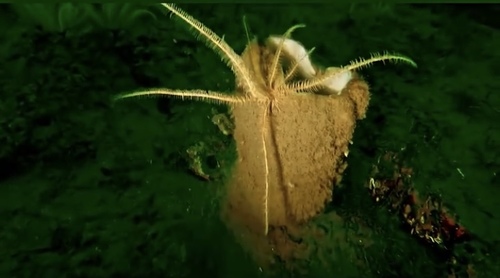
Bolosoma is a genus of pedunculated siliceous sponges belonging to the family Euplectellidae. This genus lives in deep-sea environments and provides a habitat for a plethora of other benthic species, giving Bolosoma an incredibly important ecological role in the ecosystems it is a part of.
thumb|Brittle stars and other deep-sea invertebrates use this Bolosoma species as a habitat
Rossella
genus of sponges
Acanthascus
Acanthascus is a genus of sponges in the family Rossellidae. Species include:

Lefroyella
Lefroyella is a genus of glass sponges in the subfamily Euretinae, containing 2 species.

Chonelasma
Chonelasma is a genus of sea sponge in the family Euretidae.
Corbitella elegans
species of sponge

Rossella antarctica
species of sponge
Periphragella antarctica
species of sponge
Caulophacus discohexactinus
species of sponge

Hyalostylus
Hyalostylus is a genus of sponges belonging to the family Euplectellidae.
Euplectella gibbsa
species of sponge
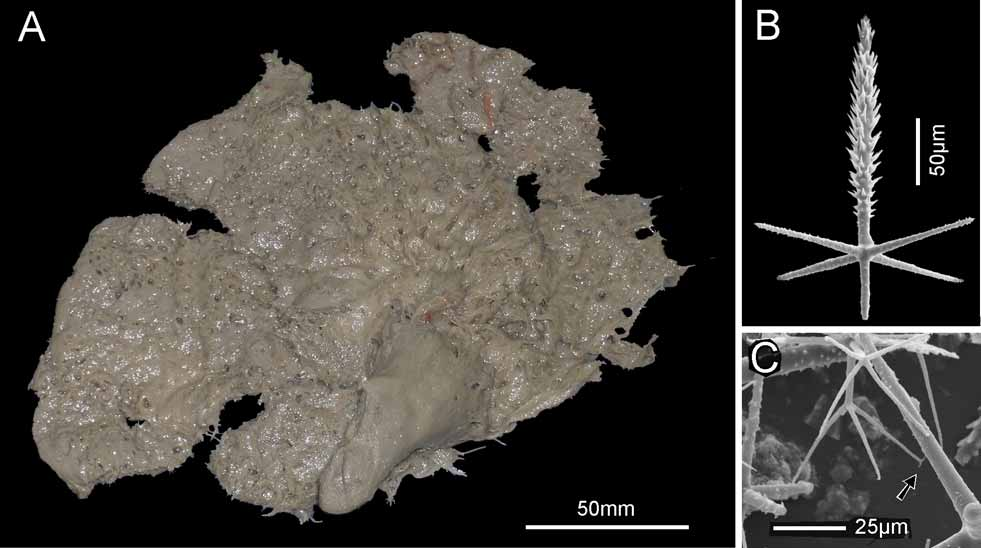
Caulophacus weddelli
species of sponge
Euplectella cucumer
species of sponge
Staurocalyptus
Staurocalyptus is a genus of sponge. It was circumscribed in 1897 by Isao Ijima.
Diapleuridae
Diapleuridae is a family of glass sponges (class Hexactinellida) in the order Lychniscosida. The only living species, Scleroplegma lanterna, is endemic to the waters around Cuba and St. Croix in the Caribbean Sea.
Cribrospongiidae
Cribrospongiidae is a family of glass sponges in the order Sceptrulophora.
Monorhaphis
thumb
Monorhaphis is a monotypic genus of siliceous deep sea Hexactinellid sponges. The single species is the type species Monorhaphis chuni, a sponge known for creating a single giant basal spicule (G.B.S.) to anchor the sponge in the sediments. The species was described by Franz Eilhard Schulze in 1904 from specimens collected by the German Deep Sea Expedition in 1898–1899. Monorhaphis is also the only genus in the monotypic family Monorhaphididae.
Craticulariidae
Craticulariidae is a family of sponges belonging to the order Sceptrulophora.
Aspidoscopulia
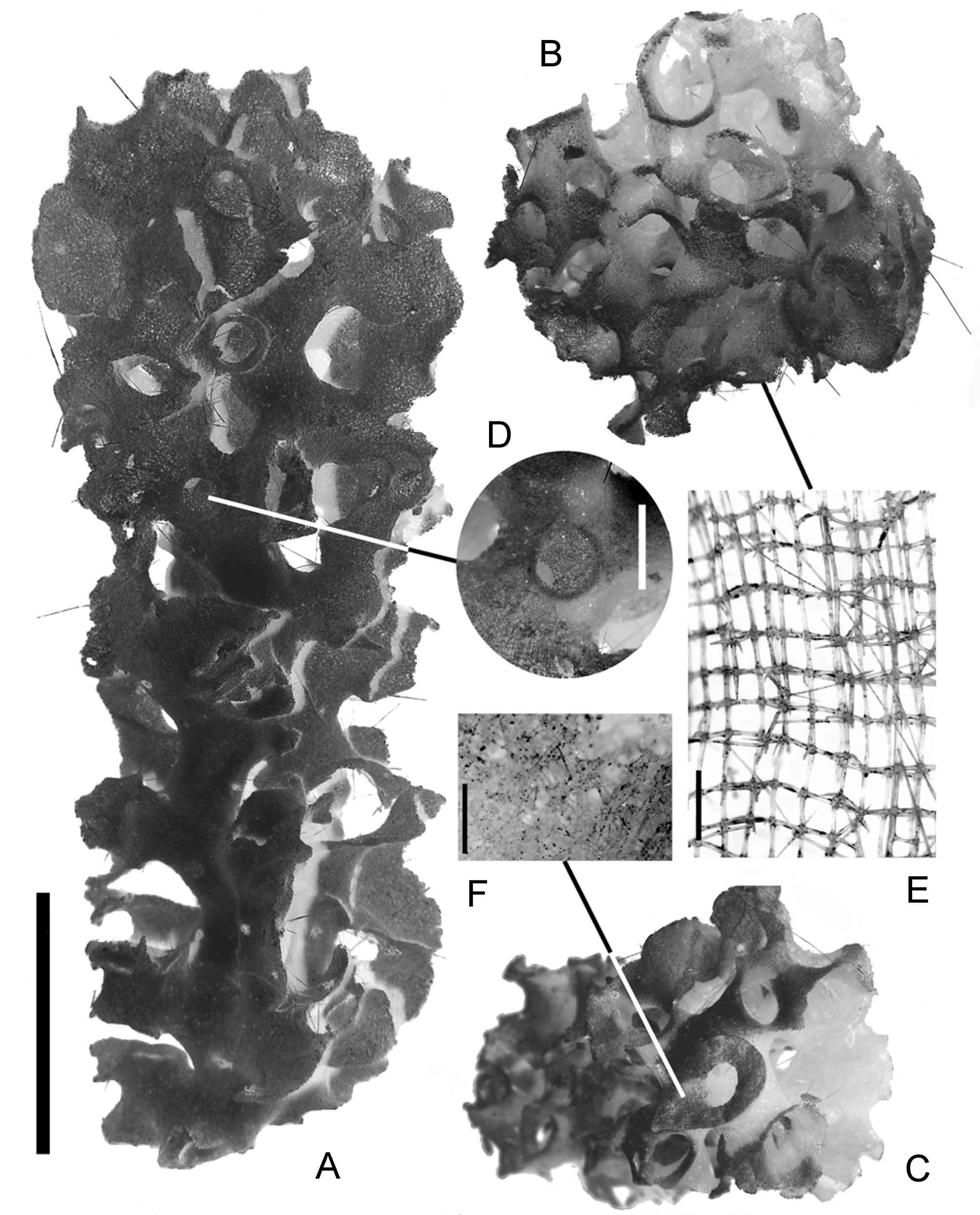
Aspidoscopulia is a genus of glass sponge in the family Farreidae.
Oopsacas minuta
species of sponge

Atlantisella
Atlantisella is a genus of glass sponges (Hexactinellids) belonging to the family Euplectellidae, first described in 2002 by Konstantin Tabachnick.
Lanuginellinae
thumb|right|Caulophacus elegans, illustration in: Report on the scientific results of the voyage of H.M.S. Challenger during the years 1873-76 - under the command of Captain George S. Nares, R.N., F.R.S. and Captain Frank Turle Thomson, R.N. (1887).
Lanuginellinae is a subfamily of glass sponges belonging to the family Rossellidae.
Fieldingiidae
Fieldingiidae is a family of sponges belonging to the order Sceptrulophora.

Sceptrulophora
Sceptrulophora (from Ancient Greek, σκῆπτρον, skêptron - "sceptre" and -φόρος, -phóros - "bearing") is an order of hexactinellid sponges (glass sponges). They are characterized by sceptrules, a type of microsclere (microscopic spicule) with a single straight rod terminating at a bundle of spines or knobs. An anchor- or nail-shaped sceptrule is called a clavule. A fork-shaped sceptrule, ending at a few large tines, is called a scopule. A broom-shaped sceptrule, ending at many small bristles, is called a sarule.

Lonchiphora
Lonchiphora is a genus of glass sponge in the family Farreidae.
Auloplacidae
Auloplacidae is a family of sponges belonging to the order Sceptrulophora.
Chonelasmatinae
Chonelasmatinae is a subfamily of sea sponge in the family Euretidae.