Category
page 1Historical Vedic religion
'%20(11151912296).jpg)
Brahmin
thumb|Brahmins worshipping river Ganges, The Land of Temples (India), 1882
Brahmin (; ) is a varna (theoretical social classes) within Hindu society. The other three varnas are the Kshatriya (rulers and warriors), Vaishya (traders, merchants, and farmers), and Shudra (labourers). The traditional occupation of Brahmins is that of priesthood (purohit, pandit, or pujari) at Hindu temples or at socio-religious ceremonies, and the performing of rite of passage rituals, such as solemnising a wedding with hymns and prayers.

Vedic period
ancient South Asian historical period
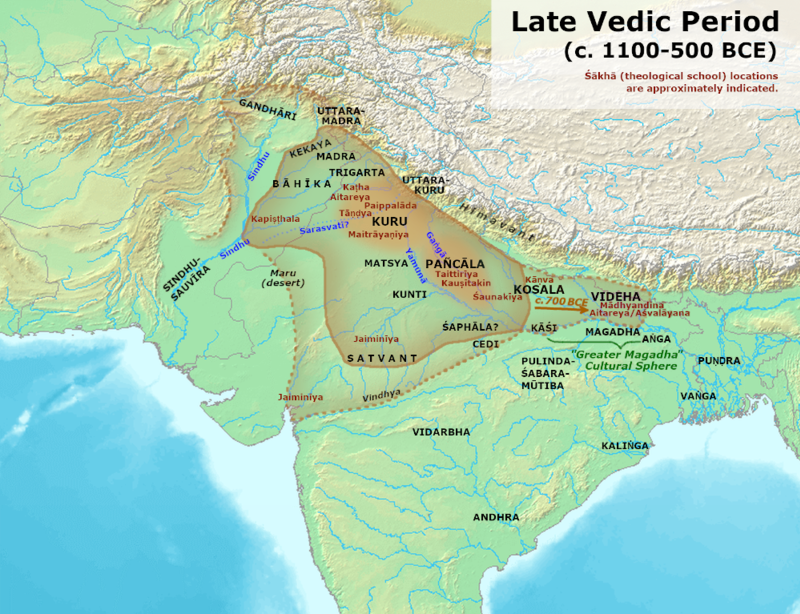
Historical Vedic religion
1500–500 BC Indo-Aryan religious practices of northwest India
%2C%20Benares%20Sanskrit%20college%2C%20Edward%20Cowell%20collection%2C%20sample%20i%2C%20Sanskrit%2C%20Devanagari.jpg)
Brahmana
thumb|upright=1.25|A 17th-century manuscript page of Sadvimsha Brahmana, a Pañcaviṃśa-Brāhmaṇa supplement (Sanskrit, Devanagari). It is found embedded in the Samaveda.
The Brahmanas (; Sanskrit: , IAST: Brāhmaṇam) are Vedic śruti works attached to the Samhitas (hymns and mantras) of the Rig, Sama, Yajur, and Atharva Vedas. They are a secondary layer or classification of Sanskrit texts embedded within each Veda, which explain and instruct on the performance of Vedic rituals (in which the related Samhitas are recited). In addition to explaining the symbolism and meaning of the Samhitas, Brahmana

Rta
In the Vedic religion, Ṛta (/ɹ̩t̪ɐ/; Sanskrit '' "order, rhythm, rule; truth; logos") is the principle of natural order which regulates and coordinates the operation of the universe and everything within it. In the hymns of the Vedas, Ṛta is described as that which is ultimately responsible for the proper functioning of the natural, moral and sacrificial orders. Conceptually, it is closely allied to the injunctions and ordinances thought to uphold it, collectively referred to as Dharma, and the action of the individual in relation to those ordinances, referred to as Karma – two terms which eve

satya
thumb|360px| is an important concept and virtue in Indian religions. [[Rigveda, dated to be from , offers the earliest discussion of . It appears in the fifth and sixth lines in this Rigveda manuscript image.]]' (Sanskrit: ; IAST: ) is a Sanskrit word, usually translated as "truth" or "essence'.“ Across Indian religions, satya is a deeply valued virtue, signifying the alignment of one's thoughts, speech, and actions with reality. In Yoga philosophy, particularly in Patañjali's Yoga Sutras, Satya is one of the five yamas—moral restraints designed to cultivate truthfulness and prevent the distor