Category
page 1History of Siberia
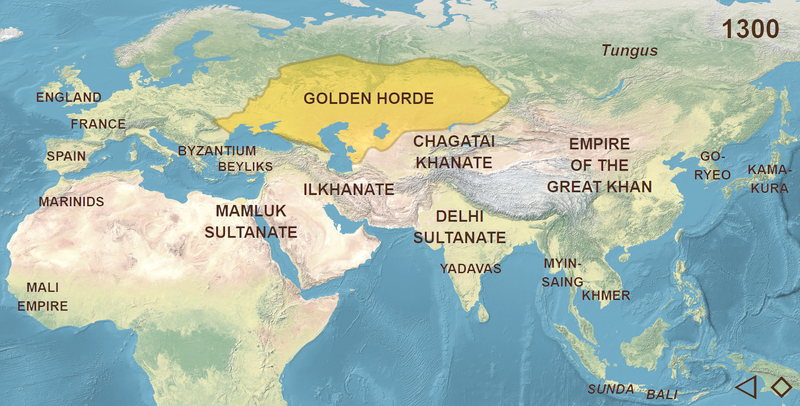
Golden Horde
medieval state in Eurasia

Tunguska event
powerful explosion that occurred near the Podkamennaya Tunguska River

Siberian Khanate
Turkic Khanate located in southwestern Siberia with a Turco-Mongol ruling class

history of Mongolia
aspect of history

Transbaikal
300px|thumb|Chita, Zabaykalsky Krai|Chita is the main city of Transbaikalia
thumb|Eastern Siberia is highlighted
thumb|The Russian-Chinese borderland in the mid-19th century with Daooria
Transbaikal, Trans-Baikal, Transbaikalia (), or Dauria (, Dauriya) is a mountainous region to the east of or "beyond" (trans-) Lake Baikal at the south side of the eastern Siberia and the south-western corner of the Far Eastern Russia.
Colonization of Siberia
process of incorporation Siberia and Northern Far East into Russia since 1550s untill 1700s

Johann Georg Gmelin
German and Russian scientist (1709-1755)
Siberia
ancient continent

katorga
thumb|350px|Removing of shackles, painting by Aleksander Sochaczewski (1843–1923)
Katorga (, ; from medieval and modern ; and Ottoman Turkish: , ) was a system of penal labor in the Russian Empire and the Soviet Union (see Katorga labor in the Soviet Union).
Siberian Route
road
Nikolai Rezanov
Russian noble and explorer (1764-1807)
Sabir people
historical ethnical group
Siberian Intervention
1918 war

Mangazeya
thumb|Materials of archaeological excavations in Mangazeya (State Historical Museum, [[Moscow)]]
Mangazeya () was a Northwest Siberian trans-Ural trade colony and later city in the 17th century. Founded in 1600 by Cossacks from Tobolsk, it was situated on the Taz River, between the lower courses of the Ob and Yenisei Rivers flowing into the Arctic Ocean. The name derives from a Nenets ethnonym Monkansi or Mongandi.
Yenisei Kirghiz
ancient Turkic people who dwelled along the upper Yenisei River in the southern portion of the Minusinsk Depression from the 3rd century BCE to the 13th century CE

Yasak
thumb|
history of Siberia
aspect of history
Yeniseysk Governorate
Governate of the Russian Empire, Republic, and RSFSR
Salekhard–Igarka Railway
railway line
.png)
Dingling
The Dingling were an ancient people who appear in Chinese historiography in the context of the 1st century BCE.
Siberia Governorate
governorate of the Russian Empire
Great Northern Expedition
research expedition in Siberia (1733–1743)

Yugra
thumb|Yugran principalities in the 15th century.
Siberian Cossacks
Cossacks who settled in the Siberian region of Russia from the end of the 16th century
Great Siberian Ice March
1919–20 White Army retreat during the Russian Civil War
Sino-Russian border conflicts
series of conflicts between China and Russia

Sybirak
400px|thumb|Farewell to Europe, by Aleksander Sochaczewski.
A sybirak (, plural: sybiracy) is a person resettled to Siberia. Like its Russian counterpart sibiryák, the word can refer to any dweller of Siberia, but it more specifically refers to Poles imprisoned or exiled to Siberia
or even to those sent to the Russian Arctic or to Kazakhstan
Siberian Republic
former country
%20(1790).png)
Zashiversk
thumb|150 px|Coat of arms of Zashiversk (1790; the upper half reproduces Irkutsk#Emblem|coat of arms of Irkutsk).

Dongdan Kingdom
established by Yelü Bei (926-930)
Ingala Valley
archaeological site in Isetsky District, Russia

American Expeditionary Force
1918 formation of the United States Army in Siberia during the Russian Civil War
Provisional Siberian Government
Short-lived government in Russian Civil War
Kurykans
The Kurykans ( pinyin: Gǔlìgān H-kɑn) were a Turkic Tiele tribe, that inhabited the Lake Baikal area in the 6th century CE. Early Kurykans migrated from the area of the Yenisey river.
Siberian regionalism
Siberian separatism from the 19th century onwards

special settlements in the Soviet Union
involuntary settlements for deported minorities in the Soviet Union
Battle of Chuvash Cape
1582 Russian expedition that led to the fall of Khanate of Sibir and the end of Khan Kuchum's power
Golden Woman
idol statue godess
Amur Annexation
annexation of the Left Bank of the Amur River in 1858 and Right Bank of the Ussuri River in 1860 by Russian Empire
koekchuch
Koekchuch is an extinct gender identity recorded among the Itelmens of Siberia. These were male assigned at birth individuals who behaved as women did, and were recorded in the late 18th century and early 19th century.
Babinov Road
road in Russia
First Kamchatka Expedition
research expedition (1725-1730)
Daniel Gottlieb Messerschmidt
German scientist (1685-1735)
West Siberian Glacial Lake
periglacial lake of the Weichselian Glaciation
Siberian River Routes
Afanasy Shchapov
Russian historian (1831-1876)
Provisional Siberian Government
provisional government (1918)
Tartarian Empire
alleged lost empire
Honghuzi
right|thumb|upright=1.1|Honghuzi during the Battle of Mukden (1905)
Oglakhty
thumb|Tashtyk culture [[funeral masks in the Hermitage Museum]]
Oglahty (, ) is a mountain range and a burial complex of Tashtyk culture located 60 km north of Minusinsk, Khakassia, Russia, on the right bank of Yenisei River. Oglahty burials are dated to the 1st century BC. The burials were first surveyed in 1903 by A.V. Adrianov. The dryness of the soil and favorable climatic conditions in the burial monument preserved perishable materials including wood, leather, fur, and fabrics. A prominent place among artifacts in the Oglahty complex occupy solid and decorated polychromatic fabrics.
Conquest of the Khanate of Sibir
1582 first Russian conquest in Siberia
Anadyrsk
thumb|Anadyrsk was on the east–west part of the Anadyr River at the point where it swings north
Eastern Front of the Russian Civil War
siberian front of the Russian Civil War
Siberian Baroque
Battle of the Songhua River
1654 battle
Akatuy katorga
Russian imperial prison
Irbit Fair

Alfons Koziełł-Poklewski
Polish industrialist and entrepreneur (1809–1890)
Siberian Military District
formerly part of the armed forces of the Russian Federation
Viktor Pepelyayev
Russian politician (1885-1920)