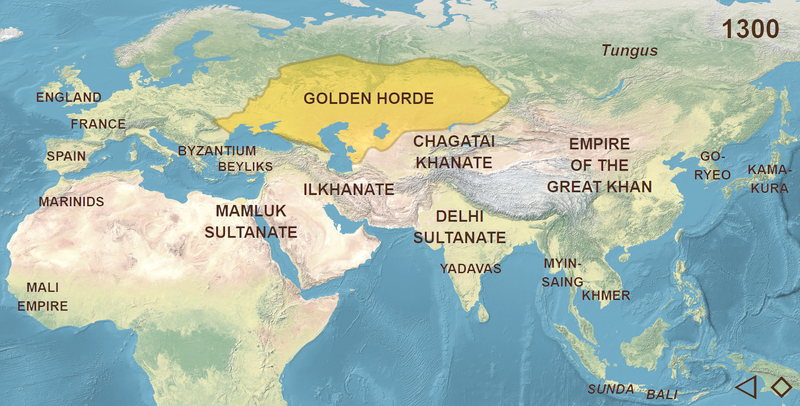
File:Map_of_the_Golden_Horde_(with_text).png · Wikimedia Commons · See Wikimedia Commons
Golden Horde
Sign in to saveAlso known as Great Horde, Ulug Ulus, Kipchak Khanate, Ulus of Jochi
medieval state in Eurasia
The Golden Horde was a medieval state in Eurasia that played a significant role in shaping the political and cultural landscape of Eastern Europe and Asia during the Middle Ages. It matters historically because of its influence on the regions it controlled and its impact on the societies that came into contact with it.
AI-generated from the Wikipedia summary — may contain errors.
Wikidata facts
- Instance of
- horde
- Official name
- Uluğ Ulus
- Religion
- Tengrism
- Country
- Golden Horde
- Continent
- Eurasia
- Capital
- Bolğar
- Official language
- Kipchak
- Currency
- som
- Area
- 6000000
- Form of government
- monarchy
- Legislature
- kurultai
- Image
- Golden Horde in the Catalan Atlas (1375).jpg
Show 11 more facts
- described by source
- Encyclopædia Britannica 11th edition
- topic's main category
- Category:Golden Horde
- Commons category
- Golden Horde
- dissolved, abolished or demolished date
- 1502-06-28
- inception
- 1243-00-00
- official religion
- Buddhism
- language used
- Uyghur
- native label
- Олуг Олыс
- on focus list of Wikimedia project
- Wikipedia:Vital articles/Level/4
- madhhab
- Hanafism
- P8168
- Huang Xu
Sources (9)
via Wikidata · CC0
~40 min read
Encyclopedic overview
The Golden Horde, or Ulus of Jochi, self-designated as Ulug Ulus (lit. 'Great State' in Turkic), was originally a Mongol and later Turkicized khanate established in the 13th century, originating from the northwestern part of the Mongol Empire. After the division of the empire in 1259, it became a functionally independent khanate. It is also known as the Kipchak Khanate, and replaced the earlier, less organized Cuman–Kipchak confederation.
It originally consisted of the lands bequeathed to Jochi (d. 1225). It grew greatly in size under Batu Khan, the founder of the Blue Horde. After Batu's death in 1255, his dynasty flourished for a full century, until 1359, though the intrigues of Nogai instigated a partial civil war in the late 1290s. The Horde's military power peaked during the reign of Özbeg Khan (1312–1341), who adopted Islam. The territory of the Golden Horde at its peak extended from Siberia and Central Asia to parts of Eastern Europe from the Urals to the Danube in the west, and from the Black Sea to the Caspian Sea in the south, while bordering the Caucasus Mountains and the territories of the Mongol dynasty known as the Ilkhanate.
Excerpted from Wikipedia’s “Golden Horde” article, available under the CC BY-SA 4.0 licence.
Gallery (12)
Available in 94 languages
- Español
- Français
- Deutsch
- 中文
- 日本語
- Русский
- Português
- Italiano
- العربية
- हिन्दी
- Achinese
- Afrikaans
- Albanian
- Aragonese
- Armenian
- Asturian
- azb
- Azerbaijani
Show 75 more
- Bahasa Indonesia
- Bangla
- Bashkir
- Basque
- be_x_old
- Belarusian
- Bosnian
- Bulgarian
- Buriat
- Catalan
- Central Kurdish
- Chuvash
- Crimean Tatar
- Croatian
- Czech
- Danish
- Egyptian Arabic
- Esperanto
- Estonian
- Filipino
- Finnish
- Galician
- Georgian
- Greek
- Hebrew
- Hungarian
- Icelandic
- Irish
- Kazakh
- Kyrgyz
- Lao
- Latin
- Latvian
- Lingua Franca Nova
- Lithuanian
- Macedonian
- Malagasy
- Malay
- Malayalam
- Mingrelian
- Mongolian
- Nederlands
- Norwegian
- Norwegian Nynorsk
- Occitan
- Ossetic
- Pashto
- Polski
- Punjabi
- Romanian
- Rusyn
- Scots
- Serbian
- Serbian (Latin)
- Slovak
- Slovenian
- Svenska
- syl
- Tajik
- Tamil
- Tatar
- Tiếng Việt
- Türkçe
- Ukrainian
- Urdu
- Uzbek
- Welsh
- Western Panjabi
- Wu Chinese
- Yakut
- zh_min_nan
- zh_yue
- فارسی
- ไทย
- 한국어
via Wikidata sitelinks · CC0