Category
page 1Holiday characters

Santa Claus
Santa Claus is a legendary figure originating in Western Christian culture who is said to bring gifts during the late evening and overnight hours on Christmas Eve. Christmas elves are said to make the gifts in Santa's workshop, while flying reindeer pull his sleigh through the air.

Cupid
In classical mythology, Cupid ( , meaning "passionate desire") is the god of desire, erotic love, attraction and affection. He is often portrayed as the son of the love goddess Venus and the god of war Mars. He is also known as Amor (Latin: '''', "love"). His Greek counterpart is Eros.
Although Eros is generally portrayed as a slender winged youth in Classical Greek art, during the Hellenistic period, he was increasingly portrayed as a chubby boy. During this time, his iconography acquired the bow and arrow that represent his source of power: a person, or even a deity, who is shot by Cupid's a

Saint Valentine
Saint Valentine was a 3rd-century Roman saint, commemorated in Western Christianity on February 14 and in Eastern Orthodoxy on July 6. From the High Middle Ages, his feast day has been associated with a tradition of courtly love. He is also a patron saint of Terni, epilepsy, and beekeepers. Saint Valentine was a clergyman – either a priest or a bishop – in the Roman Empire who ministered to persecuted Christians. He was martyred and his body buried on the Via Flaminia on February 14, which has been observed as the Feast of Saint Valentine since at least the eighth century.

Uncle Sam
personification of the United States of America and its government

Ded Moroz
Christmas figure in Slavic cultures

Easter Bunny
folkloric figure and symbol of Easter

Krampus
thumb|upright|1900s illustration of Saint Nicholas and Krampus visiting a child
The Krampus () is a horned anthropomorphic figure who, in the Central and Eastern Alpine folkloric tradition, is said to accompany Saint Nicholas on visits to children during the night of 5 December (Krampusnacht; "Krampus Night"), immediately before the Feast of St. Nicholas on 6 December. In this tradition, Saint Nicholas rewards well-behaved children with small gifts, while Krampus punishes badly behaved ones with birch rods.

Snegurochka
right|upright|thumb|Snow Maiden (1899) by Victor Vasnetsov
Zwarte Piet
companion of Saint Nicholas in the folklore of the Netherlands and Belgium
Tomte
humanoid mythical creature of Nordic folklore

Cai Shen
alt=Caishen Statue at Gardens by the Bay|thumb|Caishen statue at Singapore's Gardens by the Bay to welcome [[Lunar New Year 2024.]]
La Calavera Catrina
1910–1913 sketching by José Guadalupe Posada
Luce
mascot of the 2025 Jubilee
Jack Frost
personification of frost and cold weather
Hajji Firuz
character in Iranian folklore who appears in the streets by the beginning of Nowruz
Nian
A nian beast () is a beast in Chinese mythology. According to Chinese mythology, the nian lives under the sea or in the mountains. The Chinese character nian more usually means "year" or "new year". The earliest written sources that refer to the nian as a creature date to the early 20th century. As a result, it is unclear whether the nian creature is an authentic part of traditional folk mythology, or a part of a local oral tradition that was recorded in the early 20th century. Nian is one of the key characters in the Chinese New Year. Scholars cite it as the reason behind several practices du
Sanxing
the gods of the three stars in Chinese religion
Amoo Norooz
character from Iranian folklore
Father Time
personification of time passing
May Queen
personification of the May Day holiday, and of springtime and also summer, often part of Pentecostal traditions
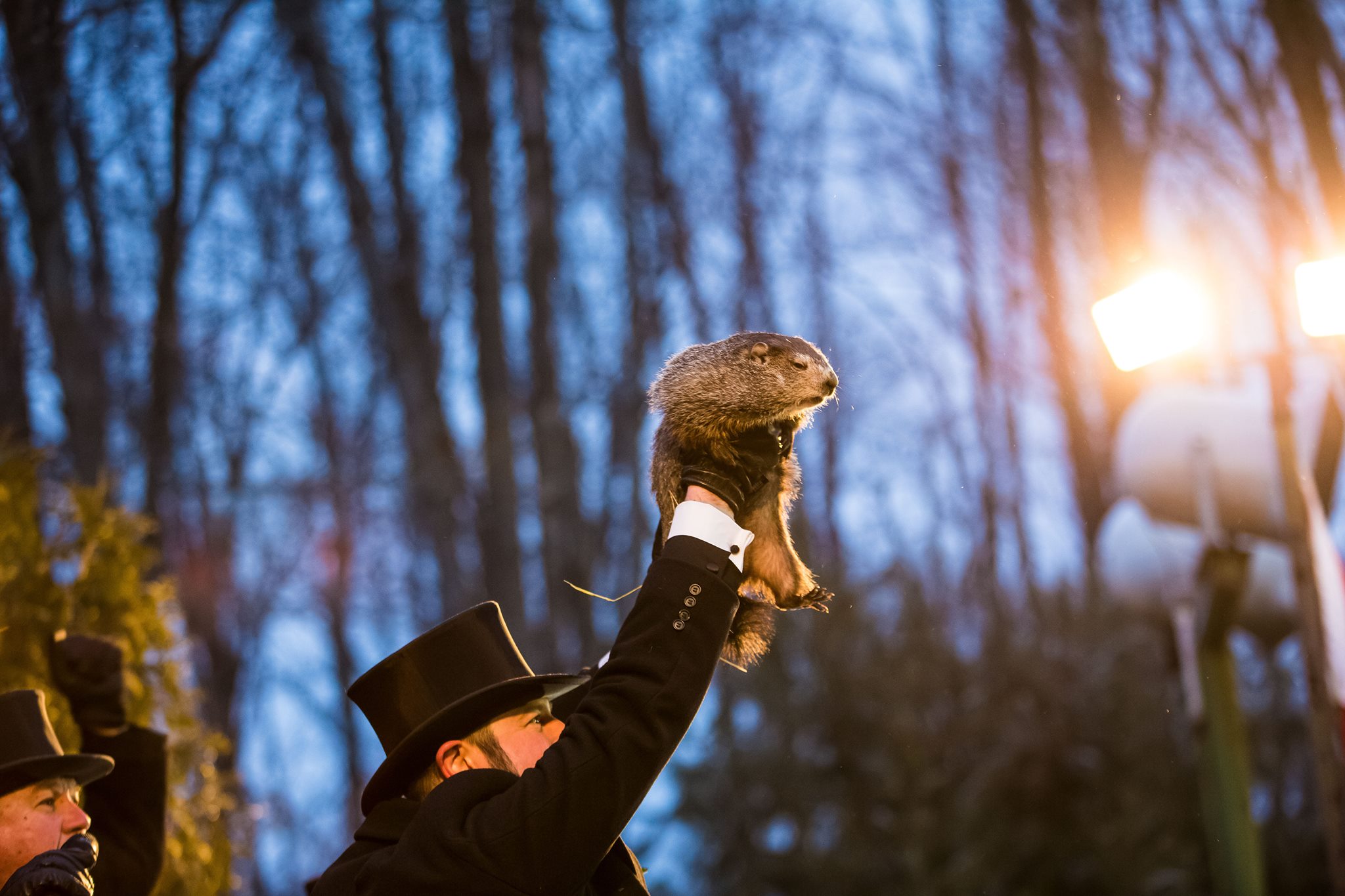
Punxsutawney Phil
Punxsutawney Phil is a groundhog residing in Young Township near Punxsutawney, Pennsylvania, United States, who is the central figure in Punxsutawney's annual Groundhog Day celebration.
Naneh Sarma
mythical character in Iranian folklore

Baby New Year
personification of the New Year
Easter Bilby
Australian holiday character
The Great Pumpkin
fictional character