Category
page 1Human head and neck

ear
In vertebrates, an ear is the organ that enables hearing and (in mammals) body balance using the vestibular system. In humans, the ear is described as having three parts: the outer ear, the middle ear and the inner ear. The outer ear consists of the auricle, the visible outer part, and the ear canal. The middle ear includes the tympanic cavity and the three ossicles. The inner ear sits in the bony labyrinth, and contains structures which are key to several senses: the semicircular canals, which enable balance and eye tracking when moving; the utricle and saccule, which enable balance when stat

nose
A nose is a sensory organ and respiratory structure in vertebrates. It consists of a nasal cavity inside the head, and an external nose on the face. The external nose houses the nostrils, or nares, a pair of tubes providing airflow through the nose for respiration. Where the nostrils pass through the nasal cavity they widen, are known as nasal fossae, and contain turbinates and olfactory mucosa. The nasal cavity also connects to the paranasal sinuses (dead-end air cavities for pressure buffering and humidification). From the nasal cavity, the nostrils continue into the pharynx, a switch track

mouth
A mouth, also referred to as the oral, is the body orifice through which many animals ingest food and vocalize. The body cavity immediately behind the mouth opening, known as the oral cavity (or ''' in Latin), is also the first part of the alimentary canal, which leads to the pharynx and the gullet. In tetrapod vertebrates, the mouth is bounded on the outside by the lips and cheeks — thus the oral cavity is also known as the buccal cavity (from Latin ', meaning "cheek") — and contains the tongue on the inside. Except for some groups like birds and lissamphibians, vertebrates usually have teeth

neck
The neck is the part of the body in many vertebrates that connects the head to the torso. It supports the weight of the head and protects the nerves that transmit sensory and motor information between the brain and the rest of the body. Additionally, the neck is highly flexible, allowing the head to turn and move in all directions. Anatomically, the human neck is divided into four compartments: vertebral, visceral, and two vascular compartments. Within these compartments, the neck houses the cervical vertebrae, the cervical portion of the spinal cord, upper parts of the respiratory and digesti

lip
The lips are a horizontal pair of soft appendages attached to the jaws and are the most visible part of the mouth of many animals, including humans. Mammal lips are soft, movable and serve to facilitate the ingestion of food (e.g. suckling and gulping) and the articulation of sound and speech. Human lips are also a somatosensory organ, and can be an erogenous zone when used in kissing and other acts of intimacy.

skull
The skull, or cranium, is typically a bony enclosure around the brain of a vertebrate. In some fish and amphibians, the skull is of cartilage. The skull is at the head end of the vertebrate.

cheek
The cheeks () constitute the area of the face below the eyes and between the nose and the left or right ear. Buccal means relating to the cheek. In humans, the region is innervated by the buccal nerve. The area between the inside of the cheek and the teeth and gums is called the vestibule or '''buccal pouch or buccal cavity and forms part of the mouth. In other animals, the cheeks may also be referred to as "jowls'''".

forehead
In human anatomy, the forehead is an area of the head bounded by three features, two of the skull and one of the scalp. The top of the forehead is marked by the hairline, the edge of the area where hair on the scalp grows. The bottom of the forehead is marked by the supraorbital ridge, the bone feature of the skull above the eyes. The two sides of the forehead are marked by the temporal ridge, a bone feature that links the supraorbital ridge to the coronal suture line and beyond. However, the eyebrows do not form part of the forehead.

chin
thumb|Photo showing the chin of a human skull

esophagus
The esophagus (American English) or oesophagus (British English) () is an organ in vertebrates through which food passes, aided by peristaltic contractions, from the pharynx to the stomach. The esophagus is a fibromuscular tube, about long in adult humans, that travels behind the trachea and heart, passes through the diaphragm, and empties into the uppermost region of the stomach. During swallowing, the epiglottis tilts backwards to prevent food from going down the larynx and lungs. The word esophagus is from Ancient Greek οἰσοφάγος (oisophágos), from οἴσω (oísō), future form of φέρω (phérō, "

throat
In vertebrate anatomy, the throat is the front part of the neck, internally positioned in front of the vertebrae. It contains the pharynx and larynx. An important section of it is the epiglottis, separating the esophagus from the trachea (windpipe), preventing food and drinks being inhaled into the lungs. The throat contains various blood vessels, pharyngeal muscles, the nasopharyngeal tonsil, the tonsils, the palatine uvula, the trachea, the esophagus, and the vocal cords. Mammal throats consist of two bones, the hyoid bone and the clavicle. The "throat" is sometimes thought to be synonymous

larynx
The larynx (: larynges or larynxes), commonly called the voice box, is an organ in the top of the neck involved in respiration, producing sound and protecting the trachea against food aspiration. The opening of the larynx into the pharynx, known as the laryngeal inlet, is about 4–5 centimeters in diameter. The larynx houses the vocal cords, and manipulates pitch and volume, which is essential for phonation. It is situated just below where the tract of the pharynx splits into the trachea and the esophagus.

thyroid gland

trachea
The trachea (: tracheae or tracheas), also known as the windpipe, is a cartilaginous tube that connects the larynx to the bronchi of the lungs, allowing the passage of air, and so is present in almost all land vertebrate animals' lungs. The trachea extends from the larynx and branches into the two primary bronchi. At the top of the trachea, the cricoid cartilage attaches it to the larynx. The trachea is formed by a number of horseshoe-shaped rings, joined together vertically by overlying ligaments, and by the trachealis muscle at their ends. The epiglottis closes the opening to the larynx duri

pharynx
The pharynx (: pharynges) is the part of the throat behind the mouth and nasal cavity, and above the esophagus and trachea (the tubes going down to the stomach and the lungs respectively). It is found in vertebrates and invertebrates, though its structure varies across species. The pharynx carries food to the esophagus and air to the larynx. The flap of cartilage called the epiglottis stops food from entering the larynx.

pituitary gland
endocrine gland at the base of the brain. Referred to as the “master gland” because it monitors and regulates many bodily functions through the hormones that it produces, including growth and sexual/reproductive development and function.
.jpg)
jaw
right|thumb|Human jaws viewed from the right
The jaws are a pair of opposable articulated structures at the entrance of the mouth, typically used for grasping and manipulating food. The term jaws is also broadly applied to the whole of the structures constituting the vault of the mouth and serving to open and close it and is part of the body plan of humans and most animals.

dandruff

eyelid
thumb|Blood vessels of the eyelids, front view

laryngeal prominence
protrusion in the human neck formed by the angle of the thyroid cartilage surrounding the larynx

nape
thumb|The uncovered nape of a neck
thumb|Cat carrying a kitten by its nape, known as the "scruff"

pineal gland
small endocrine gland found in most vertebrates, which produces melatonin; in humans, located in the epithalamus, in a groove where the two halves of the thalamus join; its shape and size resembles a pine nut, after which it is named

vocal folds
folds of throat tissues that help to create sounds through vocalization

temple
side of the head behind the eyes

hyoid bone
horseshoe-shaped bone situated in the anterior midline of the neck between the chin and the thyroid cartilage

occipital bone
saucer-shaped membrane bone situated at the back and lower part of the cranium

parietal bone
bone in the human skull which, when joined together, forms the sides and roof of the cranium
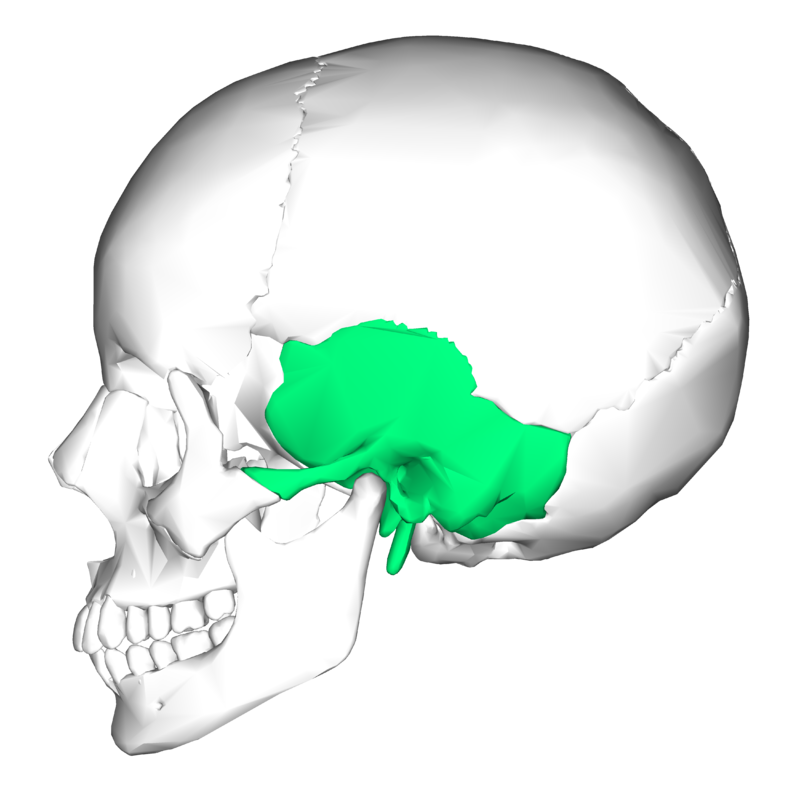
temporal bone
bones situated at the sides and base of the skull, and lateral to the temporal lobes of the cerebrum

phrenology
thumb|Phrenological skull, European, 19th century. Wellcome Collection, London

meninges
In anatomy, the meninges (; meninx ; ) are protective membranes that cover the brain and spinal cord. In mammals, three meninges have been clearly identified: the dura mater, the arachnoid mater, and the pia mater. Each layer has its own molecularly distinct type of fibroblasts. The meninges act as a physical and immunological protective barrier for the brain and spinal cord, shielding the central nervous system (CNS) from injury. They anchor and support the tissues of the CNS, and provide containment for cerebrospinal fluid (CSF) and the arteries and veins that supply blood to the brain and s

vagus nerve
tenth cranial nerve

trigeminal nerve
nerve in human face
cochlea
thumb|3D model of cochlea and semicircular canals
The cochlea is the part of the inner ear involved in hearing. It is a spiral-shaped cavity in the bony labyrinth, in humans making 2.75 turns around its axis, the modiolus. A core component of the cochlea is the organ of Corti, the sensory organ of hearing, which is distributed along the partition separating the fluid chambers in the coiled tapered tube of the cochlea.
oculomotor nerve
cranial nerve III, for eye movements

stapes
The stapes or stirrup is a bone in the middle ear of humans and other tetrapods which is involved in the conduction of sound vibrations to the inner ear. This bone is connected to the oval window by its annular ligament, which allows the footplate (or base) to transmit sound energy through the oval window into the inner ear. The stapes is the smallest and lightest bone in the human body, and is so-called because of its resemblance to a stirrup ().
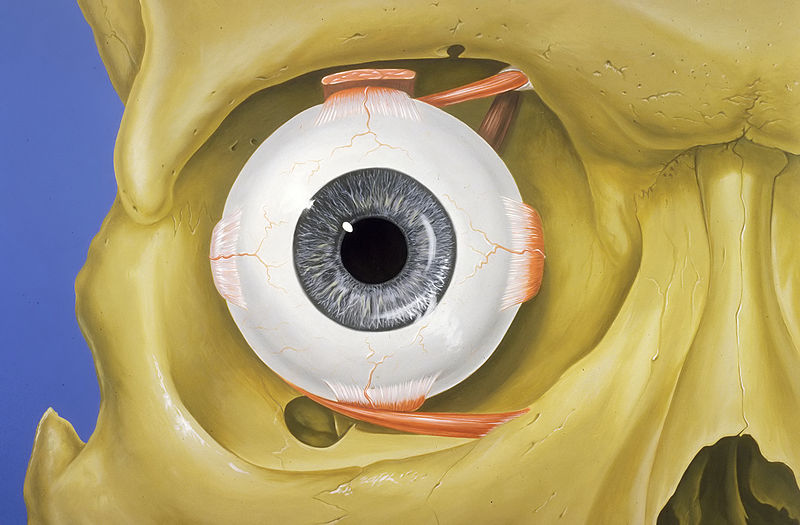
orbit
cavity or socket of the skull in which the eye and its appendages are situated

trochlear nerve
4th cranial nerve

auditory ossicle
The ossicles (also called auditory ossicles) are three irregular bones in the middle ear of humans and other mammals, and are among the smallest bones in the human body. Although the term "ossicle" literally means "tiny bone" (from ) and may refer to any small bone throughout the body, it typically refers specifically to the malleus, incus and stapes ("hammer, anvil, and stirrup") of the middle ear.

paranasal sinus
air filled spaces in nasal cavity

human mouth
part of human anatomy

scalp
The scalp is the area of the head where head hair grows. It is made up of skin, layers of connective and fibrous tissues, and the membrane of the skull. Anatomically, the scalp is part of the epicranium, a collection of structures covering the cranium. The scalp is bordered by the face at the front, and by the neck at the sides and back. The scientific study of hair and scalp is called trichology.
sternocleidomastoid muscle
paired muscle of the neck that traverses the neck between the manubrium sterni and the mastoid process
glottis
The glottis (: glottises or glottides) is the middle region of the larynx, where the vocal folds are located. Within this region is the opening between the vocal folds (the rima glottidis). The glottis is crucial in producing sound from the vocal folds.
glossopharyngeal nerve
9th cranial nerve, mixed nerve that carries afferent sensory and efferent motor information
vestibulocochlear nerve
eighth cranial nerve
vocal tract
anatomical cavity that filters vocalizations
respiratory tract
the part of the anatomy involved with the process of respiration
anterior pituitary
glandular, anterior lobe that, together with the posterior lobe, makes up the pituitary gland
orbicularis oculi muscle
muscle near the eye
temporomandibular joint
Joints connecting the jawbone to the skull
shrunken head
specially prepared human head
human nose
feature of the face
Glabella
The glabella, in humans, is the area of skin between the eyebrows and above the nose. The term also refers to the underlying bone that is slightly depressed, and joins the two brow ridges. It is a cephalometric landmark that is just superior to the nasion.
tracheitis
Tracheitis is an inflammation of the trachea.
Although the trachea is usually considered part of the lower respiratory tract, in ICD-10 tracheitis is classified under "acute upper respiratory infections".
semicircular canal
tube located inside the ear
tympanic cavity
small cavity surrounding the bones of the middle ear
human head
upper portion of the human body
digastric muscle
muscle located under the jaw
internal jugular vein
paired vein collecting the blood from the brain, the superficial parts of the face, and the neck
thyroid cartilage
largest of the nine cartilages that make up the laryngeal skeleton