Category
page 1Hydrogen

hydrogen
Hydrogen is a chemical element; it has the symbolH and atomic number1. It is the lightest and most abundant chemical element in the universe, constituting about 75% of all normal matter. Under standard conditions, hydrogen is a gas of diatomic molecules with the formula, called dihydrogen, or sometimes hydrogen gas, molecular hydrogen, or simply hydrogen. Dihydrogen is colorless, odorless, non-toxic, and highly combustible. Stars, including the Sun, mainly consist of hydrogen in a plasma state, while on Earth, hydrogen is found as the gas (dihydrogen) and in molecules, such as in water and org

hydrogenation
thumb|
Steps in the hydrogenation of a C=C double bond at a catalyst surface, for example Ni or Pt :
(1) The reactants are Adsorption|adsorbed on the catalyst surface and H2 dissociates.
(2) An H atom bonds to one C atom. The other C atom is still attached to the surface.
(3) A second C atom bonds to an H atom. The molecule leaves the surface.

antihydrogen
thumb|right|upright=1.2|Antihydrogen consists of an antiproton and a [[positron]]
thumb|right|upright=1.2|Simplified model of an antihydrogen atom in ground state

isotope of hydrogen
hydrogen with different numbers of neutrons
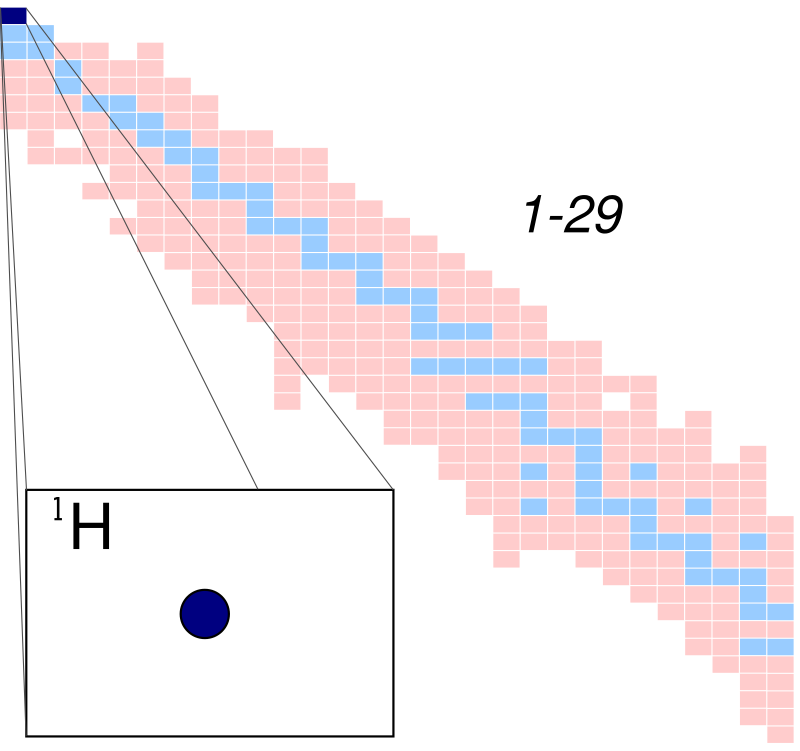
hydrogen atom
atom of element hydrogen
metallic hydrogen
phase of hydrogen
liquid hydrogen
liquid state of the element hydrogen

dehydrogenation
In chemistry, dehydrogenation is a chemical reaction that involves the removal of hydrogen, usually from an organic molecule. It is the reverse of hydrogenation. Dehydrogenation is important, both as a useful reaction and a serious problem. At its simplest, it is a useful way of converting alkanes, which are relatively inert and thus low-valued, to olefins, which are reactive and thus more valuable. Alkenes are precursors to aldehydes (), alcohols (), polymers, and aromatics. As a problematic reaction, the fouling and inactivation of many catalysts arises via coking, which is the dehydrogenati
hydron
In chemistry, the hydron, informally called proton, is the cationic form of atomic hydrogen, represented with the symbol . The general term "hydron", endorsed by IUPAC, encompasses cations of hydrogen regardless of isotope: thus it refers collectively to protons (H) for the protium isotope, deuterons (H or D) for the deuterium isotope, and tritons (H or T) for the tritium isotope.
Hydrogen Line Spectrum
important atomic emission spectra
hydrogen line
spectral line of hydrogen state transitions
Sabatier reaction
methanation process of carbon dioxide with hydrogen
helium planet
A planet with a helium-dominated atmosphere
hydrogen deuteride
isotopic compound composed of one protium atom and one deuterium atom
hydrogen embrittlement
reduction in ductility of a metal exposed to hydrogen

biohydrogen
thumb|Microbial hydrogen production.
Biohydrogen is H2 that is produced biologically. Interest is high in this technology because H2 is a clean fuel and can be readily produced from certain kinds of biomass, including biological waste. Furthermore some photosynthetic microorganisms are capable of producing H2 directly from water splitting using light as energy source.
Devarda's alloy
alloy of aluminium, copper and zinc
Hydrogenolysis
Hydrogenolysis is a chemical reaction whereby a carbon–carbon or carbon–heteroatom single bond is cleaved or undergoes lysis (breakdown) by hydrogen. The heteroatom may vary, but it usually is oxygen, nitrogen, or sulfur. A related reaction is hydrogenation, where hydrogen is added to the molecule, without cleaving bonds. Usually hydrogenolysis is conducted catalytically using hydrogen gas.
Bosch reaction
forms elemental carbon from CO2 and hydrogen using a metallic catalyst

aromatization
Aromatization is a chemical reaction in which an aromatic system is formed from a single nonaromatic precursor. Typically aromatization is achieved by dehydrogenation of existing cyclic compounds, illustrated by the conversion of cyclohexane into benzene. Aromatization includes the formation of heterocyclic systems.
center|422px|thumb|The conversion of methylcyclohexane to [[toluene is a classic aromatization reaction. This platinum (Pt)-catalyzed process is practiced on scale in the production of gasoline from petroleum.]]
Hydrogen safety
procedures for safe production, handling and use of hydrogen
triatomic hydrogen
unstable allotrope of hydrogen
native hydrogen
hydrogen that is formed by natural process
hydrogen cycle
hydrogen exchange between the living and non-living world
hydrogen oxidizing bacteria
term in biology
Spin isomers of hydrogen
spin states of hydrogen
Hydrogen Council
Belgium-based industry group
nascent hydrogen
outdated concept for reactive hydrogen
hydrogen compound
class of chemical compounds