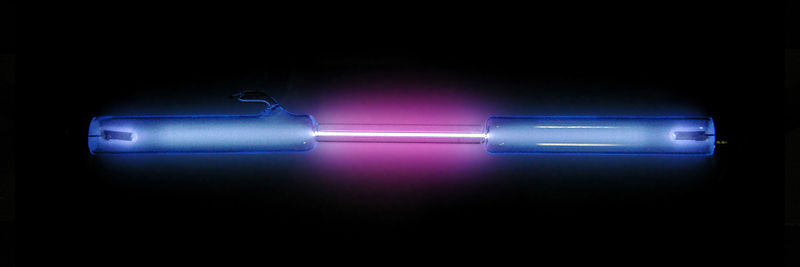
File:Hydrogen_discharge_tube.jpg · Wikimedia Commons · See Wikimedia Commons
hydrogen
Sign in to saveAlso known as element 1
Hydrogen is a chemical element; it has the symbolH and atomic number1. It is the lightest and most abundant chemical element in the universe, constituting about 75% of all normal matter. Under standard conditions, hydrogen is a gas of diatomic molecules with the formula, called dihydrogen, or sometimes hydrogen gas, molecular hydrogen, or simply hydrogen. Dihydrogen is colorless, odorless, non-toxic, and highly combustible. Stars, including the Sun, mainly consist of hydrogen in a plasma state, while on Earth, hydrogen is found as the gas (dihydrogen) and in molecules, such as in water and org
OverviewAI-generated
Hydrogen is a chemical element with the symbol H and atomic number 1. It is classified as an atmophile element, a nonmetal, an s-block element, and a reducing agent. The element has an oxidation state of -1, 1, or 0 and an electronegativity of 2.2. Its antiparticle is antihydrogen.
The substance was discovered in 1766 by Henry Cavendish, Mikhail Lomonosov, and Antoine Lavoisier in the Russian Empire, the United Kingdom, and France. It is part of period 1 and group 1, and is a component of water. Physical properties include a mass of 1.008, a density of 0.089870, a refractive index of 1.000132, a speed of sound of 1270, and a thermal conductivity of 0.1805.
Synthesized by Vinony from 25 facts across 3 sources: Wikidata, PubMed, Vinony graph. Generated from structured data (not the Wikipedia text) and checked against those facts — may still contain errors.
Research
860,653 papers- Hydrogen from Water is more than a Fuel: Hydrogenations and Hydrodeoxygenations for a Biobased Economy.ReviewChemical record (New York, N.Y.) · 2021Harnisch F, Morejón MCDOI: 10.1002/tcr.202100034
- Development of Liquid Organic Hydrogen Carriers for Hydrogen Storage and Transport.ReviewInternational journal of molecular sciences · 2024Le TH, Tran N, Lee HJDOI: 10.3390/ijms25021359
- Hydrogen Production and Utilization in a Membrane Reactor.Journal of visualized experiments : JoVE · 2023Rousseau AR, Stankovic MD, Berlinguette CPDOI: 10.3791/65098
- Photocatalytic Approaches for Hydrogen Production via Formic Acid Decomposition.ReviewTopics in current chemistry (Cham) · 2019Navlani-García M, Salinas-Torres D, Mori K et al.DOI: 10.1007/s41061-019-0253-4
- Benzothiazoline: versatile hydrogen donor for organocatalytic transfer hydrogenation.ReviewAccounts of chemical research · 2015Zhu C, Saito K, Yamanaka M et al.DOI: 10.1021/ar500414x
- A strategy of local hydrogen capture and catalytic hydrogenation for enhanced therapy of chronic liver diseases.Theranostics · 2023Tao G, Liu F, Jin Z et al.DOI: 10.7150/thno.80494
- Carbon neutral hydrogen storage and release cycles based on dual-functional roles of formamides.Nature communications · 2023Wei D, Shi X, Junge H et al.DOI: 10.1038/s41467-023-39309-4
- Structural basis for bacterial energy extraction from atmospheric hydrogen.Nature · 2023Grinter R, Kropp A, Venugopal H et al.DOI: 10.1038/s41586-023-05781-7
via PubMed
~45 min read
Encyclopedic overview
48 sectionsContents
- Properties
- Atomic hydrogen
- Electron energy levels
- Nomenclature
- Isotopes
- Dihydrogen
- Combustion
- Spin isomers
- Phases
- Thermal and physical properties
- History
- 18th century
- 19th century
- 20th century
- Hydrogen-lifted airship
- Deuterium and tritium
- Chemistry
- Reactions of H<sub>2</sub>
- Hydrogen-containing compounds
- Hydrogen bonding
- Protons and acids
- Occurrence
- Cosmic
- Terrestrial
- Production and storage
- Industrial routes
- Steam reforming
- Partial oxidation of hydrocarbons
- Water electrolysis
- Methane pyrolysis
- Thermochemical
- Natural routes
- Biohydrogen
- Serpentinization
- Laboratory syntheses
- Storage
- Applications
- Petrochemical industry
- Hydrogenation
- Fuel
- Nickel–hydrogen battery
- Semiconductor industry
- Niche and evolving uses
- Safety and precautions
- See also
- References
- Further reading
- External links
Hydrogen is a chemical element; it has the symbolH and atomic number1. It is the lightest and most abundant chemical element in the universe, constituting about 75% of all normal matter. Under standard conditions, hydrogen is a gas of diatomic molecules with the formula, called dihydrogen, or sometimes hydrogen gas, molecular hydrogen, or simply hydrogen. Dihydrogen is colorless, odorless, non-toxic, and highly combustible. Stars, including the Sun, mainly consist of hydrogen in a plasma state, while on Earth, hydrogen is found as the gas (dihydrogen) and in molecules, such as in water and organic compounds. The most common isotope of hydrogen, H, consists of one proton, one electron, and no neutrons.
Hydrogen gas was first produced artificially in the 17thcentury by the reaction of acids with metals. Henry Cavendish, in1766–1781, identified hydrogen gas as a distinct substance and discovered its property of producing water when burned: this is the origin of hydrogen's name, which means (from , and ). Understanding the colors of light absorbed and emitted by hydrogen was a crucial part of the development of quantum mechanics.
Excerpted from Wikipedia’s “hydrogen” article, available under the CC BY-SA 4.0 licence.
Gallery (42)
Available in 224 languages
- Español
- Français
- Deutsch
- 中文
- 日本語
- Русский
- Português
- Italiano
- العربية
- हिन्दी
- abstract
- Afrikaans
- Albanian
- Albanian
- Amharic
- Angika
- Aragonese
- Armenian
Show 205 more
- Assamese
- Asturian
- azb
- Azerbaijani
- Bahasa Indonesia
- Balinese
- Bangla
- Bashkir
- Basque
- bat_smg
- Bavarian
- be_x_old
- Belarusian
- Betawi
- Bhojpuri
- Bikol
- blk
- Bosnian
- Breton
- Bulgarian
- Buriat
- Burmese
- Catalan
- cdo
- Cebuano
- Central Kurdish
- Chechen
- Church Slavic
- Chuvash
- Colognian
- Cornish
- Corsican
- Crimean Tatar
- Croatian
- Czech
- Danish
- Divehi
- Egyptian Arabic
- eml
- Erzya
- Esperanto
- Estonian
- Extremaduran
- Faroese
- Fiji Hindi
- Fijian
- Filipino
- Finnish
- Friulian
- Galician
- Gan Chinese
- gcr
- Georgian
- Greek
- Guarani
- Gujarati
- Haitian Creole
- Hakka Chinese
- Hawaiian
- Hebrew
- Hungarian
- hyw
- Icelandic
- Ido
- Iloko
- Inari Sami
- Interlingua
- Interlingue
- Irish
- Jamaican Creole English
- Javanese
- Kabyle
- Kalmyk
- Kannada
- Kanuri
- Kara-Kalpak
- Kashmiri
- Kazakh
- kbp
- kge
- Khmer
- Kikuyu
- Komi
- Komi-Permyak
- Kurdish
- Kyrgyz
- Lao
- Latin
- Latvian
- Lezghian
- Ligurian
- Limburgish
- Lingala
- Lingua Franca Nova
- Lithuanian
- lld
- Lojban
- Lombard
- Low German
- Lower Sorbian
- Luxembourgish
- Macedonian
- Madurese
- Malagasy
- Malay
- Malayalam
- Maltese
- Manipuri
- Manx
- Māori
- Marathi
- Mari
- Mingrelian
- Mirandese
- Moksha
- Mongolian
- Moroccan Arabic
- nah
- Navajo
- nds_nl
- Nederlands
- Nepali
- Newari
- Northern Frisian
- Norwegian
- Norwegian Nynorsk
- Novial
- Occitan
- Odia
- Old English
- olo
- Oromo
- Ossetic
- Palatine German
- Papiamento
- Pashto
- Piedmontese
- Polski
- Pontic
- Punjabi
- Quechua
- roa_rup
- Romanian
- rsk
- Rusyn
- Sanskrit
- Santali
- Sardinian
- Saterland Frisian
- Scots
- Scottish Gaelic
- Serbian
- Serbian (Latin)
- Shona
- Sicilian
- Silesian
- simple
- Sindhi
- Sinhala
- skr
- Slovak
- Slovenian
- Somali
- Standard Moroccan Tamazight
- Sundanese
- Svenska
- Swahili
- Tachelhit
- Tajik
- Tamil
- Tatar
- Telugu
- Tibetan
- Tiếng Việt
- Toki Pona
- Tumbuka
- Türkçe
- Tuvinian
- Ukrainian
- Upper Sorbian
- Urdu
- Uyghur
- Uzbek
- Venetian
- Veps
- Volapük
- Walloon
- Waray
- Welsh
- West Flemish
- Western Frisian
- Western Mari
- Western Panjabi
- Wu Chinese
- Yakut
- Yiddish
- Yoruba
- Zaza
- zh_classical
- zh_min_nan
- zh_yue
- Zulu
- فارسی
- ไทย
- 한국어
via Wikidata sitelinks · CC0