Category
page 1Hypothetical astronomical objects

multiverse
The multiverse is the hypothetical set of all universes. Together, these universes are presumed to comprise everything that exists: the entirety of space, time, matter, energy, information, and the physical laws and constants that describe them. The different universes within the multiverse are called "parallel universes", "flat universes", "other universes", "alternate universes", "multiple universes", "plane universes", "parent and child universes", "many universes", or "many worlds". One common assumption is that the multiverse is a "patchwork quilt of separate universes all bound by the sa

wormhole
thumb|upright=1.3|A wormhole visualized as a two-dimensional surface. Route (a) is the shortest path through normal space between points 1 and 2; route (b) is a shorter path through a wormhole.

Planet Nine
hypothetical large planet in the far outer Solar System

white hole
hypothetical region of spacetime that serves as the opposite of a black hole
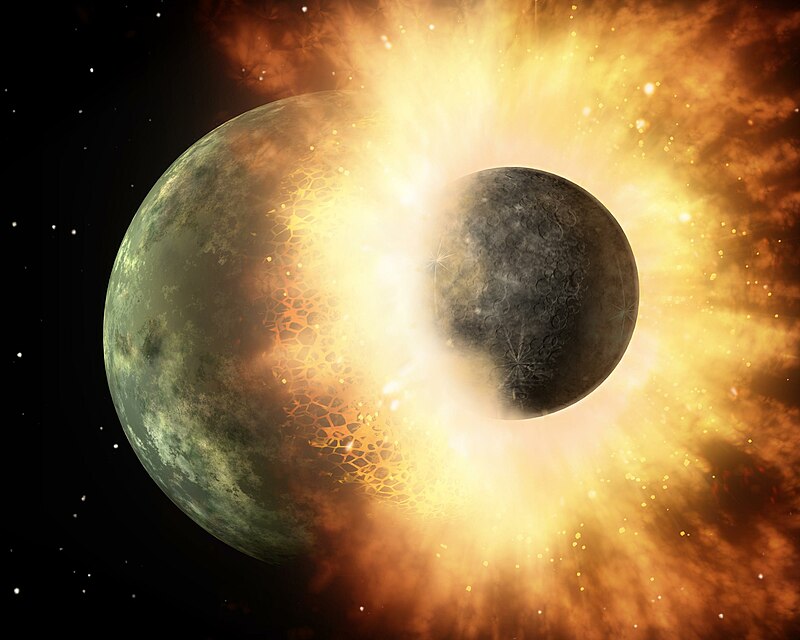
Theia
planet that is hypothesized to have impacted Earth and created the Moon

Dyson sphere
hypothetical megastructure, originally described by Freeman Dyson

Nemesis
hypothetical star orbiting the Sun, responsible of extinction events
Vulcan
hypothetical planet between the Sun and Mercury
Messier 102
Galaxy

Tabby’s Star
binary system in the constellation Cygnus
extrasolar moon
thumb|right|Artist's impression of candidate exomoon Kepler-1625b I orbiting its planet.

Vulcanoid asteroid
right|thumb|270px|The zone, represented by the orange region, in which vulcanoids may exist, compared with the orbits of Mercury (planet)|Mercury, [[Venus and Earth]]
The vulcanoids are a hypothetical population of asteroids that orbit the Sun in a dynamically stable zone inside the orbit of the planet Mercury. They are named after the hypothetical planet Vulcan, which was proposed on the basis of irregularities in Mercury's orbit that were later found to be explained by general relativity. So far, no vulcanoids have been discovered, and it is not yet clear whether any exist.
Tyche
Öpik–Oort Comet Cloud hypothetical planet
planet beyond Neptune
any Solar System planet that might orbit the Sun beyond Neptune
micro black hole
black hole on a quantum level or with quantum effects
dark galaxy
hypothesized galaxy consisting mainly of dark matter with no, or very few, stars
Phaeton
hypothetical former Solar System planet
cosmic string
speculative feature of the early universe
hycean planet
hot, water-covered planet with a hydrogen-rich atmosphere that may harbor lifeforms
natural subsatellite
thumb|Artist's concept of exomoon Kepler-1625b I orbiting exoplanet [[Kepler-1625b. Kepler-1625b I could theoretically have a subsatellite itself.|alt=]]
A subsatellite, also known as a submoon or informally a moonmoon, is a "moon of a moon" or a hypothetical natural satellite that orbits the moon of a planet.
Neith
hypothetical natural satellite of Venus
claimed moons of Earth
claims that Earth may have other natural satellites

Counter-Earth
thumb|250px|right|Philolaus believed there was a "Counter-Earth" (Antichthon) orbiting the "Central Fire" (not labeled) that was not visible from Earth. The upper illustration depicts Earth at night while the lower one depicts Earth in the day.
The Counter-Earth is a hypothetical body of the Solar System that orbits on the other side of the Solar System from Earth, e.g. at the L3 Lagrange point of the Sun–Earth system. A Counter-Earth, or Antichthon (), was hypothesized by the pre-Socratic Greek philosopher Philolaus () to support his non-geocentric cosmology, in which all objects in the unive
Themis
hypothetical moon of Saturn
Mercury's moon
supposed natural satellite orbiting Mercury
Chiron
hypothetical natural satellite of Saturn
list of hypothetical Solar System objects
Wikimedia list article
Quark-nova
A quark-nova is the hypothetical violent explosion resulting from the conversion of a neutron star to a quark star. Analogous to a supernova heralding the birth of a neutron star, a quark nova signals the creation of a quark star. The term quark-novae was coined in 2002 by Rachid Ouyed (currently at the University of Calgary, Canada) and Drs. J. Dey and M. Dey (Calcutta University, India).
Planet V
scientific proposal in 2002 for a destroyed fifth planet
Twin Earth thought experiment
thought experiment by philosopher Hilary Putnam
disrupted planet
planet, or exoplanet or, perhaps on a somewhat smaller scale, a moon or exomoon, that has been disrupted, or destroyed, by a nearby, or passing, astronomical body or object
list of unconfirmed extrasolar planets
Wikimedia list article
Gaia Sausage
Remains of a dwarf galaxy merged with the Milky Way

Synestia
thumb|Artistic impression
A synestia is a hypothesized structure for the debris field generated by the collision of planets: a rapidly spinning doughnut-shaped mass of vaporized rock. The term was coined in 2017 by Sarah T. Stewart-Mukhopadhyay, taken from Hestia, goddess of the hearth, combined with syn- meaning together. In computer simulations of giant impacts of rotating objects, a synestia can form if the total angular momentum is greater than the co-rotational limit. Beyond the co-rotational limit, the velocity at the equator of a body would exceed the orbital velocity.
rings of Earth
hypothetical former ring system around Earth first formally proposed in September of 2024
five-planet Nice model
numerical model of the early Solar System
Coatlicue
star
Fifth planet
any of various hypothetical planets thought to have existed
Type Iax supernova
subtype of Ia supernova
Hubble bubble
variation in the Hubble constant
Antimatter comet
hypothetical object
M32p
M32p is a hypothesized former galaxy that was incorporated into the Andromeda Galaxy. It was a sister galaxy to the Milky Way and Andromeda galaxies, previously the third or fourth largest galaxy in the Local Group, and was merged into the larger Andromeda Galaxy an estimated 2 billion years ago. The merger is thought to have created the thick disc and contributed the majority of the halo stars of Andromeda and caused its burst of star formation at the time of the merger. The former galaxy is likely associated with the Andromeda satellite galaxy Messier 32 (M32), which may be the remains of it