Category
page 1Iguanomorpha
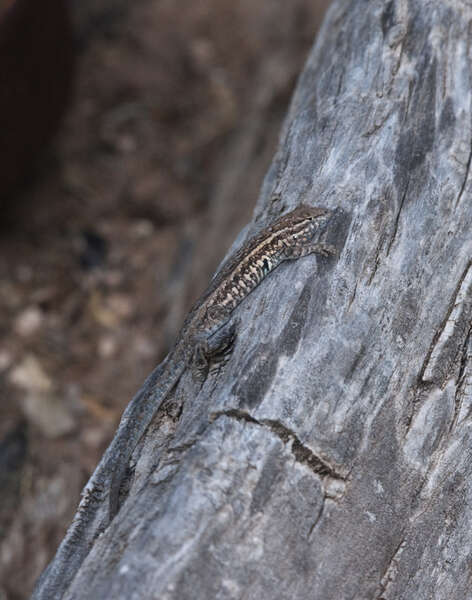
Iguania
Iguania is a suborder of squamate reptiles that includes iguanas, chameleons, agamids, and New World lizards. Using morphological features as a guide to evolutionary relationships, the Iguania are believed to form the sister group to the Squamata, which comprise nearly 11,000 named species, roughly 2000 of which are iguanians. However, molecular information has placed Iguania well within the Squamata as sister taxa to the Anguimorpha and closely related to snakes. The order has been under debate and revisions after being classified by Charles Lewis Camp in 1923 due to difficulties finding adeq
Pleurodonta
Pleurodonta (from Greek lateral teeth, is a infraorder of lizards reference to the position of the teeth on the jaw) is one of the two subdivisions of Iguania, the other being Acrodonta (teeth on the top [of the jaw]). Pleurodonta includes all families previously split from Iguanidae sensu lato (Corytophanidae, Crotaphytidae, Hoplocercidae, Opluridae, Polychrotidae, etc.), whereas Acrodonta includes Agamidae and Chamaeleonidae. The name Pleurodonta was first used by paleontologist and herpetologist Edward Drinker Cope in 1864, although he used it in a different sense than it is used today. Bec
Gueragama
Gueragama is an extinct genus of iguanian lizard from the Cretaceous of Brazil. It belongs to a group of iguanians called Acrodonta, whose living members include chameleons and agamids and are currently restricted to the Old World. Gueragama is the only acrodont known from South America, providing evidence that the group once ranged across much of Gondwana and only became restricted to the Old World after the supercontinent broke apart. The type species, Gueragama sulamericana, was named in 2015 on the basis of an isolated lower jaw from Goio-Erê Formation in the Bauru Basin, which was deposit
Chamaeleontiformes
Chamaeleontiformes is a hypothesized clade (evolutionary grouping) of iguanian lizards defined as all taxa sharing a more recent common ancestor with Chamaeleo chamaeleon (the common chamaeleon) than with Hoplocercus spinosus (the Brazilian spiny-tailed lizard), Polychrus marmoratus (bush lizard), or Iguana iguana (green iguana). It was named by paleontologist Jack Conrad in 2008 to describe a clade recovered in his phylogenetic analysis that included the extinct genus Isodontosaurus, the extinct family Priscagamidae, and the living clade Acrodonta, which includes agamids and chameleons. It is
Acrodonta
subclade of lizards