Category
page 1Incense material

cinnamon
thumb|Dried bark strips, bark powder and flowers of the small tree Cinnamomum verum

jasmine
thumb|Common jasmine

saffron
alt=Saffron|thumb|Saffron crocus, Crocus sativus, with its vivid crimson stigmas and styles

frankincense
thumb|Frankincense
thumb|Boswellia carteri tree that produces frankincense, growing inside [[Biosphere 2]]
Frankincense, also known as olibanum (), is an aromatic resin used in incense and perfume, obtained from trees of the genus Boswellia in the family Burseraceae. The word is from Old French ('high-quality incense'). There are several species of Boswellia that produce frankincense, including, but not limited to, Boswellia sacra (syn. B. bhaw-dajiana, syn. B. carteri), B. frereana, B. serrata (B. thurifera), and B. papyrifera. Resin from each is available in various grades which is affected

myrrh
thumb|right|alt=Small lumps of myrrh resin|Myrrh resin

Pogostemon cablin
Patchouli (also spelled patchouly or pachouli; ; Pogostemon cablin) is a species of flowering plant in the family Lamiaceae, commonly called the mint or deadnettle family. The plant grows as a bushy perennial herb, with erect stems reaching up to in height and bearing small, pale, pink-white flowers.
mastic
resin obtained from the mastic tree

copal
thumb|Copal from Madagascar with [[spiders, termites, ants, elateridae, hymenoptera, cockroach and a flower]]
thumb|A sample of copal containing a few termites

agarwood
Agarwood, aloeswood, eaglewood, gaharuwood, commonly referred to as oud or oudh (from , ), is a fragrant, dark and resinous wood used in incense, perfume, and small hand carvings.

sandalwood
thumb|Santalum paniculatum ), Hawaii (island)|Hawaii
Sandalwood is a class of woods from trees in the genus Santalum. The woods are heavy, yellow, and fine-grained, and, unlike many other aromatic woods, they retain their fragrance for decades. Sandalwood oil is extracted from the woods. Sandalwood is often cited as one of the most expensive woods in the world. Both the wood and the oil produce a distinctive fragrance that has been highly valued for centuries. Consequently, some species of these slow-growing trees have suffered over-harvesting in the past.

Illicium anisatum
species of plant

Boswellia serrata
species of plant
benzoin resin
balsamic resin obtained from trees in the genus Styrax

Saussurea costus
species of plant
dragon's blood
painting material and natural resin

Commiphora wightii
species of plant

sandarac
thumb|Sandarac tears
Sandarac (or sandarach) is a resin obtained from the small cypress-like tree Tetraclinis articulata. The tree is native to the northwest of Africa with a notable presence in the Southern Morocco part of the Atlas Mountains. The resin exudes naturally on the stems of the tree. It is also obtained by making cuts on the bark. It solidifies when exposed to the air. It is sold in the form of small solid translucent chips with a delicate yellow tinge. Morocco is the main place of origin of sandarac. A similar resin is obtained in southern Australia from some species of the Austr

galbanum
thumb|Ferula gummosa, from which galbanum comes.
thumbnail|Galbanum flowers, Kurdistan mountains, [[Hewraman.]]
Galbanum is an aromatic gum resin and a product of certain umbelliferous Persian plant species in the genus Ferula, chiefly Ferula gummosa (synonym F. galbaniflua) and Ferula rubricaulis. Galbanum-yielding plants grow plentifully on the slopes of the mountain ranges of northern Iran. It occurs usually in hard or soft, irregular, more or less translucent and shining lumps, or occasionally in separate tears, of a light-brown, yellowish or greenish-yellow colour. Galbanum has a disagree

Bursera graveolens
species of plant
operculum
hard structure which closes the aperture of a gastropod when the animal retreats into the shell
dammar gum
tree resin obtained from the family Dipterocarpaceae

Litsea glutinosa
species of plant
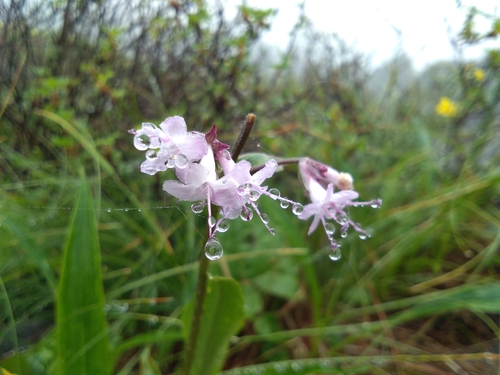
Nardostachys
Nardostachys is a genus of flowering plant in the honeysuckle family (Caprifoliaceae). Nardostachys jatamansi is the sole species in genus.

bdellium
thumb|right|Bdellium resin
Bdellium (also bdellion or false myrrh) is a semi-transparent oleo-gum resin extracted from Commiphora wightii plants, and from Commiphora africana trees growing in sub-Saharan Africa. According to Pliny the best quality came from Bactria. Other named sources for the resin are India, Pakistan, Arabia, Media, and Babylon.

labdanum
thumb|Cistus creticus, the pink rockrose, is one source of labdanum.
Labdanum, also called ladanum, ladan, or ladanon, is a sticky brown resin obtained from the shrubs Cistus ladanifer ('gum rockrose', western Mediterranean) and Cistus creticus ('pink rockrose', eastern Mediterranean), species of rock rose. It was historically used in herbal medicine and is still used in the preparation of some perfumes and vermouths.
storax
fragrant resin from the genus liquidambar
Kyphi
Kyphi, cyphi, or Egyptian cyphi is a compound incense that was used in ancient Egypt for religious and medical purposes.
Spikenard
thumb|130px|right|Spikenard (Nardostachys jatamansi) essential oil
Nag Champa
fragrance from India
Opopanax
Oleo-gum-resin of Commiphora guidottii
Ranjatai
The is a log of fragrant agarwood currently placed in the Shōsōin repository in the Tōdai-ji. The wood was first imported into Japan during the Nara period in the 8th century. It is considered a famous piece of incense wood due to its proximity and circumstance of the spread of Japanese Buddhism. It is claimed to have been placed in the repository by Empress Kōmyō in memory of Emperor Shōmu.

Machilus kurzii
species of plant