Category
page 1Indigenous peoples of Europe

Sámi people
Finno-Ugric peoples

Crimean Tatars
Turkic ethnic group, an indigenous people of Crimea

Bashkir people
The Bashkirs ( , ) or Bashkorts (, ; , ) are a Turkic ethnic group indigenous to Russia. They are concentrated in Bashkortostan, a republic of the Russian Federation and in the broader historical region of Badzhgard, which spans both sides of the Ural Mountains, where Eastern Europe meets North Asia. Smaller communities of Bashkirs also live in the Republic of Tatarstan, Perm Krai the oblasts of Chelyabinsk, Orenburg, Tyumen, Sverdlovsk, Kurgan and other regions in Russia; sizeable minorities exist in Kazakhstan.

Nogais
[[File:Carte répartition nogaïs.png|thumb|The map shows the Nogai population.

Karelians
Karelians (; ; ; ) are a Baltic Finnic ethnic group who are indigenous to the historical region of Karelia, which is today split between Finland and Russia. Karelians living in Russian Karelia are considered a distinct ethnic group closely related to Finnish Karelians, who are considered a subset of Finns. This distinction historically arose from Karelia having been fought over and eventually split between Sweden and Novgorod, resulting in Karelians being under different cultural spheres.

Mordvins
Mordvins (also Mordvinians, Mordovians; ; no equivalents in Moksha and Erzya) is an official term used in Russia and the Soviet Union to refer both to Erzyas and Mokshas since 1928.

Crimean Karaites
ethnic group
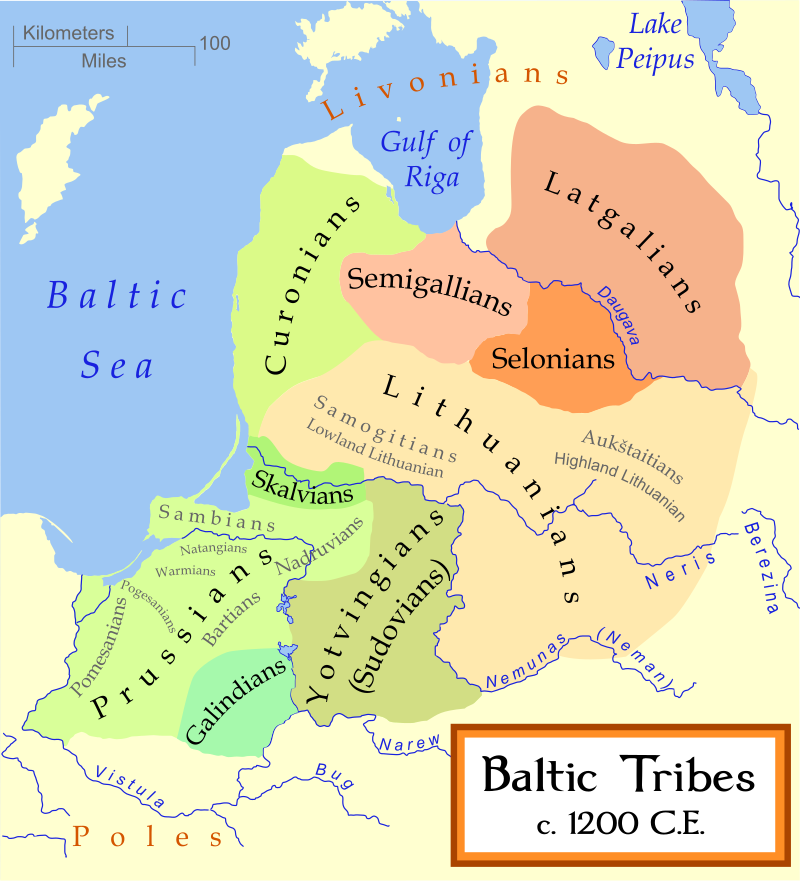
Old Prussians
historical Baltic tribal group

Livonians
The Livonians, or Livs, are a Balto-Finnic people indigenous to the Livonian Coast, in northwestern Latvia. Livonians historically spoke Livonian, a Uralic language closely related to Estonian and Finnish. It was believed that the last person to have learned and spoken Livonian as a mother tongue, Grizelda Kristiņa, died in 2013. In 2020, however, it was reported that newborn Kuldi Medne had become the only living person who speaks Livonian as their first language. As of 2010, there were approximately 30 people who had learned it as a second language.

Setos
Setos (, , , ) are an indigenous Finnic people and linguistic minority that have historically lived in the borderlands between modern day Estonia and Russia. Setos have historically spoken the Seto language and been Orthodox Christians. The Seto language (like Estonian and Finnish) belongs to the Finnic group of the Uralic language family. Since the early 2000s, the Setos have sought greater recognition, rather than having their language considered a dialect of Estonian. Eastern Orthodox Christianity, with influences from local folk religions is widely practiced by the Seto peoples.
.svg)
Pelasgians
The name Pelasgians (, ) was used by Classical Greek writers to refer either to the predecessors of the Greeks, or to all the inhabitants of Greece before the emergence of the Greeks. In general, "Pelasgian" has come to mean more broadly all the indigenous inhabitants of the Aegean Sea region and their cultures, and British historian Peter Green comments on it as "a hold-all term for any ancient, primitive and presumably indigenous people in the Greek world".

Votes
Votians, also referred to as Votes, Vots and Vods (; ; ; ) are a Finnic ethnic group native to historical Ingria, the part of modern-day northwestern Russia that is roughly southwest of Saint Petersburg and east of the Estonian border-town of Narva. The Finnic Votic language spoken by Votians is close to extinction. The language is still spoken in three villages of historical Votia and by an unknown number of speakers in the countryside. The villages are Jõgõperä (Krakolye), Liivcülä (Peski), and Luuditsa (Luzhitsy). In the Russian 2020 census, 99 people identified as Votian.

Krymchaks
Krymchaks (Krymchak: , , , ) are Jewish ethno-religious communities of Crimea derived from Turkic-speaking adherents of Rabbinic Judaism. They have historically lived in close proximity to the Crimean Karaites, who follow Karaite Judaism.
Irish Travellers
traditionally nomadic people of ethnic Irish origin

Gorals
thumb|right|A Goral with bagpipes from the region of [[Podhale in Poland]]
The Gorals (; Goral ethnolect: Górole; ; Cieszyn Silesian: Gorole), also anglicized as the Highlanders, are an ethnographic group with historical ties to the Vlachs. The Goral people are primarily found in their traditional area of southern Poland, northern Slovakia – especially Orava, Spiš and Zamagurie, and in the region of Cieszyn Silesia in the Czech Republic, where they are known as the Silesian Gorals. There is also a significant Goral diaspora in the area of Bukovina in western Ukraine and northern Romania, as we
Muromians
REDIRECT Volga Finns#Muroma
Aborigines
earliest inhabitants of central Italy in Roman mythology

indigenous small-numbered peoples of the North, Siberia and the Far East
peoples numbering >50000 living in the North Russia, Siberia and Russian Far East in the territories of the traditional settlement of their ancestors, preserving their traditional way of life, farming and crafts and recognizing themselves as such
list of small-numbered indigenous peoples of Russia
Wikimedia list article
Vaqueiros de alzada
northern Spanish nomadic people in the mountains of Asturias and León