Category
page 1Insect common names

Musca domestica
The housefly (Musca domestica) is a fly of the suborder Cyclorrhapha. It possibly originated in the Middle East, and spread around the world as a commensal of humans. Adults are gray to black, with four dark, longitudinal lines on the thorax, slightly hairy bodies, and a single pair of membranous wings. They have red compound eyes, set farther apart in the slightly larger female.

locust
thumb|Locusts, such as this migratory locust (Locusta migratoria), are grasshoppers in a migratory phase of their life.
thumb|Millions of swarming [[Australian plague locusts on the move]]

cockroach
Cockroaches (or roaches) are insects belonging to the order Blattodea (Blattaria). About 30 cockroach species out of 4,600 are associated with human habitats. Some species are well-known pests.

Melolontha melolontha
The common cockchafer (Melolontha melolontha), also colloquially known as the Maybug, Maybeetle, or doodlebug, is a species of scarab beetle belonging to the genus Melolontha. It is native to Europe, and it is one of several closely-related and morphologically similar species of Melolontha called cockchafers, alongside Melolontha hippocastani (the forest cockchafer).

dung beetles
informal group of beetles
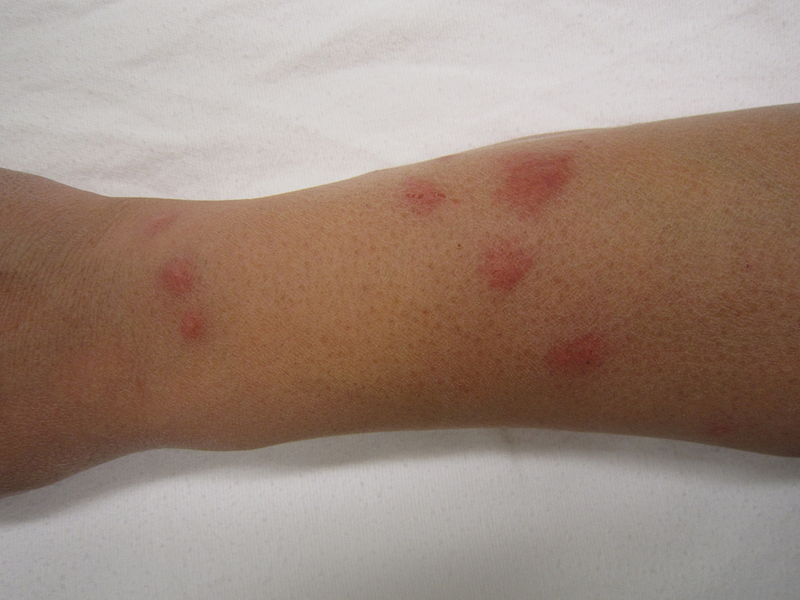
bed bug
parasitic insects

grasshopper
Grasshoppers are a group of insects belonging to the suborder Caelifera. They are amongst what are possibly the most ancient living groups of chewing herbivorous insects, dating back to the early Triassic, around 250 million years ago.
army ant
group of nomadic predatory ant species

wētā
Wētā (also spelled weta in English) is the common name for a group of about 100 insect species in the families Anostostomatidae and Rhaphidophoridae endemic to New Zealand. They are giant flightless crickets, and some are among the heaviest insects in the world. Generally nocturnal, most small species are carnivores and scavengers while the larger species are herbivorous. Although some endemic birds (and tuatara) likely prey on them, wētā are disproportionately preyed upon by introduced mammals, and some species are now critically endangered.

Cardinal beetle
species of insect

Atrophaneura
genus of butterflies

gnat
thumb|Gnat from Robert Hooke's [[Micrographia, 1665]]
thumb|A female black fungus gnat
A gnat () (also knat) is any of many species of tiny flying insects in the dipterid suborder Nematocera, especially those in the families Mycetophilidae, Anisopodidae and Sciaridae. Most often they fly in large numbers, called clouds. "Gnat" is a loose descriptive category rather than a phylogenetic or other technical term, so there is no scientific consensus on what constitutes a gnat. Some entomologists consider only non-biting flies to be gnats. Certain universities and institutes also distinguish eye gna
water beetle
common name for any beetle living in water
bombardier beetle
Beetles that emit a spray when threatened
glowworm
Glowworm is any member of various groups of insect larvae and adult larviform females that glow through bioluminescence. They include the European common glow-worm and other members of the Lampyridae, but bioluminescence also occurs in the families Elateridae, Phengodidae and Rhagophthalmidae among beetles; as well as members of the genera Arachnocampa, Keroplatus and Orfelia among keroplatid fungus gnats.
Paper wasps
bookworm
common name for any insect which bores through books

midge
.jpg)
cutworm
thumb|right|220px|The cutworm larva of the large yellow underwing (Noctua pronuba)
Cutworms are moth larvae that hide under litter or soil during the day, coming out in the dark to feed on plants. A larva typically attacks the first part of the plant it encounters, namely the stem, often of a seedling, and consequently cuts it down, hence the name cutworm. Cutworms are not worms, biologically speaking, but caterpillars.

birdwing
Birdwings are butterflies in the swallowtail family, that belong to the genera Trogonoptera, Troides, and Ornithoptera. Most recent authorities recognise 36 species, however, this is debated, and some authorities include additional genera. Birdwings are named for their exceptional size, angular wings, and birdlike flight. They are found across tropical Asia, mainland and archipelagic Southeast Asia, and Australasia.

woodworm
thumb|upright=1.2|The common furniture beetle (Anobium punctatum) in situ

waxworms
thumb|right|250px|Adult specimen of the lesser wax moth (Achroia grisella)
thumb|right|250px|Adult specimen of the Galleria mellonella|greater wax moth (Galleria mellonella)
thumb|right|250px|G. mellonella larva
rat-tailed maggot
larvae of certain species of hoverflies
cuckoo bee
type of parasitic bee
cricket
common name of insects
Hopliini
tribe of insects
sandfly
thumb|New Zealand sandfly biting a human's thumb
witchetty grub
common name
ambrosia beetle
any of several species of beetles having a symbiosis with ambrosia fungi
fig wasp
common name for several insect species
mud dauber
group of wasps known by one particular common name
Dead leaf mantis
Common name for several praying mantises
harvester ant
common name for any ant species or genera that collect and store seeds and plant material