Category
page 1Insect taxonomy

Pterygota
Pterygota ( ) is a subclass of insects that includes all winged insects and groups which lost them secondarily.
.jpg)
Neoptera
Neoptera (Ancient Greek néos ("new") + pterón ("wing")) is a classification group that includes most orders of the winged insects, specifically those that can flex their wings over their abdomens. This is in contrast with the more basal orders of winged insects (the "Palaeoptera" assemblage), which are unable to flex their wings in this way.
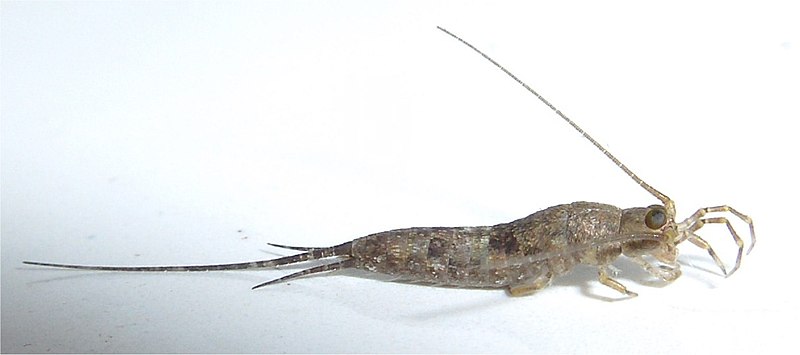
Apterygota
The name Apterygota is sometimes applied to a former subclass of small, agile insects, distinguished from other insects by their lack of wings in the present and in their evolutionary history; notable examples are the silverfish, the firebrat, and the jumping bristletails. Their first known occurrence in the fossil record is during the Devonian period, 417–354 million years ago. The group Apterygota is not a clade; it is paraphyletic, and not recognized in modern classification schemes. As defined, the group contains two separate clades of wingless insects: Archaeognatha comprises jumping bris

Palaeoptera
The name Palaeoptera (from Greek ( 'old') + ( 'wing')) has been traditionally applied to those ancestral groups of winged insects (most of them extinct) that lacked the ability to fold the wings back over the abdomen as characterizes the Neoptera. The Diaphanopterodea, which are palaeopteran insects, had independently and uniquely evolved a different wing-folding mechanism. Both mayflies and dragonflies lack any of the smell centers in their brain found in Neoptera. Their midgut epithelium has a dual origin: the anterior and posterior regions develop through cellular differentiation, while the
Dicondylia
Dicondylia is a taxonomic group (taxon) that includes all insects except the jumping bristletails (Archaeognatha). Dicondylia species have a mandible attached with two hinges to the head capsule (dicondyl), in contrast to a hypothetical ancestral mandible with a single ball joint (monocondyl); the members of Archaeognatha do in fact have dicondylic mandibles, though they are not identical to the structure seen in "true" dicondylic insects.
Eumetabola
Eumetabola is an unranked clade of Neoptera. Two large unities known as the Eumetabola and Paurometabola are probably from the adelphotaxa of the Neoptera after exclusion of the Plecoptera. The monophyly of these unities appears to be weakly justified.
Metapterygota
Metapterygota is a clade of winged insects containing order Odonata and Infraclass Neoptera. They share morphological characteristics of a loss of caudal filaments and a subimago stage. Genetically the clade is supported by similarities in the mitochondrial genomes.