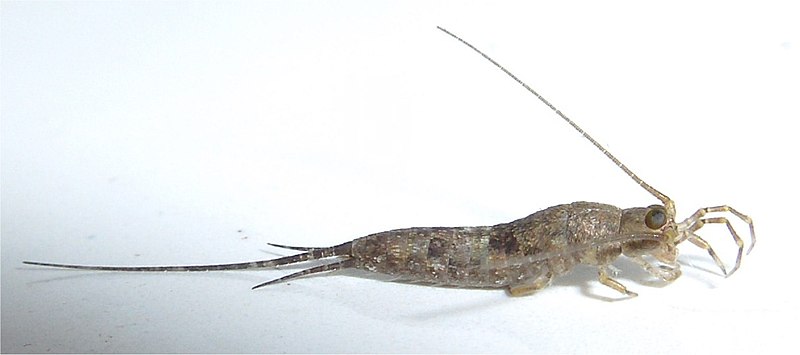
File:Archaeognatha.jpg · Wikimedia Commons · See Wikimedia Commons
Apterygota
Sign in to saveThe name Apterygota is sometimes applied to a former subclass of small, agile insects, distinguished from other insects by their lack of wings in the present and in their evolutionary history; notable examples are the silverfish, the firebrat, and the jumping bristletails. Their first known occurrence in the fossil record is during the Devonian period, 417–354 million years ago. The group Apterygota is not a clade; it is paraphyletic, and not recognized in modern classification schemes. As defined, the group contains two separate clades of wingless insects: Archaeognatha comprises jumping bris
Species
aptérygotes
Infraclass
- PhylumArthropoda
- ClassInsecta
via
Wikidata facts
Show 5 more facts
- does not have part
- insect wing
- Commons category
- Apterygota
- taxon name
- Apterygota
- taxon rank
- subclass
- topic's main category
- Category:Apterygota
Sources (1)
via Wikidata · CC0
~4 min read
Encyclopedic overview
3 sectionsContents
- Characteristics
- History of the concept
- References
The name Apterygota is sometimes applied to a former subclass of small, agile insects, distinguished from other insects by their lack of wings in the present and in their evolutionary history; notable examples are the silverfish, the firebrat, and the jumping bristletails. Their first known occurrence in the fossil record is during the Devonian period, 417–354 million years ago. The group Apterygota is not a clade; it is paraphyletic, and not recognized in modern classification schemes. As defined, the group contains two separate clades of wingless insects: Archaeognatha comprises jumping bristletails, while Zygentoma comprises silverfish and firebrats. The Zygentoma are in the clade Dicondylia with winged insects, a clade that includes all other insects, while Archaeognatha is sister to this lineage.
The nymphs (younger stages) go through little or even no metamorphosis, hence they resemble the adult specimens (ametabolism). Currently, no species are listed as being at conservation risk.
Excerpted from Wikipedia’s “Apterygota” article, available under the CC BY-SA 4.0 licence.