Category
page 1Intermediate-mass black holes

Omega Centauri
globular cluster in the constellation Centaurus

47 Tucanae
globular cluster in the constellation Tucana
intermediate-mass black hole
black hole with a mass range of 100 to 100000 solar masses
GW190521
GW190521 (initially S190521g) was a gravitational wave signal resulting from the merger of two black holes. It was possibly associated with a coincident flash of light; if this association is correct, the merger would have occurred near a third supermassive black hole. The event was observed by the LIGO and Virgo detectors on 21 May 2019 at 03:02:29 UTC, and published on 2 September 2020. The event had a Luminosity distance of 17 billion light years away from Earth, within a 765 deg2 area towards one of two roughly antipodal areas of the sky, one centered around Coma Berenices and the oth
M82 X-1
suspected black hole
GCIRS 13E
infrared and radio emitting object near the galactic centre
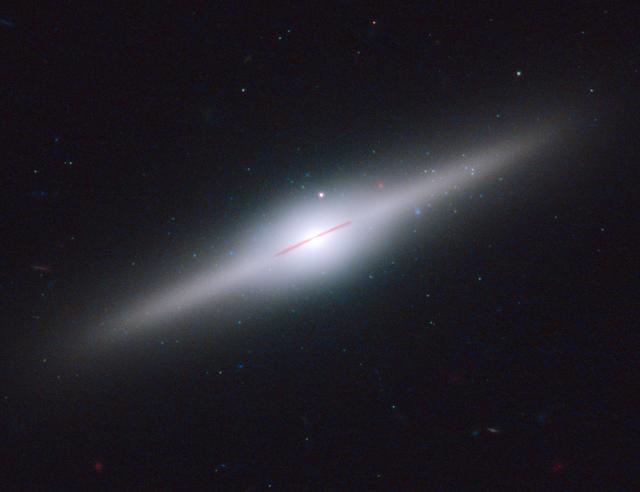
HLX-1
Hyper-Luminous X-ray source 1, commonly known as HLX-1, is an intermediate-mass black hole candidate located in the lenticular galaxy ESO 243-49 about 290 million light-years from Earth. The mass of its central black hole is estimated to be approximately 20,000 solar masses. The source was discovered at the Institut de Recherche en Astrophysique et Planétologie (IRAP, formerly the CESR), Toulouse, France and gained interest from the scientific community because of strong evidence supporting it as an intermediate-mass black hole. HLX-1 is possibly the remnant of a dwarf galaxy that may have bee