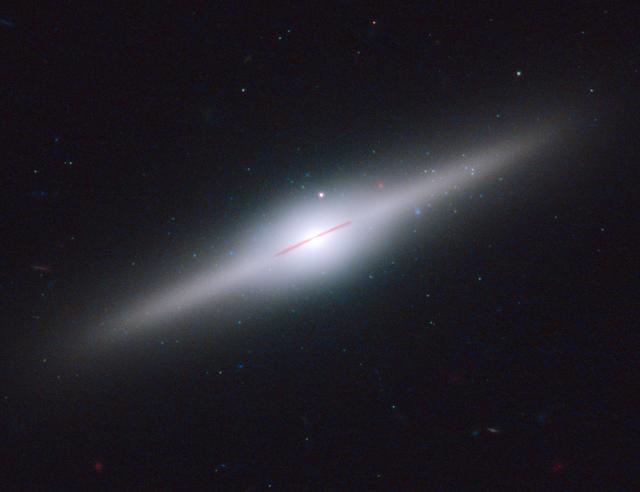
NASA's Hubble Spots a Relic from a Shredded Galaxy · NASA · NASA — public domain
HLX-1
Sign in to saveHyper-Luminous X-ray source 1, commonly known as HLX-1, is an intermediate-mass black hole candidate located in the lenticular galaxy ESO 243-49 about 290 million light-years from Earth. The mass of its central black hole is estimated to be approximately 20,000 solar masses. The source was discovered at the Institut de Recherche en Astrophysique et Planétologie (IRAP, formerly the CESR), Toulouse, France and gained interest from the scientific community because of strong evidence supporting it as an intermediate-mass black hole. HLX-1 is possibly the remnant of a dwarf galaxy that may have bee
Wikidata facts
- Instance of
- star
- Part of
- ESO 243-49
- Constellation
- Phoenix
Show 6 more facts
- radial velocity
- 6523
- Commons category
- ESO 243-49
- right ascension
- 17.61792
- declination
- -46.072861
- epoch
- J2000.0
- apparent magnitude
- 23.80
Sources (1)
via Wikidata · CC0
~3 min read
Encyclopedic overview
3 sectionsContents
- Discovery
- {{anchor|ESO 243-49}}ESO 243-49
- References
Hyper-Luminous X-ray source 1, commonly known as HLX-1, is an intermediate-mass black hole candidate located in the lenticular galaxy ESO 243-49 about 290 million light-years from Earth. The mass of its central black hole is estimated to be approximately 20,000 solar masses. The source was discovered at the Institut de Recherche en Astrophysique et Planétologie (IRAP, formerly the CESR), Toulouse, France and gained interest from the scientific community because of strong evidence supporting it as an intermediate-mass black hole. HLX-1 is possibly the remnant of a dwarf galaxy that may have been in a galactic collision with ESO 243-49.
== Discovery == The object was first observed in November 2004, in which it was seen as a source emitting X-rays in the outskirts of the spiral galaxy ESO 243-49 and was catalogued as 2XMM J011028.1-460421, but nicknamed "HLX-1". In 2008, a team of astronomers led by Natalie Webb at the Institut de Recherche en Astrophysique et Planétologie in Toulouse, France, discovered HLX-1 and from the very high X-ray luminosity (~, ), as well as its X-ray characteristics, proposed that it was an intermediate mass black hole candidate.
Excerpted from Wikipedia’s “HLX-1” article, available under the CC BY-SA 4.0 licence.