Category
page 1Interpersonal relationships

Sexual intercourse
Sex, more formally known as sexual intercourse, coitus, or copulation, is an intimate social activity typically involving the insertion of the erect male penis inside the female vagina and followed by thrusting motions for erotic pleasure, biological reproduction, or both. This specific type of sex is also known as vaginal intercourse. However, other forms of penetrative sexual intercourse also exist, including anal sex, oral sex, fingering and penetration by use of a dildo, and vibrators. The desire for these activities is grounded in natural human instinct and they involve physical intimacy between two or more people, usually enacted by humans solely for physical-emotional pleasure, sometimes contributing to human bonding.

kiss
thumb|right|Maternal Kiss, an 1896 painting by Mary Cassatt.
thumb|A forehead kiss
right|thumbnail|American sailor kissing his infant son
right|thumbnail|Kissing the gospel
right|thumbnail|Graduates of the Basic Patrol Course in Afghanistan kiss the [[Quran after the graduation ceremony.]]
.svg)
heterosexuality
thumb|upright|A heterosexuality symbol

sexual orientation
enduring pattern of sexual attraction

altruism
thumb|Giving alms to the poor is often considered an altruistic action.

respect
thumb|right|A sign entreating "silence and respect" at Arlington National Cemetery
Respect, also called esteem, is a positive feeling or deferential action shown towards someone or something considered important or held in high esteem or regard. It conveys a sense of admiration for good or valuable qualities. It is also the process of honoring someone by exhibiting care, concern, or consideration for their needs or feelings.

enemy
thumbnail|Duel between two enemies; here, the characters of Eugene Onegin and Vladimir Lensky from the novel, [[Eugene Onegin.]]
An enemy or a foe is an individual or a group that is considered as forcefully adverse or threatening. The concept of an enemy has been observed to be "basic for both individuals and communities". The term "enemy" serves the social function of designating a particular entity as a threat, thereby invoking an intense emotional response to that entity. The state of being or having an enemy is enmity, foehood or foeship.
%202.jpg)
empathy
alt=A small child hugs an older, injured child|thumb|Hugging is a common display of empathy

Stockholm syndrome
supposed condition in which the hostage develops a psychological bond with the captor

trust
assumption of and reliance on the honesty of another party
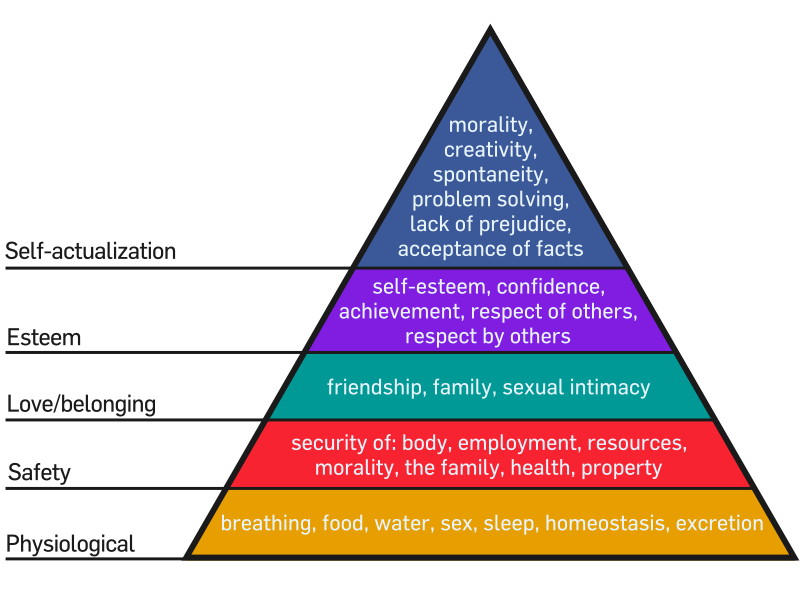
Maslow's hierarchy of needs
theory in developmental psychology proposed by Abraham Maslow, comprising a five-tier model of human needs: physiological, safety, love and belonging, esteem, and self-actualization
interpersonal relationship
strong, deep, or close association or acquaintance between two or more people

shyness
thumb |upright=1.6| Shyness is a personality trait distinct from Extraversion and introversion|introversion and [[social anxiety disorder.]]

romantic love
thumb|Romeo and Juliet, by [[Frank Dicksee, considered to be the archetypal romantic couple, depicting the play's iconic balcony scene]]

sympathy
Sympathy is the perception of, understanding of, and supportive reaction to the distress or need of another life form.
.jpg)
betrayal
thumb|The Taking of Christ by Caravaggio (c.1602) shows Judas betraying Jesus.
Betrayal is the breaking or violation of a presumptive contract, trust, or confidence that produces moral and psychological conflict within a relationship amongst individuals, between organizations or between individuals and organizations. Often betrayal is the act of supporting a rival group, or it is a complete break from previously decided upon or presumed norms by one party from the others. Someone who betrays others is commonly known as a traitor or betrayer.

frustration
thumb|262px|A frustrated man sitting in a traffic jam

Golden Rule
principle of treating others as one wants to be treated

romantic comedy
genre of dramatic works (such as plays, films, and television series)

romance film
film genre

schadenfreude
thumb|upright=1.4|alt=painting|Return to the Convent, by Eduardo Zamacois y Zabala, 1868. The painting depicts a group of [[monks laughing while a lone monk struggles with a donkey. ]]

polyamory
Polyamory () is the practice or support of, maintaining committed, romantic, and/or sexual relationships with more than one partner, in parallel or concurrently, with the consent of all involved partners. Polyamory allows for ethical-non-monogamy (ENM) which is a subset of the broader consensual non-monogamy. Many people who identify as polyamorous believe in a conscious management of jealousy and reject the view that sexual and relational exclusivity (monogamy) are prerequisites for deep, committed, long-term, loving relationships. When members of a closed polyamorous relationship restrict th
%2004.jpg)
aegis
thumb|The aegis on the so-called Athena Lemnia, a Roman statue type often identified as a copy of a work by the Classical Greek sculptor [[Pheidias (Dresden Skulpturensammlung)]]

attachment theory
Psychological ethological theory about human relationships
.jpg)
adoration
thumb|right|300px|Adoration, 1913, by William Strang
Adoration is respect, reverence, strong admiration, and love for a certain person, place, or thing. The term comes from the Latin adōrātiō, meaning "to give homage or worship to someone or something".

infatuation
thumb|right|230px|An illustrated depiction of Mahābhārata character [[Ulupi becoming infatuated with Arjuna]]
Infatuation, also known as being smitten, is the personal state of being largely driven by a potentially uninformed or unreasonable passion, usually towards another person for whom one has developed strong romantic or sexual feelings.

intimate relationship
physical or emotional intimacy between humans

flattery
thumb|Yes, It Is My Deceased Wife!...Only You Have Flattered Her Too Much!, lithograph by Honoré Daumier, [[Brooklyn Museum]]

courtesan
A courtesan is a prostitute with a courtly, wealthy, or upper-class clientele. Historically, the term referred to a courtier, a person who attended the court of a monarch or other powerful person.
social relation
relationship between two people or groups in which their thinking, acting or feeling is mutually related

sportsmanship
right|thumb|Shaking hands after a tennis match is considered a symbol of good sportsmanship.
thumb|Pat on the back|Patting on the back sometimes occurs before the game like this one from the [[Philippine Basketball Association.]]
right|thumb|These two teams of young soccer|football (soccer) players line up and high-five after a game to practice good sportsmanship.
Sportsmanship is an ethos that a sport or activity should be enjoyed for its own sake, with proper consideration for fairness, ethics, respect, and a sense of fellowship with competitors.

dehumanization
thumb|right|upright=1.2|link=Warsaw Ghetto boy|In his Stroop Report|report on the suppression of the [[Warsaw Ghetto uprising, Jürgen Stroop described Jews resisting deportation to Nazi camps as "bandits".]]
thumb|Lynndie England pulling a leash attached to the neck of a prisoner in Abu Ghraib prison, who is forced to crawl on the floor, while [[Megan Ambuhl watches, 2003.]]
courtly love
medieval European literary conception of love

spinster
thumb|A poem entitled "It won't be my fault if I die an Old Maid", containing the lines "Remember no thought to a girl is so dread / As the terrible one—She may die an Old Maid."
single person
marital status; person not in a marital relationship
%20-%20Admiration%20(1897).jpg)
admiration
thumb|Admiration by William-Adolphe Bouguereau, 1897
Admiration is a social emotion felt by observing people of competence, talent, virtuous actions, or skill exceeding standards. Admiration facilitates social learning in groups. Admiration motivates self-improvement through learning from role-models. Admiration is not automatically induced, but is built from active mental evaluations of social and real world knowledge.
social isolation
lack of contact between an individual and society, which is a risk factor for one of any age

bromance
thumb|240px|In 2017, US President Barack Obama's relationship with US Vice President [[Joe Biden was described as a "bromance".]]
blood brother
male not related by birth who has sworn loyalty
hedgehog's dilemma
metaphor about the challenges of human intimacy
Dunbar's number
value important in sociology and anthropology
codependency
In psychology, codependency is a theory that attempts to explain imbalanced relationships where one person enables another person's self-destructive behavior, such as addiction, poor mental health, immaturity, irresponsibility, or under-achievement.

consolation
thumb|right|Consolation, by A. Kindler.
Consolation, consolement, and solace are terms referring to psychological comfort given to someone who has suffered severe, upsetting loss, such as the death of a loved one. It is typically provided by expressing shared regret for that loss and highlighting the hope for positive events in the future. Consolation is an important topic arising in history, the arts, philosophy, and psychology.
conflict resolution
methods and processes involved in facilitating the peaceful ending of conflict and retribution
social rejection
exclusion of an individual from relationships
sociometry
Sociometry is a quantitative method for measuring social relationships. It was developed by psychotherapist Jacob L. Moreno and Helen Hall Jennings in their studies of the relationship between social structures and psychological well-being, and used during Remedial Teaching.
social intelligence
capacity to know oneself and to know others
friend zone
platonic relationship wherein one person wishes to enter into a romantic or sexual relationship, while the other does not
imaginary friend
phenomenon where a friendship or other interpersonal relationship takes place in imagination
ghosting
practice of suddenly breaking off a relationship or friendship with someone

limerence
right|240px|thumb|''Psyche Revived by Cupid's Kiss'', by [[Antonio Canova, first version 1787–1793]]
human bonding
process of development of a close, interpersonal relationship
herbivore men
term used in Japan to describe men who have no interest in getting married or finding a girlfriend
drive theory
theory that attempts to define, analyze, or classify psychological drives
sexual fluidity
changes in sexuality or sexual identity
homophily
Homophily () is a concept in sociology describing the tendency of individuals to associate and bond with similar others, as in the proverb "". The presence of homophily has been discovered in a vast array of network studies: over have observed homophily in some form or another, and they establish that similarity is associated with connection. The categories on which homophily occurs include age, gender, class, and organizational role.
asociality
Asociality refers to the lack of motivation to engage in social interaction, or a preference for solitary activities. Asociality may be associated with avolition, but it can, moreover, be a manifestation of limited opportunities for social relationships. Developmental psychologists use the synonyms nonsocial, unsocial, and social uninterest. Asociality is distinct from, but not mutually exclusive to, anti-social behavior. A degree of asociality is routinely observed in introverts, while extreme asociality is observed in people with a variety of clinical conditions.
sexual capital
social value from sexual attractiveness
reciprocity
social norm of responding to a positive action with another positive action, rewarding kind actions

belongingness
Belongingness is the human emotional need to be an accepted member of a group. Whether it is family, friends, co-workers, a religion, or something else, some people tend to have an 'inherent' desire to belong and be an important part of something greater than themselves. This implies a relationship that is greater than simple acquaintance or familiarity.