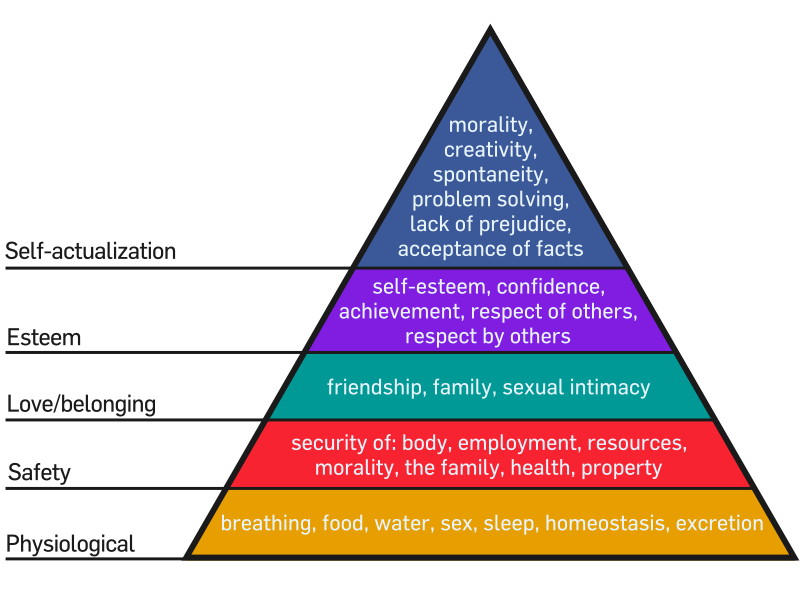
Maslow's hierarchy of needs
Also known as Maslow's pyramid of needs
theory in developmental psychology proposed by Abraham Maslow, comprising a five-tier model of human needs: physiological, safety, love and belonging, esteem, and self-actualization
AI overview
Maslow's hierarchy of needs is a psychological theory that arranges human needs into five levels, starting with basic physical requirements like food and safety, moving up through the need for love and belonging, then self-esteem, and finally self-actualization or reaching one's full potential. The theory suggests that people are motivated to meet these needs in order, with lower-level needs taking priority before people can focus on higher-level goals.
AI-generated from the Wikipedia summary — may contain errors.
Wikidata facts
- Image
- Maslowsneeds.png
Show 1 more fact
- Commons category
- Maslow's hierarchy of needs
Sources (2)
via Wikidata · CC0
~29 min read
Article
Diagram of Maslow's Hierarchy of Needs (five-level model). Based on his original 1943 paper "A Theory of Human Motivation" and later clarifications.
Maslow's hierarchy of needs is a conceptualization of the needs (or goals) that motivate human behaviour, which was proposed by the American psychologist Abraham Maslow.