Category
page 1Islamic art
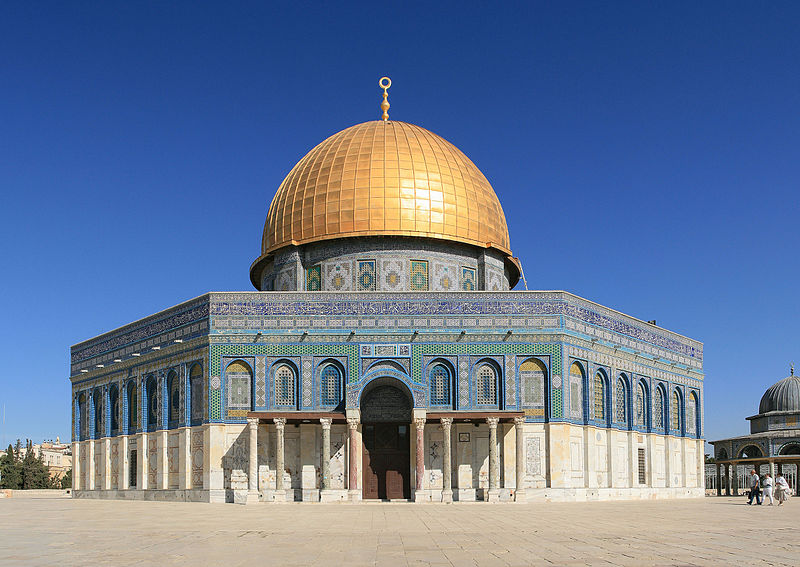
Islamic architecture
architectural style

Islamic art
artistic production that developed from the hegira (year 622) to the nineteenth century, from Spain to India among populations of Islamic culture

arabesque
thumb|340px|Stone relief with arabesques of tendrils, palmettes and half-palmettes in the [[Umayyad Mosque, Damascus, Syria]]
thumb|Part of a 15th-century ceramic panel from Samarkand ([[Uzbekistan) with white calligraphy on a blue arabesque background]]The arabesque is a form of artistic decoration consisting of "surface decorations based on rhythmic linear patterns of scrolling and interlacing foliage, tendrils" or plain lines, often combined with other elements. Another definition is "Foliate ornament, used in the Islamic world, typically using leaves, derived from stylised half-palmettes,
Persian carpet
handmade carpet from Iran
Islamic calligraphy
artistic practice of calligraphy in the Islamic world
pietra dura
artwork technique of creating works in which pieces of hard, polished stone of varying shapes are set into marble or another hard surface to form a pattern
.jpg)
lusterware
thumb|Staffordshire pottery jug, c. 1815
Lustreware or lusterware (the respective spellings for British English and American English) is a type of pottery or porcelain with a metallic glaze that gives the effect of iridescence. It is produced by metallic oxides in an overglaze finish, which is given a second firing at a lower temperature in a "muffle kiln", or a reduction kiln, excluding oxygen.
Doris Duke
American heiress, philanthropist and billionaire (1912-1993)
interlace
decorative element of bands or portions of other motifs looped, braided, and knotted in complex geometric patterns
oriental rug
type of textile
Islamic garden
expressive estate of land that includes themes of water and shade
Islamic geometric pattern
geometric pattern characteristic of Muslim art
aniconism in Islam
avoidance of images of sentient beings in some forms of Islamic art
Girih tiles
five tiles used in Islamic decorative art

Girih
thumb|upright=1.2|Girih pattern with inlaid floral decoration from :en:Shah-i-Zinda|Shah-i-Zinda in [[Samarkand, Uzbekistan]]
Mshatta Facade
facade of Umayyad palace
Islamic glass
type of glass artifact made in the Islamic world, especially in periods up to the 19th century
Islamic pottery
pottery of Islamic lands
.jpg)
Sebka
thumb|A sebka motif on Hassan Tower in [[Rabat, Morocco, (late 12th century)]]
Sebka () refers to a type of decorative motif used in western Islamic ("Moorish") architecture and Mudéjar architecture.
Islamic ornament
interlaced knotwork in Islamic art

tiraz
thumb|right|A sovereign wearing an armband with Arabic inscription, the tiraz

Pseudo-Kufic
Pseudo-Kufic, or Kufesque, also sometimes pseudo-Arabic, is a style of decoration used during the Middle Ages and the Renaissance, consisting of imitations of the Arabic script, especially Kufic, made in a non-Arabic context: "Imitations of Arabic in European art are often described as pseudo-Kufic, borrowing the term for an Arabic script that emphasizes straight and angular strokes, and is most commonly used in Islamic architectural decoration". Pseudo-Kufic appears especially often in Renaissance art in depictions of people from the Holy Land, particularly the Virgin Mary. It is an example o
Islamic influences on Western art
Hedwig glass
type of glass beaker originating in the Middle East or Norman Sicily and dating from the 10th-12th centuries AD
Mahmal
thumb|right|upright|Cover for a Damascus Mahmal, Istanbul, 16th century. Khalili Collection of Hajj and the Arts of Pilgrimage
A mahmal () is a ceremonial passenger-less litter that was carried on a camel among caravans of pilgrims on the Hajj, the pilgrimage to Mecca which is a sacred duty in Islam. It symbolised the political power of the sultans who sent it, demonstrating their custody of Islam's holy sites. Each mahmal had an intricately embroidered textile cover, or sitr. The tradition dates back at least to the 13th century and ended in the mid-20th. There are many descriptions and photo
Pisa Griffin
medieval Islamic bronze sculpture
Nasser D. Khalili Collection of Islamic Art
private collection of art from Islamic lands
Shamsa
thumb|Shamsa at the center of Ardabil Carpet. [[Iran, 1539-40. Victoria and Albert Museum]]
upright=0.8|thumb|Shamsa in the Book frontispiece|frontispiece of the [[Ruzbihan Qur'an. Iran, . Chester Beatty Library]]
upright=0.8|thumb|Shamsa bearing the names and titles of Shah Jahan. [[India, c. 1630-45. Metropolitan Museum of Art]]
In Islamic art, a shamsa (Persian: شمسه shamseh, Arabic: شمسة shums, Ottoman Turkish: شمسه [Turkish: Şemse]) is an intricately decorated rosette or medallion which is used in many contexts, including manuscripts, carpets, ornamental metalwork and architectural decora
Empire of the Sultans: Ottoman Art of the Khalili Collection
travelling exhibition of Islamic art
Hajj: Journey to the Heart of Islam
2012 exhibition at the British Museum
Qashani
thumb|Model of typical Qashani tile work consists of floral and geometrical patterns.
Qashani or Kashani is a Persian decorative art which had been popular in Iran in the 16th to 18th century, and then moved to Turkey in the time of the Ottomans with the transfer of many Persians artists to Turkey, becoming the basis for decorating the walls of mosques, palaces, shrines and tombs. It is a square-shaped ceramic tile which uses Persian-like floral-depicting 4- or 6-sided glazed tiles, decorated with blue, cyan, green and sometimes red colors. The decoration is surrounded by fine black lines that
Transylvanian rug
any of a group of Anatolian rugs of various designs used as decoration of Transylvanian Protestant churches
Oriental carpets in Renaissance painting
aspect of art history
aina-kari
Ayeneh-kari () is a kind of Iranian interior decoration where artists assemble finely cut mirrors together in geometric, calligraphic or foliage forms (inspired by flowers and other plants). This creates a shining surface covered with complex facets, reflecting light as intricate abstract patterns or glittering reflections. Beside their decorative use, this art form is used as a strong durable cover for interior spaces.
Khalili Collection: Hajj and the Arts of Pilgrimage
private collection of art and artefacts
Topkapı Scroll
Timurid dynasty pattern scroll

Painting of the Six Kings
fresco at Qasr Amra, a desert castle in Jordan
Kubachi silver
traditional handicraft
sitara
ornamental curtain used in some sacred sites of Islam
gul
medallion-like motif, often octagonal, typical of traditional hand-woven carpets from Central and West Asia
list of museums of Islamic art
Wikimedia list article
Khalili Collections
group of art collections
Muqarnas
academic journal
Hurufiyya movement
art movement referring to traditional Islamic calligraphy within the precepts of modern art
mosque lamp
glass vessels of vase shape with a wide flaring neck