Category
page 1Isopoda
.jpg)
Isopoda
Isopoda is an order of crustaceans. Members of this group are collectively called isopods and include both aquatic species such as gribbles and terrestrial species such as woodlice. All have rigid, segmented exoskeletons, two pairs of antennae, seven pairs of jointed limbs on the thorax, and five pairs of branching appendages on the abdomen that are used in respiration. Females brood their young in a pouch under their thorax called the marsupium.

Oniscidea
Woodlice are terrestrial isopods in the suborder Oniscidea. Their name is derived from being often found in old wood, and from louse, a parasitic insect, although woodlice are neither parasitic nor insects. Other common names include slater, sow bug, and wood pig, common names varying widely by region.
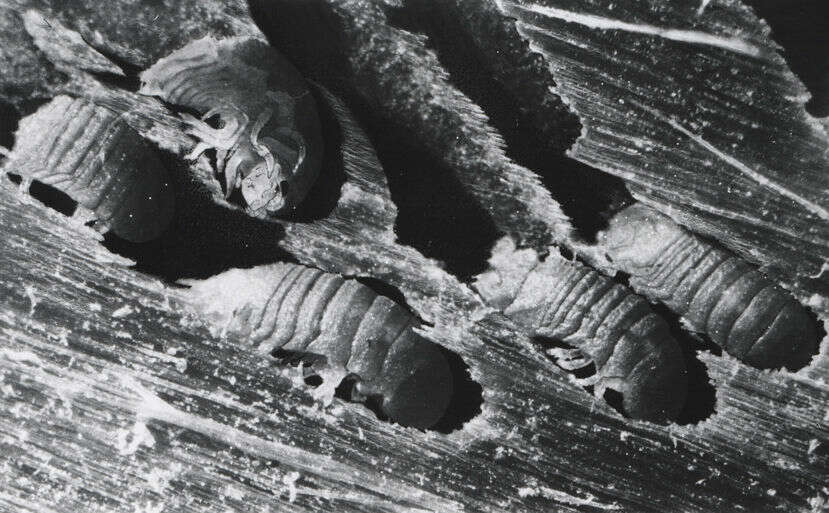
Gribble
A gribble () or gribble worm is any of about 56 species of marine isopod from the family Limnoriidae. They are mostly pale white and small ( long) crustaceans, although Limnoria stephenseni from subantarctic waters can reach .

Limnoria
Limnoria is a genus of isopods from the family Limnoriidae.
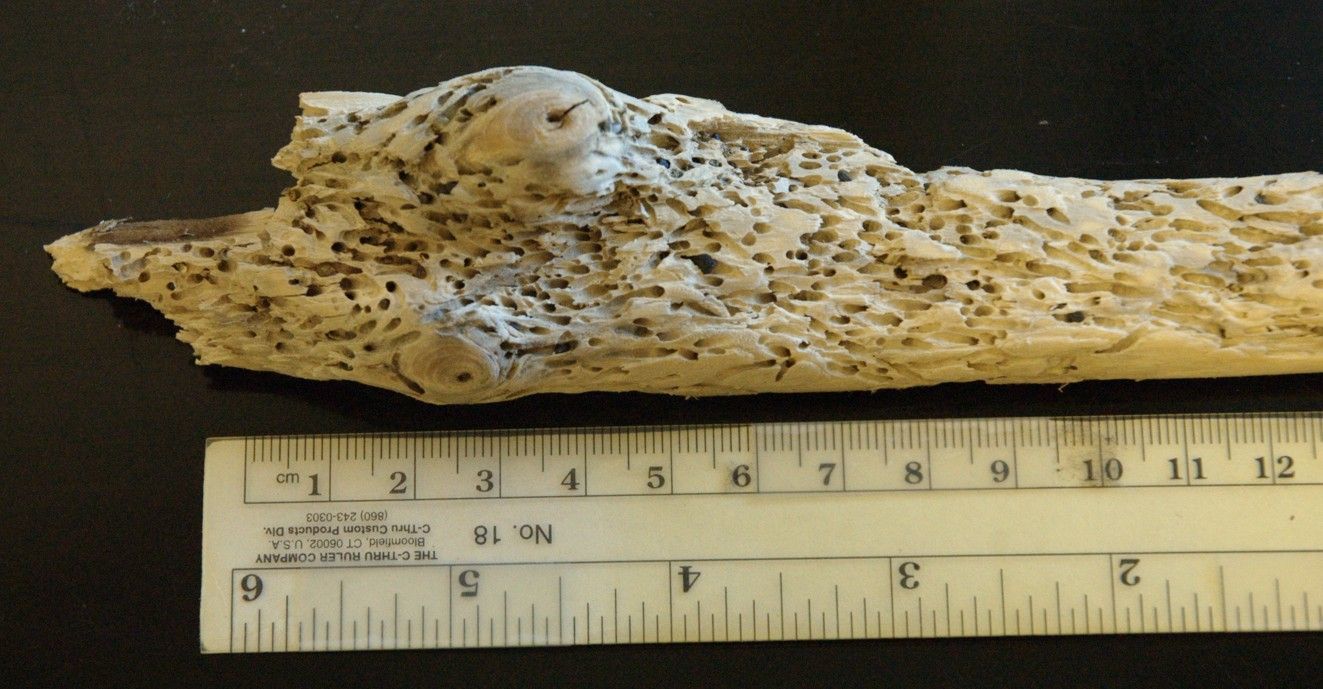
Limnoria lignorum
species of crustacean
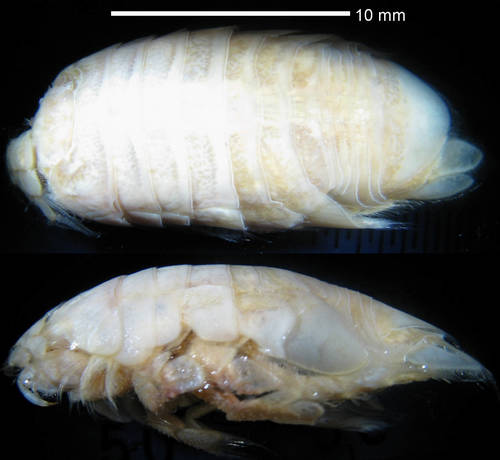
Phoratopus remex
Phoratopus remex is a species of isopod crustaceans known from only two specimens, and first described in 1925 by Herbert Matthew Hale (1895–1963). It lives on the continental shelf at Encounter Bay and Fowlers Bay, South Australia. Unlike all other Isopods, it is placed in its own family, Phoratopodidae and suborder, Phoratopidea.
Onchotelson spatulatus
species of crustacean
Onchotelson brevicaudatus
species of crustacean
Onchotelson
Onchotelson is a genus of isopod crustaceans in the family Phreatoicidae, which is endemic to Tasmania. It contains two species, both of which are listed as vulnerable on the IUCN Red List:
Onchotelson brevicaudatus (Smith, 1909)
Onchotelson spatulatus Nicholls, 1944

Limnoria quadripunctata
species of crustacean
Atlantasellus
Atlantasellus is a genus of crustaceans, and the only member of the family Atlantasellidae. It contains these species:
Phreatoicidea
Phreatoicidea is a suborder of isopod crustaceans. Extant species are confined to freshwater environments in South Africa, India, and Oceania. This seemingly Gondwana-derived distribution belies the fact that the group once had a cosmopolitan distribution; fossils which can be assigned to the Phreatoicidea are the oldest isopod fossils, and are found throughout the world. In the intervening 325 million years, phreatoicideans have changed little, and are thus considered living fossils.
Phreatoicidae
Phreatoicidae is a family of blind, freshwater isopods. They have survived apparently unchanged for 350 million years, and are only found in South Africa, India, Australia and New Zealand. They were first found near Christchurch in 1882 by Charles Chilton. The family Phreatoicidae now contains 13 genera:
Hypsimetopidae
Hypsimetopidae is a family of freshwater isopods.
Flabellifera
Flabellifera is a former suborder of isopod crustaceans. It is a polyphyletic or paraphyletic group, and contained over 3000 species. Its members are now placed in the Sphaeromatidea and Cymothoida.
Keuphylia
Keuphylia is a monotypic genus of crustaceans belonging to the monotypic family Keuphyliidae. The only species is Keuphylia nodosa.
Phreatoicopsidae
Phreatoicopsidae is a family of freshwater isopods found in Oceania. It was originally described as a subfamily of Amphisopidae.