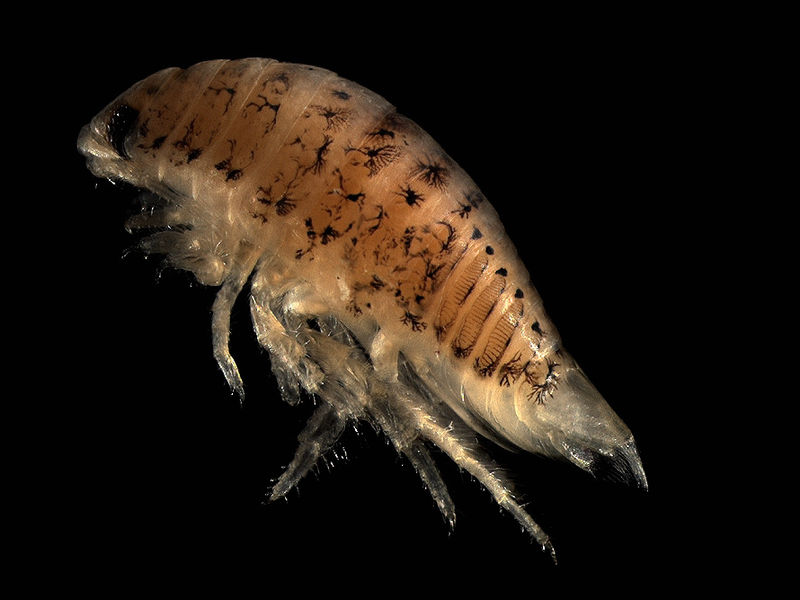
File:Eurydice_pulchra.jpg · Wikimedia Commons · See Wikimedia Commons
Isopoda
Sign in to saveAlso known as the isopods
Isopoda is an order of crustaceans. Members of this group are collectively called isopods and include both aquatic species such as gribbles and terrestrial species such as woodlice. All have rigid, segmented exoskeletons, two pairs of antennae, seven pairs of jointed limbs on the thorax, and five pairs of branching appendages on the abdomen that are used in respiration. Females brood their young in a pouch under their thorax called the marsupium.
Isopods are crustaceans found in both water and on land, including familiar creatures like woodlice and aquatic gribbles, all of which share a rigid segmented body with multiple pairs of limbs and antennae. They matter because they are widespread animals that play various ecological roles in their environments, from decomposition in soil and leaf litter to feeding on wood and other materials in both marine and terrestrial habitats.
AI-generated from the Wikipedia summary — may contain errors.
Species
isopods
Arthropoda
PHYLUM
- KingdomAnimalia
- PhylumArthropoda
- ClassMalacostraca
- OrderIsopoda
等足目(學名:Isopoda),又名等足類或等腳類,是一目甲殼類,其下包括了潮蟲及球潮蟲。等足目的化石紀錄可以追溯至3億年前的石炭紀[3][4]。 目录 1 語源 2 特徵 3 生態 4 多樣化及分類 5 生長 6 參考資料 7 外部連結 語源 其學名是來自希臘文的「相等」及「腳」,故中文名等足目[5]。 特徵 Oniscus asellus:潮蟲的一種。 等足目是體型較細小的甲殼類,有七對大小及形態相似的腳,體型由300微米至50厘米不等。[5]它們的腹背一般都是扁平的,但在深海或地下水中的物種很多時都會不同。[5]等足目沒有明顯的甲殼,只在頭部有殼。[6]氣體交換是由似鰓的腹肢開始至身體後部。陸地生活的等足目很多時都有像肺部的結構,往往在底部顯而易見。[5]若有眼睛,都是無柄的。[6]與異足目一樣,它們最後的腹節與尾節融合,組成腹尾節。[6]胸部的第一節則與頭部融合。胸部附器是單枝的,而腹肢則是二枝的。[6] 生態 Anilocra寄生在黑斑棒鱸。 約有4500種等足目是生活在水中的,大部份分佈在海床。[3]約有500種是淡水的,其餘5000種是屬於潮蟲亞目,遠比陸生的甲殼類成功。[3]在深海中以櫛水虱亞目較為豐富,差不多完全排除了其他等足目,成功發展輻射適應。[3] 一些等足目發展成寄生生態。上蝦亞目是完全寄生的,而扇肢亞目則是部份寄生。例如縮頭魚虱(Cymothoa exigua)是寄生在墨西哥笛鯛中,它會吃了墨西哥笛鯛的舌頭,並且取而代之,是已知唯一在功能上取代主體的寄生方式。[7] 多樣化及分類 等足目屬於囊蝦總目,有特製的育幼袋孵蛋。根據2001年的分類,當時約有11437個物種,分別分類在11個亞目[5][8]。 生長 等足目的幼蟲如同其成蟲,但卻沒有最後一對胸足。等足目生長周期中沒有了游泳階段是限制其分佈的原因,並形成高度特有性。[3]它們會以兩個階段來脫殼。[5] 參考資料 ^ Boxshall, Geoff. Isopoda. World Register of Marine Species. [2014-05-08]. ^ Dreyer, Hermann; Wägele, Johann-Wolfgang. The Scutocoxifera Tax. Nov. and the Information Content of Nuclear ssu rDNA Sequences for Reconstruction of Isopod Phylogeny (Peracarida: Isopoda). Journal of Crustacean Biology. 2002-05, 22 (2): pp. 217–234 [2017-07-17]. 引文格式1维护:冗余文本 (link) ^ 3.0 3.1 3.2 3.3 3.4 Richa
via GBIF
Museum specimens
- Specimen records
- 14,277
- With media
- 860
- Family
- Sparassidae
- Collections
- UWBM, LACM, YPM, SDNHM, FMNH, SIO
- Recorded in
- United States, British Virgin Islands, Canada, Mexico
Research
1,731 papers- Nutrition in terrestrial isopods (Isopoda: Oniscidea): an evolutionary-ecological approach.ReviewBiological reviews of the Cambridge Philosophical Society · 2002Zimmer MDOI: 10.1017/s1464793102005912
- Review of the global distribution and hosts of the economically important fish parasitic isopod genus Ceratothoa (Isopoda: Cymothoidae), including the description of Ceratothoa springbok n. sp. from South Africa.ReviewInternational journal for parasitology · 2020Hadfield KA, Smit NJDOI: 10.1016/j.ijpara.2020.07.001
- Agamermis sp. (Nematoda: Mermithidae) parasitizing Armadillidium vulgare (Crustacea: Isopoda) in Argentina.Journal of helminthology · 2023Rusconi JM, Eliceche D, Salas A et al.DOI: 10.1017/S0022149X23000068
- A new species of Janiralata Menzies, 1951 (Isopoda: Asellota, Janiridae) from Korea.Zootaxa · 2024Kim J, Lee TDOI: 10.11646/zootaxa.5458.3.7
- Cataphryxus zapoteca sp. nov. (Isopoda, Bopyridae) and new hosts and records of bopyrid isopods from the Mexican Eastern Pacific.Systematic parasitology · 2023Romero-Rodríguez J, Álvarez FDOI: 10.1007/s11230-023-10118-z
- Checklist of parasitic isopods from Brazil: Bopyroidea and Cryptoniscoidea (Isopoda: Cymothoida: Epicaridea).Zootaxa · 2023Ribeiro FB, Horch APDOI: 10.11646/zootaxa.5325.2.1
- Ontogenetic Changes in Pigmentation Pattern in Mesanthura miyakoensis (Crustacea: Isopoda: Anthuridae).Zoological science · 2024Shiraki S, Kakui KDOI: 10.2108/zs230122
- Review of the fish-parasitic genus Ceratothoa Dana, 1852 (Crustacea: Isopoda: Cymothoidae) from Australia, with description of two new species.ReviewZootaxa · 2015Martin MB, Bruce NL, Nowak BFDOI: 10.11646/zootaxa.3963.3.1
via PubMed
Wikidata facts
- Instance of
- taxon
- Parent taxon
- Peracarida
- Image
- Eurydice pulchra.jpg
Show 9 more facts
- taxon rank
- order
- Commons category
- Isopoda
- taxon name
- Isopoda
- topic's main category
- Category:Isopoda
- taxon common name
- isopoder
- means of locomotion
- rolling
- exact match
- wordnet-rdf.princeton.edu/wn31/101993545-n
- start time
- 300000000-
- IPA transcription
- ˈaɪsəˈpɑdə
via Wikidata · CC0
~19 min read
Encyclopedic overview
13 sectionsContents
- Etymology
- Description
- Diversity and classification
- Taxonomy
- Evolutionary history
- Biology
- Terrestrial isopods
- Woodlice
- Feeding ecology
- Reproduction and development
- See also
- References
- External links
Isopoda is an order of crustaceans. Members of this group are collectively called isopods and include both aquatic species such as gribbles and terrestrial species such as woodlice. All have rigid, segmented exoskeletons, two pairs of antennae, seven pairs of jointed limbs on the thorax, and five pairs of branching appendages on the abdomen that are used in respiration. Females brood their young in a pouch under their thorax called the marsupium.
Isopods have various feeding methods: some are scavengers and detritivores, eating dead or decaying plant and animal matter; others are grazers or filter feeders, a few are predators, and some are internal or external parasites, mostly of fish. Aquatic species are mostly benthic, living on the bottom of water bodies, but some taxa can swim for short distances. Terrestrial forms move around by crawling and tend to be found in cool, moist places. Some species are able to roll themselves into a ball (known as volvation) as a defense mechanism or to conserve moisture like species in the family Armadillidiidae, commonly called the pillbugs.
Excerpted from Wikipedia’s “Isopoda” article, available under the CC BY-SA 4.0 licence.
Gallery (23)
Available in 67 languages
- Español
- Français
- Deutsch
- 中文
- 日本語
- Русский
- Português
- Italiano
- العربية
- Afrikaans
- azb
- Azerbaijani
- Bahasa Indonesia
- Bangla
- Basque
- Belarusian
- Bulgarian
- Catalan
Show 48 more
- Cebuano
- Croatian
- Czech
- Danish
- Egyptian Arabic
- Esperanto
- Estonian
- Filipino
- Finnish
- Galician
- Georgian
- Hebrew
- Hungarian
- Icelandic
- Irish
- Javanese
- Kannada
- Latin
- Latvian
- Lithuanian
- Low German
- Madurese
- Malay
- Malayalam
- Navajo
- Nederlands
- Northern Frisian
- Norwegian
- Norwegian Nynorsk
- Polski
- Romanian
- Serbian
- simple
- Slovenian
- Svenska
- Tiếng Việt
- Türkçe
- Ukrainian
- Waray
- West Flemish
- Western Frisian
- Western Mari
- Wu Chinese
- Yiddish
- Zeelandic
- فارسی
- ไทย
- 한국어
via Wikidata sitelinks · CC0