Category
page 1Jewellery making

carat
unit of mass
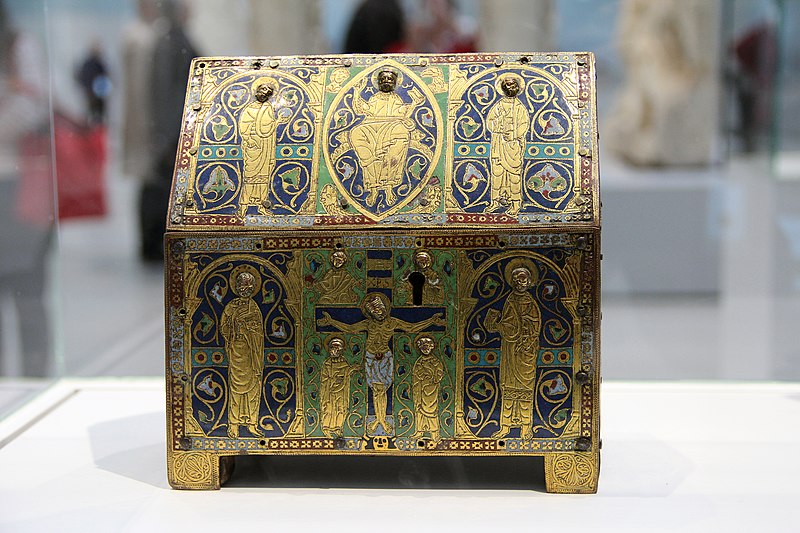
vitreous enamel
material made by fusing powdered glass to a substrate by firing

goldsmith
thumb|The Baqdadi goldsmith by Kamal-ol-molk

engraving process
thumb|Saint Jerome in His Study (Dürer)|St. Jerome in His Study (1514), engraving by [[Northern Renaissance master Albrecht Dürer]]
Engraving is the practice of incising a design on a hard, usually flat surface by cutting grooves into it with a burin. The result may be a decorated object in itself, as when silver, gold, steel, or glass are engraved, or may provide an intaglio printing plate, of copper or another metal, for printing images on paper as prints or illustrations; these images are also called "engravings". Engraving is one of the oldest and most important techniques in printmaking.

lost-wax casting
process by which a duplicate sculpture (often metal) is cast from an original sculpture

filigree
thumb|Gold filigree intricate work from Portugal
thumb|Albanian silver jewellery from 19th and 20th century
thumb|Sterling dish, filigree work
thumb|Citrine cannetille-work brooch
Filigree (also less commonly spelled filagree, and formerly written filigrann or filigrene) is a form of intricate metalwork used in jewellery and other small forms of metalwork.

cloisonné
thumb|Pectoral of Senusret II, from his daughter's grave, using shaped stones rather than enamel. Cloisonné inlays on gold of [[carnelian, feldspar, garnet, turquoise, lapis lazuli, 1880s BC]]
thumb|right|Chinese Ming dynasty|Ming Dynasty cloisonné enamel bowl, using nine colours of enamel
metal casting
pouring liquid metal into a mold
repoussé
metalworking technique
.jpg)
hallmark
thumb|A hallmark is Punch (tool)|punched into a section of a silver chain by a [[silversmith.]]
A hallmark is an official mark or series of marks struck on items made of metal, mostly to certify the content of noble metals—such as platinum, gold, silver and in some nations, palladium. In a more general sense, the term hallmark is used to refer to any standard of quality. Not to be confused with responsibility marks that are the marks of the maker.

fineness
The fineness of a precious metal object (coin, bar, jewelry, etc.) represents the weight of fine metal therein, in proportion to the total weight which includes alloying base metals and any impurities. Alloy metals are added to increase the hardness and durability of coins and jewelry, alter colors, decrease the cost per weight, or avoid the cost of high-purity refinement.. For example, copper is added to the precious metal silver to make a more durable alloy for use in coins, housewares and jewelry. Coin silver, which was used for making silver coins in the past, contains 90% silver and 10% c

cupellation
thumb|200px| 16th century cupellation furnaces (per Georgius Agricola|Agricola)
surgeon's knot
modification to the reef knot that adds an extra twist when tying the first throw, forming a double overhand knot
laser engraving
practice of using lasers to engrave an object
draw plate
manufacturing wire
Fretwork
Fretwork is an interlaced decorative design that is either carved in low relief on a solid background, or cut out with a fretsaw, coping saw, jigsaw or scroll saw. Most fretwork patterns are geometric in design. The materials most commonly used are wood and metal. Fretwork is used to adorn furniture and musical instruments. The term is also used for tracery on glazed windows and doors. Fretwork is also used to adorn/decorate architecture, where specific elements of decor are named according to their use such as eave bracket, gable fretwork or baluster fretwork, which may be of metal, especiall
investment casting
industrial application of lost-wax casting for metal forming
metal clay
craft material of metal particles and a plastic binder

lapidary
Lapidary () is the practice of shaping stone, minerals, or gemstones into decorative items such as cabochons, engraved gems (including cameos), and faceted designs. A person who practices lapidary techniques of cutting, grinding, and polishing is known as a lapidary or lapidarist. Hardstone carving requires specialized carving techniques.
Chip carving
is a style of carving in which knives or chisels are used to remove small chips of the material
Opus interrasile
Callaïs
thumb|380x380px|An example of a variscite "callaïs" necklace of Neolithic origin, dated 4500 - 4000 BC, found in Arzon. The necklace now located in the Musée d'Histoire et d'Archéologie de Vannes.
Callaïs is the generic name for ancient green-blue precious stones used for making pendants and beads by western European cultures of the later Neolithic and early Bronze Age. The term includes turquoise and variscite but not jade. "Callaïs" was described by Pliny the Elder as being paler than lapis lazuli. Callaïs objects have been found in Neolithic tombs from the mid-5th millennium BC in the Carna
millesimal fineness
dimensionless measure of fineness
basse-taille
thumb|300px|The Royal Gold Cup, 23.6 cm high, 17.8 cm across at its widest point; weight 1.935 kg. [[British Museum]]
diamond cutter
thumb|Polishing a diamond
A diamantaire (French origin) could be a gem-quality diamond manufacturer or producer, master diamond cutter, and or a graduate gemologist specializing in diamonds.
art jewelry
Type of jewelry
Skan'
thumb|A Skan'
A Skan' (Old Russian: съкань, skan', which is in turn from the verb съкати, skati, "twist", "twist into a single or a few strands") is the Russian counterpart of a filigree. It is a kind of jewelry art with a thin layer of gold, silver or copper wire wound in cords or soldered on a metal background. Skan's are often supplemented by tiny silver or gold beads and enamel.
ODISHA
thumb|Tarakashi work of Cuttack