Category
page 1Julii

Philip the Arab
Roman Emperor (204-249)

Constantius II
Roman emperor (317-361)
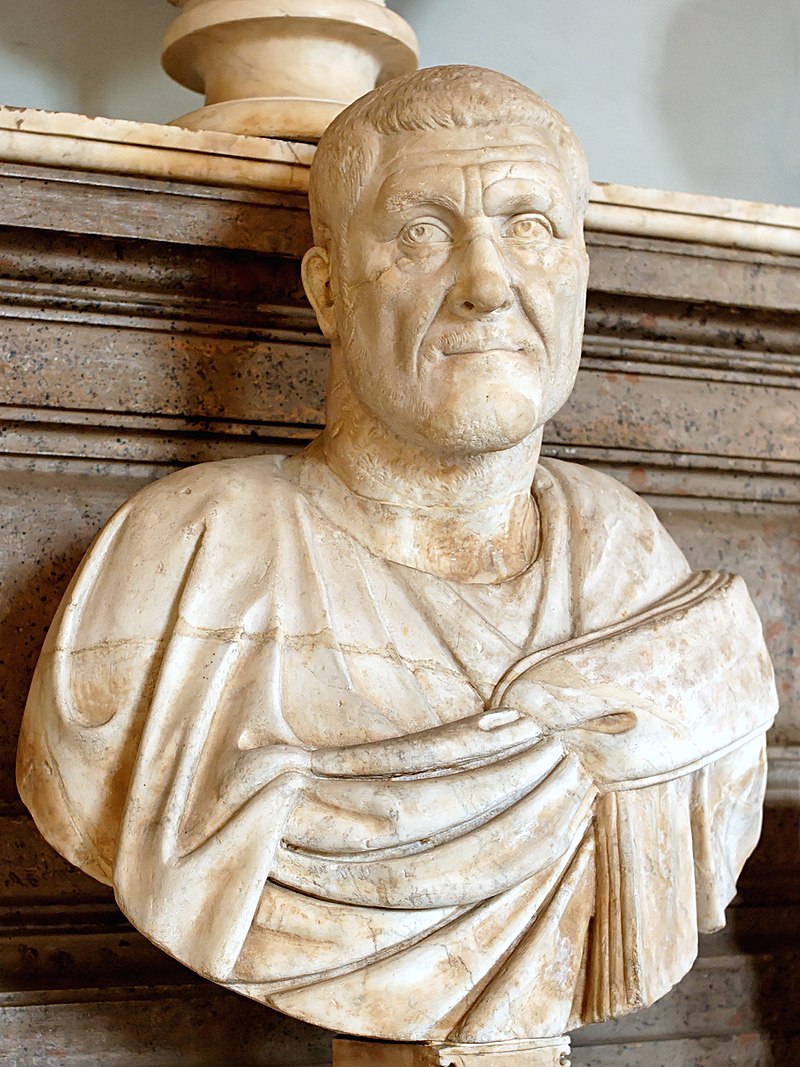
Maximinus Thrax
Roman Emperor (173-238)

Julius Nepos
Roman emperor (430-480)

Helena Augusta
saint, first wife of Roman emperor Constantius Chlorus, and mother of Emperor Constantine the Great (250-330)
%20th%C3%A9odosienne%20de%20la%20villa%20romaine%20de%20Chiragan%20-%20Mus%C3%A9e%20Saint-Raymond%20Ra%2082.jpg)
Majorian
Majorian (; 7 August 461) was Western Roman emperor from 457 to 461. A prominent commander in the Western military, Majorian deposed Avitus in 457 with the aid of his ally Ricimer at the Battle of Placentia. Possessing little more than Italy and Dalmatia, as well as some territory in Hispania and northern Gaul, Majorian campaigned vigorously for three years against the Empire's enemies. In 461, he was murdered at Dertona in a conspiracy, and his successors until the fall of the Empire in 476 were puppets either of barbarian generals or the Eastern Roman court.
%20MET%20DT5196.jpg)
Constans
Flavius Julius Constans ( 323 – 350), also called Constans I, was Roman emperor from 337 to 350. He held the imperial rank of caesar from 333, and was the youngest son of Constantine the Great.

Agrippa I
King of Judaea (11 BC-44 AD) (r. 41-44 AD)

Gnaeus Julius Agricola
Roman governor and general, AD 40-93 (40-93)
Juba II
crown prince of Numidia and King of Mauretania (c. 48 BC - AD 23)

Julia Domna
ancient Roman empress

Frontinus
Sextus Julius Frontinus (c. 40 – 103 AD) was a Roman civil engineer, author, soldier and senator of the late 1st century AD. He was a successful general under Domitian, commanding forces in Roman Britain, and on the Rhine and Danube frontiers. A novus homo, he was consul three times. Frontinus ably discharged several important administrative duties for Nerva and Trajan. However, he is best known to the post-Classical world as an author of technical treatises, especially De aquaeductu, dealing with the aqueducts of Rome.

Gaius Julius Hyginus
Roman freedman and writer (c. 64 BC – AD 17)

Agrippa II
king of Chalcis (Syria) from Herodian dynasty (28-100)

Sextus Julius Africanus
Greco-Roman Christian traveller and historian (c.160–c.240)

Philippus II
consul of the Roman Empire (237-249)
Julia Maesa
grandmother of Roman emperors Elagabalus and Severus Alexander

Julius Paulus
late 2nd/early 3rd century Roman jurist and possibly father of empress Julia Cornelia Paula
Julius Firmicus Maternus
4th century Latin writer and astrologer
Gaius Julius Solinus
3rd or 4th century Roman geographer and grammarian

Berenice
1st century CE member of the Herodian Dynasty that ruled the Roman province of Judaea

Julia Avita Mamaea
mother of Roman emperor Alexander Severus (died 235)

Julia Soaemias
mother of Roman emperor Elagabalus (180-222)
Julia gens
Roman gens

Gaius Julius Civilis
leader of the Batavian rebellion against the Romans in 69 AD
Ptolemy of Mauretania
1st century king of Mauretania
Flavia Julia Constantia
4th-century Roman empress and wife of Licinius
Vindex
Roman senator and governor (AD c.25-68)
Julius Constantius
son of Roman Emperor Constantius Chlorus (died 337)
Eulalia of Mérida
early 4th-century Spanish saint

Vaballathus
Septimius Vaballathus (; ; – ) was emperor of the Palmyrene Empire centred at Palmyra in the region of Syria.
Tigranes VI of Armenia
1st century AD Herodian Prince who was a Roman Client King of Armenia
Antiochus IV of Commagene
Last king of Commagene (ruled AD 38-72)
Julius Pollux
2nd century Greek grammarian and sophist
Julius Saturninus
3rd-century Roman usurper
Tiberius Julius Alexander
Roman governor and general
Julius Obsequens
Roman historian and writer

Gaius Julius Priscus
brother of Roman emperor Philip the Arab
Julia Cornelia Paula
Roman Empress as the first wife of Elagabalus

Uranius
thumb|300px|Uranius Antoninus coin, with Greek inscriptions and dated according to the Seleucid Empire. On the reverse, the Emesa temple to the sun god El Gabal, with the holy stone.
Drusilla
daughter of Herod Agrippa
Julia Balbilla
Roman noble woman and poet
Julia of Corsica
Carthaginian martyr
Sextus Julius Severus
Roman suffect consul 127 AD

Philopappos
thumb|Bronze coin of Philopappos from Selinus (Cilicia) (ca. AD 72)
thumb|Mausoleum of Philopappos
Gaius Julius Quadratus Bassus
Roman senator, general and governor (70 – 117)
Gaius Julius Verus Maximus
son of Roman Emperor Maximinus Thrax
Licinianus
Julius Valens Licinianus, known as Licinian, was a Roman usurper in 250. Apparently, Licinian, who was a senator, had the support of the Roman Senate and parts of the population when he initiated an uprising against Decius, who was fighting the Goths. However, Valerian, who had been left in charge in Rome by Decius, had little trouble in suppressing the rebellion.
Lucius Julius Ursus Servianus
Iberian Roman politician and consul (45 – 136)
Lucius Julius Libo
Roman consul 267 BC
Tiberius Julius Mithridates
Roman client ruler of the Bosporan Kingdom
Julius Asclepiodotus
Late 3rd-century Roman politician
Tiberius Julius Aspurgus
Tiberius Julius Aspurgus Philoromaios (, fl. second half of 1st century BC and first half of 1st century AD; died 37/38) was a prince and Roman client king of the Bosporan Kingdom.
Tiberius Julius Abdes Pantera
Roman soldier of the Cohors I Sagittariorum (c. 22 BC - AD 40)
Julius Sabinus
1st century aristocratic Gaul of the Lingones tribe
Quintus Pompeius Falco
2nd century Roman senator, governor and general
Julius Avitus
Syrian-born Roman military commander, senator and governor (c. 155-217)
Sohaemus of Emesa
Roman Client Priest King of the Emesan kingdom (ruled AD 54-73)
Gaius Antius Aulus Julius Quadratus
Roman consul in 105 AD
Seleucus
3rd century Roman imperial usurper