Category
page 1Laboratory glassware

funnel
thumb|A typical kitchen funnel
thumb|A ceramic Ancient Rome|Roman kitchen funnel (1st–3rd century AD)

hydrometer
thumb|upright=0.65|Schematic drawing of a hydrometer. The lower the density of the fluid, the deeper the weighted float B sinks. The depth is read off the scale A.
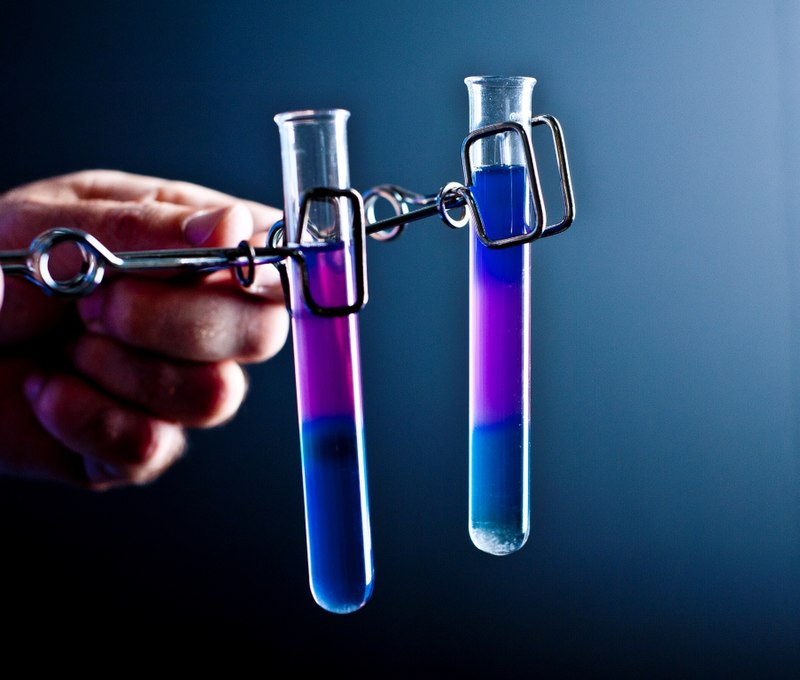
test tube
laboratory glassware consisting of a finger-like length of glass or clear plastic tubing, open at the top and closed at the bottom

Petri dish
shallow dish on which biological cultures may be grown and/or viewed
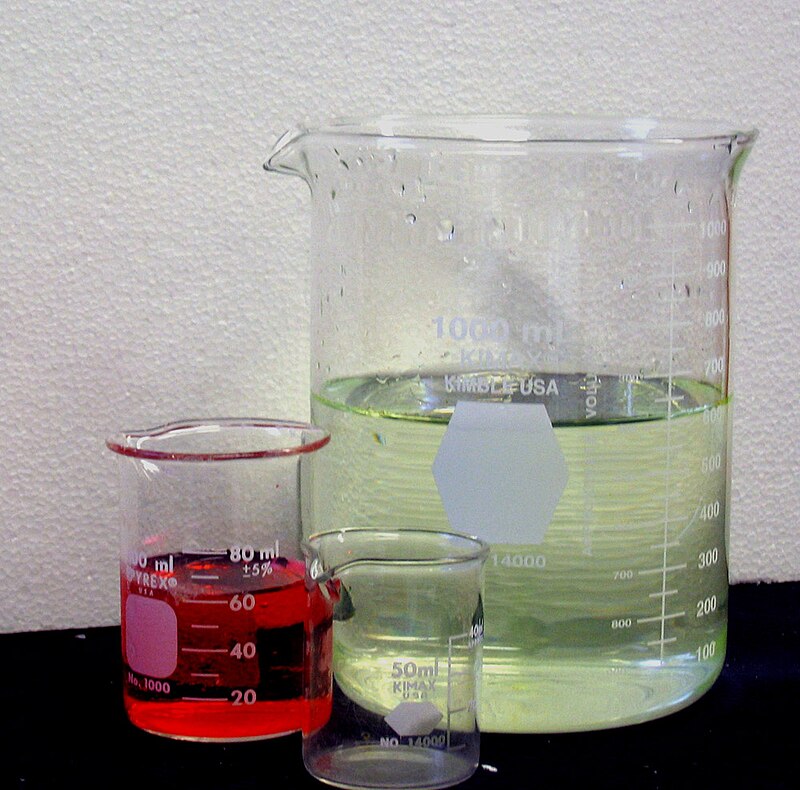
beaker
cylindrical, open-topped laboratory container

pipette
A pipette (also spelled pipet) is a type of laboratory tool commonly used in chemistry and biology to transport a measured volume of liquid, often as a media dispenser. Pipettes come in several designs for various purposes with differing levels of accuracy and precision, from single piece glass pipettes to more complex adjustable or electronic pipettes. Many pipette types work by creating a partial vacuum above the liquid-holding chamber and selectively releasing this vacuum to draw up and dispense liquid. Measurement accuracy varies greatly depending on the instrument.

Erlenmeyer flask
flat-bottomed, conical laboratory glassware
measuring cylinder
common piece of laboratory equipment used to measure the volume of a liquid; has a narrow cylindrical shape

laboratory flask
type of laboratory glassware; container with a narrow neck

volumetric flask
type of laboratory flask

condenser
device used to condense a substance from its gaseous to its liquid state

desiccator
thumb|right|A vacuum desiccator (left - note the stopcock which allows a vacuum to be applied), and a desiccator (right). The blue silica gel in the space below the platform is used as the [[desiccant.]]
Desiccators are sealable enclosures containing desiccants used for preserving moisture-sensitive items such as cobalt chloride paper for another use. A common use for desiccators is to protect chemicals which are hygroscopic or which react with water from humidity.
watch glass
piece of labratory glassware
Büchner funnel
chemical laboratory filtration apparatus
Büchner flask
laboratory glassware

cuvette
thumb|Dansyl chloride solution in a cuvette|220x220px
In laboratories, a cuvette () is a small tube-like container with straight sides and a circular or square cross-section. It is sealed at one end, and made of a clear, transparent material such as plastic, glass, or fused quartz. Cuvettes are designed to hold samples for spectroscopic measurement, where a beam of light is passed through the sample within the cuvette to measure the absorbance, transmittance, fluorescence intensity, fluorescence polarization, or fluorescence lifetime of the sample. This measurement is done with a spectrophotom

retort
thumb|A copper retort
thumb|300px|A glass retort
round-bottom flask
type of flasks having spherical bottoms used as laboratory glassware, mostly for chemical or biochemical work
laboratory condenser
laboratory apparatus used to condense gases into liquids
laboratory glassware
variety of equipment, traditionally made of glass, used for scientific experiments and other work in science, especially in chemistry and biology laboratories
Soxhlet extractor
piece of laboratory apparatus

carboy
thumb|right|Large plastic bottles for a water dispenser
thumb|upright|A glass carboy acting as a fermentation vessel for beer. It is fitted with a fermentation lock.
upright|thumb|A Bulgarian demijohn (damadzhana)
microscope slide
thin piece of glass (or transparent material) used to hold objects for examination under a microscope

vial
thumb|Vial of vaccine and syringe
thumb|Examples of modern flat-bottomed plastic vials
thumb|Sterile single-use vial of eye drops
A vial (also known as a phial or flacon) is a small glass or plastic vessel or bottle, often used to store medication in the form of liquids, powders, or capsules. They can also be used as scientific sample vessels; for instance, in autosampler devices in analytical chromatography. Vial-like glass containers date back to classical antiquity; modern vials are often made of plastics such as polypropylene. There are different types of vials such as a single dose vial a
wash bottle
style of squeeze bottle for laboratory use
glass rod
laboratory glassware using for stirring

eudiometer
A eudiometer is a laboratory device that measures the change in volume of a gas mixture following a physical or chemical change.
weighing bottle
Thiele tube
thiele tube
Pasteur pipette
dropper (not screwed to a vial)
Dean-Stark apparatus
Laboratory equipment
dropping funnel
laboratory glassware used to transfer fluids slowly
Liebig condenser
laboratory glassware used for cooling gases into liquids
evaporating dish
a piece of laboratory glassware used for the evaporation of solutions and supernatant liquids, and sometimes to their melting point
Schlenk flask
reaction vessel used in air-sensitive chemistry

cold finger
laboratory equipment
Drying tube

ground glass joint
laboratory equipment connection standard
Cold trap
device that condenses specific vapors and gases

McLeod gauge
Type of measuring device
Nessler cylinder
10-30cm long flat-bottomed laboratory tube made of glass
Florence flask
glass laboratory container
boiling tube
small cylindrical vessel used to strongly heat substances in the flame of a Bunsen burner; larger than a test tube; designed to be wide enough to allow substances to boil violently
Schlenk line
glass apparatus used in chemistry
gas syringe
tool used in a laboratory
cryophorus
thumb|300px|right|Wollaston's diagram of a cryophorus. When the empty ball on the right is immersed in a freezing mixture of snow and salt, the water in the ball on the left freezes in a few minutes.
NMR tube
laboratory glassware
bell jar
glass jar
Dasymeter
thumb|Dasymeter at standard pressure
thumb|Dasymeter at reduced pressure
thumb|Historical drawing of a dasymeter (in German: "Fig. 109. Baroscope. (Apparatus for proving the buoyancy of air)")
coil
thistle tube
piece of laboratory glassware
Boston round
standard type of glass bottle
volumetric pipette
precise measurement glassware
gas bubbler
laboratory equipment used to remove air
stopcock
thumb|right|Example of symbol for a stop valve
A stopcock is a form of valve used to control the flow of a liquid or gas. The term is not precise and is applied to many different types of valve. The only consistent attribute is that the valve is designed to completely stop the flow when closed fully.
Perkin triangle
chemistry apparatus specialized for the distillation of air-sensitive substances
Abderhalden's drying pistol
Abderhalden's drying pistol
cell spreader
type of laboratory equipment
Conical measure
type of graduated laboratory glassware with a conical cup and a notch on the top to facilitate pouring of liquids
reagent bottle
laboratory storage container