File:Pipette_gallery.jpg · Wikimedia Commons · See Wikimedia Commons
pipette
Sign in to saveAlso known as pipet, pipettor, chemical dropper, pipettes, plunging siphon
A pipette (also spelled pipet) is a type of laboratory tool commonly used in chemistry and biology to transport a measured volume of liquid, often as a media dispenser. Pipettes come in several designs for various purposes with differing levels of accuracy and precision, from single piece glass pipettes to more complex adjustable or electronic pipettes. Many pipette types work by creating a partial vacuum above the liquid-holding chamber and selectively releasing this vacuum to draw up and dispense liquid. Measurement accuracy varies greatly depending on the instrument.
Key facts
- Tool.name
- Pipette
- Tool.caption
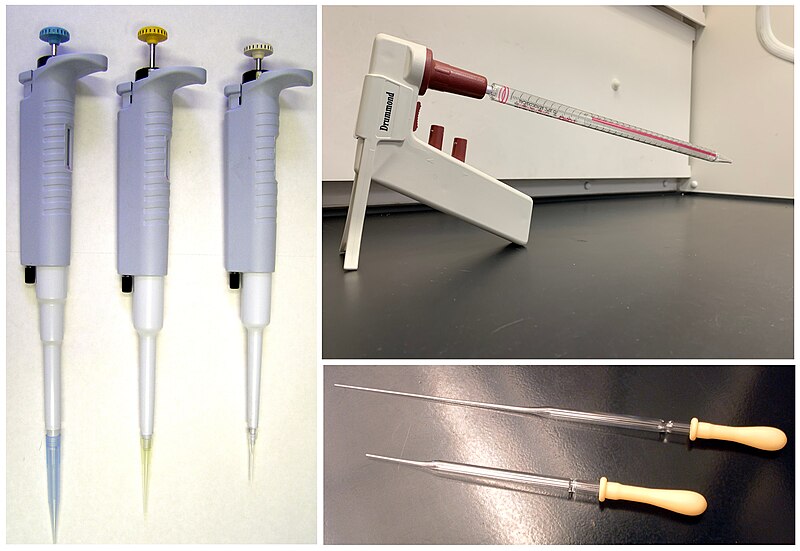
- Clockwise from top left: various sizes of micropipettes; a graduated serological pipette attached to an electronic manual pipetter; two Pasteur pipettes.
- Tool.image
- File:Pipette gallery.jpg
- Tool.image_size
- 315
- Tool.classification
- Media dispenser
- Tool.uses
- Volume measurement, liquid transfer
via Wikipedia infobox
Wikidata facts
- Subclass of
- container
- Image
- Pipette 2 (PSF).png
Show 2 more facts
- Commons gallery
- Pipette
- Commons category
- Pipettes
Sources (3)
via Wikidata · CC0
~16 min read
Encyclopedic overview
26 sectionsContents
- History
- Nomenclature
- Common pipettes
- Air displacement micropipettes
- Electronic pipette
- Positive displacement pipette
- Volumetric pipettes
- Graduated pipettes
- Pasteur pipette
- Transfer pipettes
- Specialized pipettes
- Pipetting syringe
- Van Slyke pipette
- Ostwald–Folin pipette
- Winkler–Dennis gas combustion pipette
- Glass micropipette
- Microfluidic pipette
- Extremely low volume pipettes
- Pipette aids
- Robots
- Calibration
- Posture and injuries
- Pipette stand
- Alternatives
- References
- External links
A pipette (also spelled pipet) is a type of laboratory tool commonly used in chemistry and biology to transport a measured volume of liquid, often as a media dispenser. Pipettes come in several designs for various purposes with differing levels of accuracy and precision, from single piece glass pipettes to more complex adjustable or electronic pipettes. Many pipette types work by creating a partial vacuum above the liquid-holding chamber and selectively releasing this vacuum to draw up and dispense liquid. Measurement accuracy varies greatly depending on the instrument.
==History== The first simple pipettes were made of glass, such as Pasteur pipettes. Large pipettes continue to be made of glass; others are made of squeezable plastic for situations where an exact volume is not required.
Excerpted from Wikipedia’s “pipette” article, available under the CC BY-SA 4.0 licence.