Category
page 1Latin American caste system
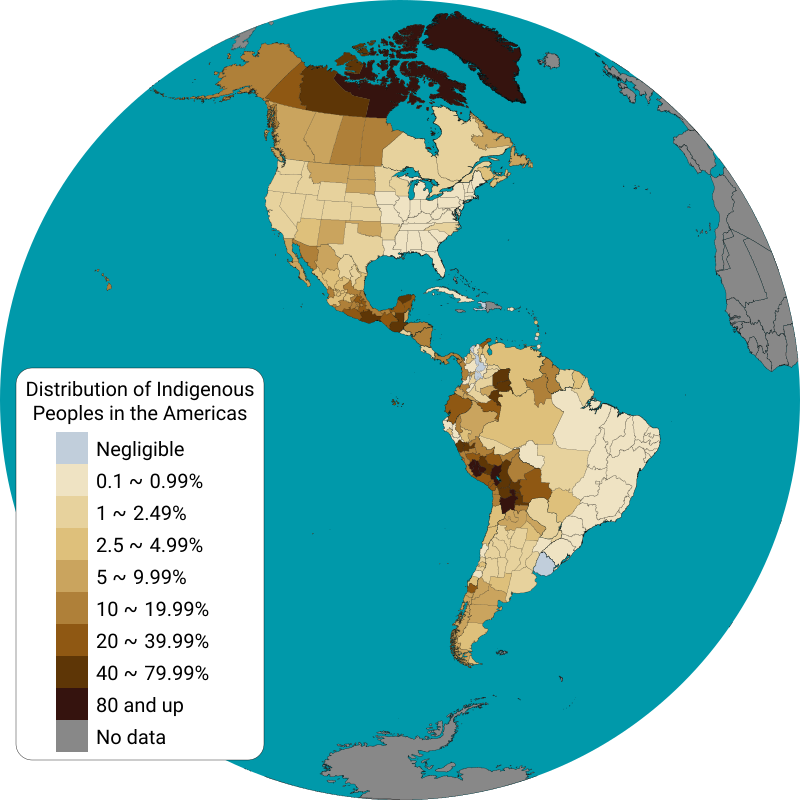
Indigenous peoples of the Americas
peoples indigenous to the Western Hemisphere

Black people
skin color-based classification of people with origins in the tropical climate zone of Africa and Melanesia

mestizo
'''''' is a term primarily used to denote people of mixed Spanish and Indigenous ancestry in the former Spanish Empire. In certain regions such as Latin America, it may also refer to people who are culturally European, even though their ancestors were Indigenous Americans. The term was used as an ethno-racial exonym for mixed-race that evolved during the Spanish Empire. It was a formal label for individuals in official documents, such as censuses, parish registers, Inquisition trials, and others. Priests and royal officials might have classified persons as mestizos, but individuals also used t
_Arellano.jpg)
mulatto
' ( , ) is a racial classification that refers to people of mixed African and European ancestry. When speaking or writing about a singular woman in English, the word is ' (). The use of this term began in areas that later became the United States shortly after the Atlantic slave trade began. Although it has been employed in derogatory contexts, some mixed-race communities reject the claim that the term is inherently offensive and instead regard it as a descriptor that has been mischaracterized by individuals who are not of mixed-race origin. After the post Civil Rights Era, the term is now con

zambo
Zambo ( or ) or Sambu is a racial term to refer to people of mixed Amerindian and sub-Saharan African ancestry.
.svg)
adelantado
Adelantado (, , ; meaning 'advanced') was a title held by some Spanish nobles in service of their respective kings during the Middle Ages. It was later used as a military title held by some Spanish conquistadores of the 15th, 16th and 17th centuries.
New Christian
community descended from Muslims and Jews
Limpieza de sangre
Spanish oppressive policies against crypto-Jews and crypto-Muslims

casta
thumb|upright=1.3|. A casta painting showing 16 racial groupings. Anonymous, 18th century, oil on canvas, 148×104 cm, , , Mexico
Peninsulars
In the context of the Spanish Empire, a peninsular (, pl. peninsulares) was a Spaniard born in Spain residing in the New World, Spanish East Indies, or Spanish Guinea. In the context of the Portuguese Empire, reinóis (singular reinol) were Portuguese people born in Portugal residing primarily in Portuguese America; children born in Brazil to two reinóis parents were known as mazombos.

reductions
thumb|300px|A church was always at the center of the reductions; this one is in Loreto, Baja California Sur.

Ilustrado
thumb|300px|right|Ilustrados in Madrid, c.1890; Standing clockwise from left: Vicente Francisco, Cajigas, José Abreu, Mariano Abella, Dominador Gómez, [[Francisco Tongio Liongson, Flaviano Cordecruz, a Tuazon from Malabon, Alejandro Yance de Lara, Lauro Dimayuga, Marcelo H. del Pilar, Gregorio Aguilera, José Rizal, José Alejandrino, Baldomero Roxas, Moises Salvador, Modesto Reyes, Gaudencio Juanengo, Pablo Rianzares Bautista; Seated from left: Dr. Santamaria, Candido Morada, Damaso Ponce, Ariston Bautista, Pedro Serrano Lactao, and Teodoro Sandiko]]
The Ilustrados (, "erudite", "learned" or "e

Cholo
thumb|A mestizo and Indigenous parents' child was a , traditionally. Casta painting from colonial Peru, 1770.
thumb|Casta painting showing 16 hierarchically arranged, Mestizo|mixed-race groupings. The top left grouping uses cholo as a synonym for mestizo. Ignacio Maria Barreda, 1777. [[Real Academia Española de la Lengua, Madrid.]]
Laws of the Indies
entire body of laws issued by the Spanish Crown for the American and the Philippine possessions of its empire

Ladinos
mix of mestizo or hispanicized peoples in Latin America, principally in Central America
Mestiço
thumb|right|Mestiço man with gun and sword under a fruiting papaya tree, Albert Eckhout, mid-seventeenth century [[Dutch Brazil]]
Mestiço is a Portuguese term that refers to persons of mixed race, as people from European and Indigenous non-European ancestry.
Criollo people
Latin Americans of Spanish descent
Mameluco
thumb|right|150px|Albert Eckhout: a mameluco woman in Brazil, 1641–1644
Mameluco is a Portuguese word that denotes the first generation child of a European and an Amerindian. It corresponds to the Spanish word mestizo.
race and ethnicity in Brazil
overview of race and ethnicity in Brazil
Castizo
thumb|The child of a Spaniards|Spaniard (right) and a mestiza (middle) is a castiza. By Miguel Cabrera. (1763)
blanqueamiento
thumb|''Ham's Redemption|A Redenção de Cam (Redemption of Ham''), by Galician painter [[Modesto Brocos, 1895, Museu Nacional de Belas Artes. The painting depicts a black grandmother, mulatta mother, white father and their quadroon child, hence three generations of racial hypergamy through whitening.]]