Category
page 1Lecideales genera

Lecidea
Lecidea is a genus of crustose lichens with a carbon-black ring or outer margin (exciple) around the fruiting body disc (apothecium), usually (or always) found growing on (saxicolous) or in (endolithic) rock. Lichens that have such a black exciple are called lecideine, meaning "like Lecidea, even if they are not in this genus. Members of the genus are commonly called disk lichens or tile lichens.

Porpidia
Porpidia is a genus of crustose lichens in the family Lecideaceae. Porpidia species primarily inhabit siliceous rocks, pebbles, and stonework, with rare occurrences on bark, wood, and compacted soil. The thallus, or body of the lichen, varies in appearance from thick and crusty to barely visible. It may form a continuous layer or develop cracks resulting in a segmented, structure. The colour of the thallus ranges from grey and white to orange.
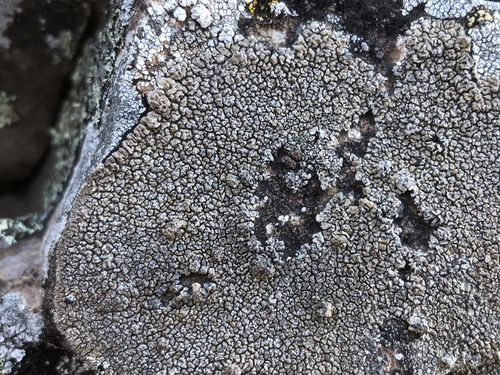
Immersaria
Immersaria is a genus of lichen-forming fungi in the family Lecideaceae. Species in the genus form brown to orange-brown crusts on rock, often with a waxy or glossy surface. They are characterised by dark, sunken fruiting bodies that lack the prominent rim seen in some related genera. The genus occurs in Europe, Asia, and the Southern Hemisphere, typically in alpine or montane habitats.

Bellemerea
Bellemerea is a genus of saxicolous (rock-dwelling) crustose lichens in the family Lecideaceae. These lichens form tough, crusty patches on hard rock surfaces, often appearing as a mosaic of small angular blocks in colours ranging from white and grey to brown. The genus includes nine species found primarily in mountainous and polar regions where they help colonize bare rock surfaces in harsh environments.

Koerberiella
Koerberiella is a genus of lichenized fungi within the Lecideaceae family.

Clauzadea
Clauzadea is a genus of lichen-forming fungi in the family Lecideaceae. The genus contains four species. These lichens grow almost exclusively on limestone and other calcium-rich rocks, often living mostly hidden within the upper layers of the stone with only a faint grey or brown film visible on the surface. They produce small, initially reddish-brown fruiting bodies that darken to black and may sit flush with the rock surface or be sunken so deeply that they leave neat pits when they weather away.

Farnoldia
Farnoldia is a small genus of lichen-forming fungi in the family Lecideaceae. These lichens grow as dark crusts on limestone and other calcium-rich rocks, especially in mountainous areas. The genus contains three known species and can be distinguished from similar lichens by their distinctive black fruiting bodies (apothecia) and violet reaction when tested with iodine staining.

Lopadium
genus of fungi

Cecidonia
Cecidonia is a genus of lichenicolous (lichen-dwelling) fungi in the family Lecideaceae. It has two species. These fungi create distinctive white, warty swellings or galls up to 6 mm across on the surface of their rock-dwelling lichen hosts, which then develop small black fruiting bodies. The genus name refers to this gall-forming behaviour, and the two species primarily attack crustose lichens that grow on siliceous rocks.

Amygdalaria
Amygdalaria is a genus of lichen-forming fungi in the family Lecideaceae. These lichens are typically found growing as crusts on siliceous rocks in arctic and alpine environments. Members of this genus form crustose thalli and are distinguished by their unusually large, smooth ascospores enclosed in gelatinous sheaths. The lichens have cephalodia containing Stigonema, a blue-green alga that enables nitrogen fixation.

Eremastrella
Eremastrella is a genus of lichen in the family Psoraceae. The genus was circumscribed by the lichenologist Stefan Vogel in 1955, with Eremastrella tobleri assigned as the type species.
Catarrhospora
Catarrhospora is a genus of two species of lichens in the family Lecideaceae that are found in South Africa. The genus was circumscribed by the lichenologist Franklin Andrej Brusse in 1994.
Bryobilimbia
Bryobilimbia is a genus of lichen-forming fungi belonging to the family Lecideaceae. It was circumscribed in 2014 by Alan Fryday, Christian Printzen, and Stefan Ekman. The type species is Bryolimbia hypnorum.
Stephanocyclos
Stephanocyclos is a genus of lichen-forming fungi in the family Lecideaceae. It is a monotypic genus, containing the single species Stephanocyclos henssenianus. This crustose lichen was formally described as a new species in 1983 by German lichenologist Hannes Hertel as part of a set of exsiccata (dried herbarium specimens). The type specimen was collected from volcanic rock found on Marion Island, one of the two Prince Edward Islands in the southern Indian Ocean. The specific epithet henssenianus honours lichenologist Aino Henssen.

Schizodiscus
Schizodiscus is a genus of lichenized fungi within the Lecideaceae family. This is a monotypic genus, containing the single species Schizodiscus afroalpinus.
Xenolecia
Xenolecia is a genus of saxicolous (rock-dwelling) and crustose lichens in the family Lecideaceae. It has two species: X. cataractarum, and the type species, X. spadicomma. The genus was circumscribed by German lichenologist Hannes Hertel in 1987 to contain the type, a lichen known at that time only from the type locality on Wellington Island, Chile. Its range has since been expanded to include the Falkland Islands and northern Patagonia. X. cataractarum, found in Campbell Island, New Zealand was added to the genus in 2017.
Pachyphysis
Pachyphysis is a fungal genus in the family Lecideaceae. It is a monotypic genus, containing the single species Pachyphysis ozarkana, a lichen. It is a crust-forming lichen that grows on limestone and dolomite rocks in open, sunny habitats, and is often inconspicuous because its main body develops within the rock surface rather than on top of it. The species has a restricted range in the eastern and central United States, centred on the Ozarks, and is associated with landscapes that were not covered by ice sheets during the last ice age.

Lecidoma
Lecidoma is a single-species fungal genus in the family Lecideaceae. It is a monotypic genus, containing the single species Lecidoma demissum, a crustose lichen. This lichen forms thick, cushion-like crusts up to 12 cm across that are dark brown to grey-brown and broken into tightly packed, slightly swollen blocks giving a lumpy appearance, with glossy black to reddish-brown fruiting bodies dotting the upper surface.