Category
page 10Lichen genera

Wadeana
Wadeana is a small genus of lichen-forming fungi in the division Ascomycota. Its to other taxa within the division is unknown (incertae sedis), and it has not yet been placed with certainty into any class, order, or family. The genus was established in 1978 by the British lichenologists Brian Coppins and Peter James, who named it after the veteran naturalist Arthur Edward Wade for his decades of work studying British lichens. These bark-dwelling lichens live almost completely hidden within the outer layers of tree bark and produce distinctive crack-like fruiting bodies with bright red-brown in

Hafellia
Hafellia is a genus of lichen-forming fungi in the family Caliciaceae. The genus has a widespread distribution, especially in tropical regions. The genus is named in honour of the Austrian lichenologist Josef Hafellner. The genus was proposed by the German lichenologist Klaus Kalb in 1986 to contain two bark-dwelling species, formerly in genus Buellia, with callispora-type spores. These ascospores have ridged walls, and are thin walled at their tips at early states of their differentiation.

Julella
Julella is a genus of ascomycete fungi. Most species are non-lichenised, bark-dwelling saprophytes, though some collections appear to be facultatively lichenised with the green alga Trentepohlia. The fungi produce immersed, black, flask-shaped perithecia with a dark . Their asci are double-walled and contain two or eight large, colourless, (multi-chambered) ascospores. Asexual fruiting bodies (pycnidia) produce simple, rod-shaped conidia. No secondary metabolites are known. The genus was introduced by Jean-Henri Fabre in 1879. Modern treatments recognise only a few species, and its family plac

Acolium
Acolium is a genus of lichenized fungi in the family Caliciaceae. The genus has a widespread distribution and contains six species. These lichens are found on bark and wood, occasionally on rocks, or growing on other lichens.

Santessonia
Santessonia is a genus of lichenized fungi in the family Caliciaceae. The genus was circumscribed in 1978 by lichenologists Mason Hale and Gernot Vobis, with Santessonia namibensis assigned as the type species, and at that time, only species. This species, endemic to the Namib Desert, has deep depressions (lacunae) in the thallus, which are interpreted as an adaptation to take advantage of the infrequent moisture provided by fog. The genus name honours Norwegian lichenologist Rolf Santesson.
Pseudocalopadia
Pseudocalopadia is a genus of lichen-forming fungi in the family Ectolechiaceae. The genus was circumscribed in 1999 by the lichenologist Robert Lücking, with Pseudocalopadia mira as the type, and at the time, only species. P. chibaensis was added to the genus in 2017.

Scytinium
Scytinium is a genus of lichen-forming fungi in the family Collemataceae. It has 49 species. These lichens are typically found on basic rocks, soil, and trees, occasionally in association with mosses. In its revised sense, Scytinium includes crustose, squamulose or small foliose jelly-lichens with thalli (lichen bodies) usually only a few millimetres to a few centimetres across. Despite the morphological and ecological diversity within Scytinium, its species share similar ascospore features, such as shape and septation, as well as a small to medium-sized thallus with at least a partial .

Pyrenothrix
Pyrenothrix is a small genus of lichen-forming fungi in the family Pyrenotrichaceae. It comprises two species of filamentous lichens, which are organisms formed by a symbiotic relationship between fungi and photosynthetic partners. The genus is characterized by its unique structure, featuring densely arranged filaments composed of cyanobacteria (blue-green algae) wrapped in fungal threads. Pyrenothrix species form dark greyish-brown growths on various surfaces, with one species found on tree bark and the other on leaves in tropical forests. The genus was circumscribed in 1917 by American scien
Pseudosagedia
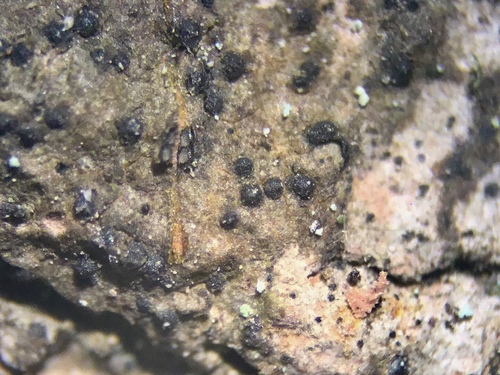
Pseudosagedia is a genus of corticolous (bark-dwelling) lichens in the family Porinaceae. It was first circumscribed as a section of genus Arthopyrenia by Swiss botanist Johannes Müller Argoviensis in 1862. Maurice Choisy elevated it to distinct generic status in 1949. Pseudosagedia was little used until, in 1995, Josef Hafellner and Klaus Kalb resurrected the genus to contain members of the Porina nitidula species group with the perithecial pigment called Pseudosagedia-violet and lacking setae.

Everniopsis
Everniopsis is a fungal genus in the family Parmeliaceae. It consists of a single species, the bark-dwelling lichen Everniopsis trulla, which occurs in Africa and South America.

Placomaronea
Placomaronea is a genus of lichen-forming fungi in the family Candelariaceae. These lichens are primarily found in the high mountains of South America, particularly in the Andes, where they grow on rocks and soil in harsh, exposed conditions. Most species form bright yellow, circular patches that can range from flat crusts to more complex, three-dimensional structures. The genus is distinguished from similar yellow lichens by its distinctive cellular structure, which includes specialised pigment-containing caps on the surface cells. Recent studies have added two new species from Peru, bringing

Microtheliopsis
Microtheliopsis is a genus of lichen-forming fungi in the family Microtheliopsidaceae. It comprises four species of foliicolous (leaf-dwelling) crustose lichens.

Gomphillus
Gomphillus is a genus of lichen-forming fungi in the family Gomphillaceae.

Pseudoparmelia
Pseudoparmelia is a genus of lichen-forming fungi in the family Parmeliaceae. The genus has a pantropical distribution.
Palicella
Palicella is a genus of crustose lichens in the family Lecanoraceae. It contains six species.
Variospora
Variospora is a genus of crustose lichens belonging to the family Teloschistaceae. The genus was established in 2013 when DNA studies revealed that many species previously grouped under the traditional large genus Caloplaca actually belonged to distinct evolutionary lineages. These bright orange lichens are distinguished by their variable ascospore shapes—which can be lemon-shaped, hourglass-shaped, or simply divided by a straight partition—and their distinctive purple reaction when tested with potassium hydroxide solution.

Schizodiscus
Schizodiscus is a genus of lichenized fungi within the Lecideaceae family. This is a monotypic genus, containing the single species Schizodiscus afroalpinus.

Melanotrema
Melanotrema is a genus of lichen-forming fungi in the family Graphidaceae. The genus was circumscribed by German lichenologist Andreas Frisch in 2006, with M. platystomum assigned as the type species.
Calopadiopsis
Calopadiopsis is a genus of lichen-forming fungi in the family Ectolechiaceae. It was circumscribed in 2002 by the lichenologists Robert Lücking and Rolf Santesson. It has two species:

Dermatiscum
Dermatiscum is a genus of lichen-forming fungi in the family Caliciaceae. The genus contains two species found in South Africa and North America.
Leciophysma
Leciophysma is a genus of cyanolichens in the family Pannariaceae. It has four species. The genus was circumscribed by Theodor Magnus Fries in 1865, with Leciophysma finmarkicum assigned as the type species.

Zwackhia
Zwackhia is a genus of crustose lichens in the family Lecanographaceae. It has six species. These lichens form thin, film-like crusts on bark and rock surfaces, often with a subtle orange tint from their algal partner. They produce distinctive elongated, slit-like fruiting bodies that remain narrow rather than opening into disc shapes.

Lecidoma
Lecidoma is a single-species fungal genus in the family Lecideaceae. It is a monotypic genus, containing the single species Lecidoma demissum, a crustose lichen. This lichen forms thick, cushion-like crusts up to 12 cm across that are dark brown to grey-brown and broken into tightly packed, slightly swollen blocks giving a lumpy appearance, with glossy black to reddish-brown fruiting bodies dotting the upper surface.
Wirthiotrema
Wirthiotrema is a genus of lichen-forming fungi in the family Graphidaceae. These tropical bark-dwelling lichens form yellow-green to light olive crusts with small, disc-like fruiting bodies that open through tiny circular pores. The genus contains six species found in lowland to mountain forests across tropical regions worldwide.
Chapsa
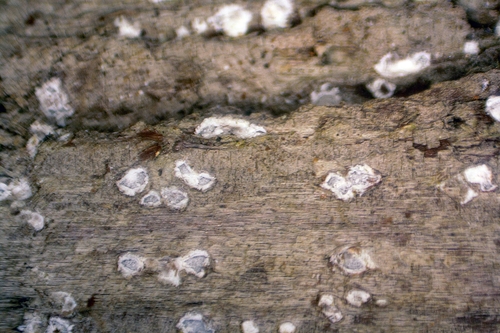
Chapsa is a genus of lichens in the family Graphidaceae. These lichens form thin, grey-whitish to pale olive crusts on tree bark and are characterized by fruiting bodies that start as slits but expand into round to angular discs level with the surface, each bordered by a pale rim. The genus has a pantropical to warm-temperate distribution, growing on shaded bark in humid lowland or foothill rainforests, with over 60 species that often serve as indicators of undisturbed forest habitats.

Blastenia
Blastenia is a genus of lichen-forming fungi in the family Teloschistaceae. The genus was established in 1852 by the Italian botanist Abramo Massalongo, who brought together several species that had previously been scattered across different genera. These lichens are characterised by their rust-brown to orange-red fruiting bodies and a thin, crusty growth that often breaks into small plate-like sections. The genus includes around 40 recognised species found primarily in the Mediterranean region and Macaronesia, though some species have spread to other parts of the world.
Rostania
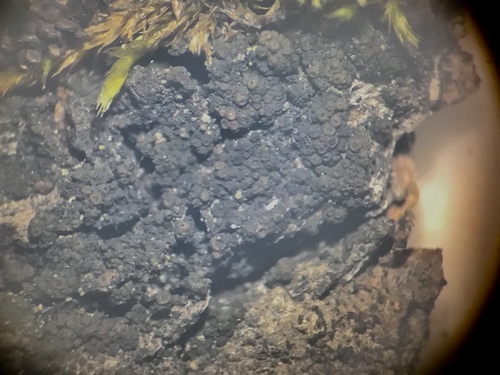
Rostania is a genus of lichen-forming fungi in the family Collemataceae. These lichens are primarily found on tree bark, occasionally on wood, with one species known to inhabit soil. The genus is characterized morphologically by having minute thalli made of hyphal tissue without a separate , and the more or less cuboid-shaped .
Loflammia
Loflammia is a small genus of lichen-forming fungi in the family Ectolechiaceae. The genus was established by the Czech lichenologist Antonín Vězda in 1986 to accommodate a group of foliicolous (leaf-dwelling) lichens with distinctive reddish fruiting bodies. These lichens form small greyish-white crusts on the surfaces of living leaves in tropical forests, and are recognised by their bright carmine-red disc-shaped reproductive structures. Species are known from Central and South America, Africa, and Papua New Guinea.
Cyanodermella
Cyanodermella is a genus of fungi within the family Stictidaceae. It contains five species.
Myrionora
Myrionora is a genus of fungi in the family Lecanoraceae.

Laurera
Laurera is a genus of lichen-forming fungi in the family Trypetheliaceae.
Calathaspis
Calathaspis is a fungal genus in the family Cladoniaceae. A monotypic genus, Calathaspis contains the single species Calathaspis devexa, which is found in Papua New Guinea in middle- and high-elevation forests at altitudes ranging from .

Metamelanea
Metamelanea is a small genus of lichen-forming fungi in the family Lichinaceae. It consists of three species of rock-dwelling lichens.

Phaeotrema
Phaeotrema is a genus of lichen-forming fungi in the family Graphidaceae. The genus was circumscribed in 1887 by Johannes Müller Argoviensis, with P. subfarinosum assigned as the type species.
Xanthocarpia
Xanthocarpia is a genus of mostly crustose lichens in the family Teloschistaceae. It has 12 species with a largely Northern Hemisphere distribution.

Sclerophora
Sclerophora is a genus of lichen-forming fungi in the family Coniocybaceae. Largely restricted to temperate latitudes, three of its species have been reported in North America.

Violella
Violella is a genus of two species of crustose lichens in the family Tephromelataceae. The genus is characterized by its brownish inner ascospore walls, brilliant violet hymenial pigment (called Fucatus-violet), and thallus chemistry. The type species, Violella fucata, was originally placed in genus Mycoblastus, but molecular phylogenetic analysis showed that this species as well as the Asian species V. wangii formed a phylogenetically distinct clade and warranted placement in a new genus. The generic name Violella, a diminutive form of the Latin viola, refers to the characteristic hymeni
Enterodictyon
Enterodictyon is a genus of lichen-forming fungi in the family Roccellaceae.
Maronea
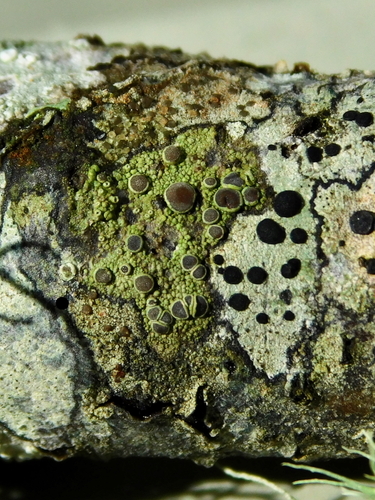
genus of fungi
Thecaria
Thecaria is a genus of lichen-forming fungi in the family Graphidaceae.

Romjularia
Romjularia is a fungal genus in the family Lecideaceae, containing the single species Romjularia lurida, a saxicolous and terricolous (rock- and ground-dwelling) squamulose lichen.
Pentagenella
Pentagenella is a genus of lichen-forming fungi in the family Opegraphaceae. It contains five species.

Coronoplectrum
Coronoplectrum is a single-species genus of unknown familial placement in the order Lecanorales. The only species in the monotypic genus is Coronoplectrum namibicum, a fruticose (bushy), saxicolous (rock-dwelling) lichen found in Namibia. The genus was circumscribed by Franklin Brusse in 1987.
Hertella
Hertella is a lichenized genus of fungi within the Placynthiaceae family.

Tapellaria
Tapellaria is a genus of mostly leaf-dwelling lichens in the family Ectolechiaceae. These lichens form thin, paint-like crusts on their host surfaces and are found mainly in tropical regions of the Americas, with about twenty known species. The genus was first proposed in 1890 by the lichenologist Johannes Müller Argoviensis. Tapellaria lichens reproduce both sexually through small black disc-shaped structures and asexually through distinctive hood-shaped outgrowths that release thread-like spores.

Byssolecania
Byssolecania is a genus of lichen-forming fungi in the family Ectolechiaceae.

Haplodina
Haplodina is a lichenized genus of fungi in the family Roccellaceae.
Squamella
Squamella is a fungal genus in the family Cladoniaceae. The genus is monotypic, containing the single species Squamella spumosa, a squamulose lichen found in Australia. The genus was established in 2001 for a lichen collected in the McIlwraith Range of far-northern Queensland, distinguished by its flattened, leaf-like scales that develop foam-like masses of tiny at their tips. It lacks the stalked structures typical of related genera and grows on bark in seasonal monsoon forests. Its precise evolutionary relationships remain uncertain due to the absence of DNA sequence data.

Kuettlingeria
Kuettlingeria is a genus of saxicolous (rock-dwelling), crustose lichens in the family Teloschistaceae. Species are characterized by a white or gray thallus and the presence of anthraquinones in the apothecial and , with the exception of Kuettlingeria diphyodes, which entirely lacks anthraquinones. First described by Italian botanist Trevisan in 1857, the genus includes 15 recognized species, although it is believed to be more diverse with additional unnamed species. These lichens are predominantly found in the Northern Hemisphere, particularly in the Mediterranean region, and grow on limeston
Roccellinastrum
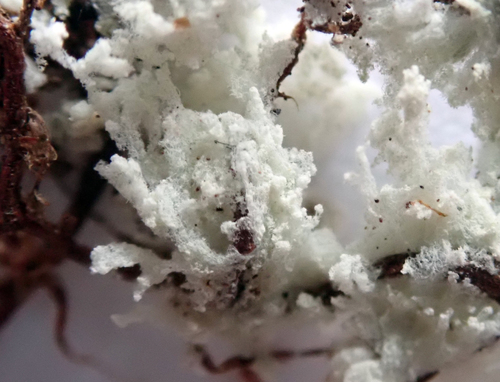
Roccellinastrum is a genus of lichen-forming fungi in the family Ectolechiaceae. It has seven species.
Physcidia
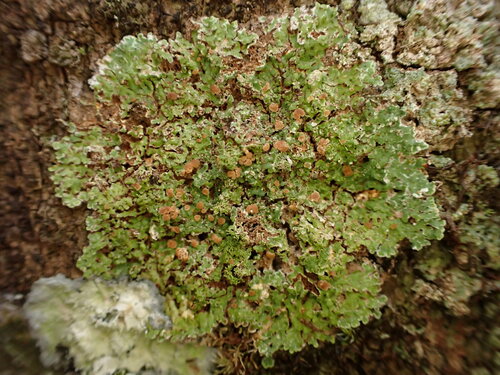
Physcidia is a genus of lichen-forming fungi in the family Ramalinaceae. The genus was circumscribed in 1862 by American lichenologist Edward Tuckerman.
Poeltinula
Poeltinula is a small genus of lichen-forming fungi in the family Rhizocarpaceae. It comprises three species of crustose lichens that grow on limestone. The genus was established in 1984 by the lichenologist Josef Hafellner and is characterized by its inconspicuous, paint-like growth that often goes unnoticed until the distinctive black fruiting bodies appear. These lichens are recognized by their dark spores that turn bright red when treated with ammonia solution and their fruiting bodies that turn crimson when tested with potassium hydroxide solution.

Aspilidea
Aspilidea is a genus of rock-dwelling crustose lichens in the family Megasporaceae (order Pertusariales). It was introduced for the species Aspilidea myrinii, but a five-locus phylogenetic study recovered two distinct taxa in the genus and treated Aspilidea as an early-diverging lineage within Megasporaceae. In the same study, all North American records previously attributed to A. myrinii were found to be misidentifications, with many representing a second species, Aspilidea subadunans.
Arthotheliopsis
Arthotheliopsis is a genus of fungi in the family Gomphillaceae. It comprises five species of crustose lichens. The genus was introduced by the Finnish lichenologist Edvard August Vainio in 1896, with A. hymenocarpoides assigned as the type species.
Ancistrosporella
Ancistrosporella is a genus of lichen-forming fungi in the family Roccellaceae. The genus was circumscribed in 1995 by Swedish lichenologist Göran Thor, with Ancistrosporella australiensis assigned as the type species. The International Union for Conservation of Nature has classified A. leucophila as a Critically Endangered species due to its limited known distribution in South America and the threats to its habitat from deforestation and land-use changes.

Cryptothele
genus of lichen
Jarmania
Jarmania is a small genus of lichen-forming fungi in the family Ramalinaceae. The genus was established in 1996 and contains two species that are both found only in Tasmania. These lichens grow as cottony mats on the bark of trees in cool rainforests, where they favour the sheltered undersides of trunks and branches.

Polycauliona
Polycauliona is a genus of lichen-forming fungi in the family Teloschistaceae.
Paralecanographa
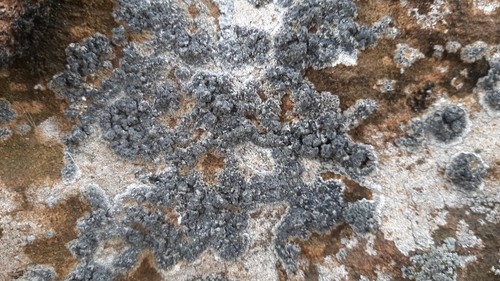
Paralecanographa is a single-species fungal genus in the family Roccellaceae. The genus was established in 2011 when genetic studies revealed that its single species does not belong where it had been previously classified and needed its own separate genus. This unusual lichen begins life as a parasite on other coastal lichens before eventually taking over and replacing its host, producing small black fruiting bodies that can appear as either tiny slits or rounded discs.