Category
page 9Lichen genera
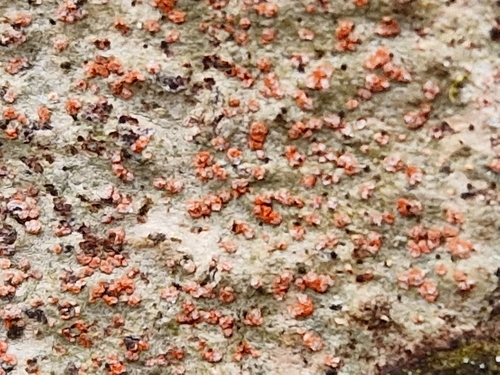
Coniocarpon
Coniocarpon is a genus of lichen-forming fungi in the family Arthoniaceae. It has eight species of corticolous (bark-dwelling) lichens. This genus is distinct for its crystalline orange, red, and purple quinoid pigments in the ascomata that turn purple in potassium hydroxide solution, its colourless, transversely septate ascospores with large apical cells, and its rounded to ascomata (fruiting bodies).
Arctopeltis
Myriolecis is a genus of lichen-forming fungi in the family Lecanoraceae. These lichens typically form thin, crust-like patches on rocks, bark, or soil, and reproduce through small disc-shaped structures that contain spores. The genus was reinstated in recent years when DNA studies showed that these species form a distinct group separate from the closely related genus Lecanora. Phylogenetic studies place Myriolecis in the MPRPS clade of Lecanoraceae, close to Protoparmeliopsis.

Wahlenbergiella
Wahlenbergiella is a small genus of saxicolous (rock-dwelling), crustose lichens in the family Verrucariaceae. It comprises three species, all of which live in marine intertidal zones on exposed, nutrient-poor rocky shores where they get periodically immersed in seawater. Wahlenbergiella closely resembles another lichen genus that includes marine species, Hydropunctaria.

Spilonema
Spilonema is a genus of lichen-forming fungi in the family Coccocarpiaceae. These lichens form small, dark tufts of thread-like filaments that grow on rocks and are found in various regions from tropical to arctic climates. They partner with nitrogen-fixing cyanobacteria, which gives them their distinctive blue-green colouration and allows them to survive in nutrient-poor environments. The genus was established in 1856 by the French botanist Jean-Baptiste Édouard Bornet, who distinguished these species from similar-looking lichens based on their unique internal structure.
Lasioloma
Lasioloma is a genus of lichenized fungi in the family Ectolechiaceae. The genus was circumscribed by the Swedish lichenologist Rolf Santesson in 1952, with Lasioloma arachnoideum assigned as the type species. Found predominantly in tropical rainforests, genus Lasioloma contains both foliicolous (leaf-dwelling) and corticolous (bark-dwelling) species. The foliicolous species are distinguished by their woolly prothallus (initial growth stage), a thallus that ranges from dispersed to continuous, and a hairy margin (the edge of the spore-producing structure). In contrast, corticolous species typi
Zeroviella
Zeroviella is a genus of lichen-forming fungi in the subfamily Xanthorioideae of the family Teloschistaceae. It has eight saxicolous (rock-dwelling) species. Zeroviella was segregated from Rusavskia, a closely related genus, in 2015.
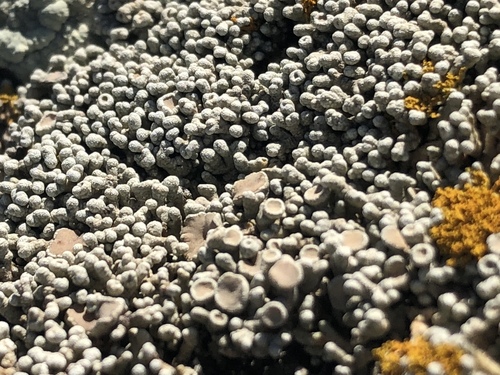
Cladidium
Cladidium is a genus of two species of lichen in the family Lecanoraceae. Cladidium was circumscribed by Josef Hafellner in 1984 with C. thamnitis assigned as the type species. C. bolanderi was added to the genus in 1989.
Semigyalecta
Semigyalecta is a genus of lichenized fungi in the family Gyalectaceae. It is a monotypic genus, containing the single species Semigyalecta paradoxa, described as new to science in 1921 by Finnish lichenologist Edvard August Vainio.
Xenolecia
Xenolecia is a genus of saxicolous (rock-dwelling) and crustose lichens in the family Lecideaceae. It has two species: X. cataractarum, and the type species, X. spadicomma. The genus was circumscribed by German lichenologist Hannes Hertel in 1987 to contain the type, a lichen known at that time only from the type locality on Wellington Island, Chile. Its range has since been expanded to include the Falkland Islands and northern Patagonia. X. cataractarum, found in Campbell Island, New Zealand was added to the genus in 2017.

Pyrenodesmia
Pyrenodesmia is a genus of lichen-forming fungi in the family Teloschistaceae. The genus currently includes 23 recognized species but is believed to contain many more unnamed taxa. The genus was circumscribed in 1852 by Italian lichenologist Abramo Bartolommeo Massalongo. It is characterised by the complete absence of anthraquinones and the presence of Sedifolia-gray pigments in both the thallus and apothecia. These lichens are typically found in calcareous outcrops in the Northern Hemisphere, with biodiversity centres in the Mediterranean basin, Central Asia, and arid regions of western North
Esslingeriana
Esslingeriana is a fungal genus in the family Parmeliaceae. The genus is monotypic, containing the single foliose lichen species Esslingeriana idahoensis, commonly known as the tinted rag lichen. It is found in northwestern North America.
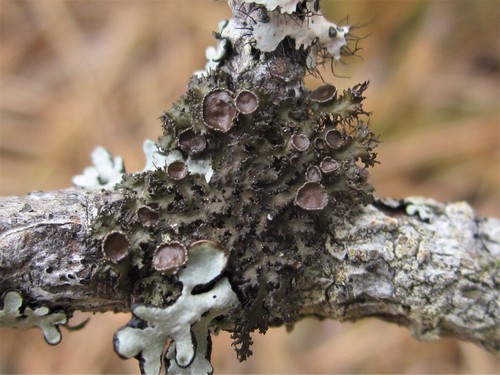
Tuckermanella
Tuckermanella is a genus of lichen-forming fungi in the family Parmeliaceae.

Cora
a genus of lichenized fungi

Carbonicola
genus of fungi
Monerolechia
Monerolechia is a genus of lichen-forming fungi in the family Caliciaceae. These lichens form crusty patches that break into small blocks or flakes, typically coloured chocolate to grey-brown, and produce black fruiting bodies for reproduction. Most species in this genus start life as parasites on other lichens before developing their own independent growth, which helps distinguish them from similar-looking lichen groups.
Pachyphysis
Pachyphysis is a fungal genus in the family Lecideaceae. It is a monotypic genus, containing the single species Pachyphysis ozarkana, a lichen. It is a crust-forming lichen that grows on limestone and dolomite rocks in open, sunny habitats, and is often inconspicuous because its main body develops within the rock surface rather than on top of it. The species has a restricted range in the eastern and central United States, centred on the Ozarks, and is associated with landscapes that were not covered by ice sheets during the last ice age.
Redonographa
Redonographa is a genus of lichen-forming fungi in the monogeneric family Redonographaceae. It has five species.
Orceolina
Orceolina is a small genus of lichen-forming fungi in the family Trapeliaceae. Established in 1970 as a replacement name for an earlier genus that was already used for flowering plants, Orceolina comprises just two species that form orange to deep red crusty patches on sun-exposed rocks. These lichens are found exclusively on the windswept subantarctic islands of the southern Indian Ocean, where they grow from sea level to alpine ridges on basaltic and granitic surfaces.

Cetrariopsis
Cetrariopsis is a genus of foliose lichens in the large family Parmeliaceae. The genus contains three species, including the type, Cetrariopsis wallichiana.
Omphalora
Omphalora is a fungal genus in the family Parmeliaceae. The genus is monotypic, containing the single species Omphalora arizonica, a foliose lichen found in North America.

Stirtonia
genus of fungi
Tylophoropsis Sambo (1938) non N.E.Br. (1894)
later homonym, do not use

Polymeridium
Polymeridium is a genus of lichen-forming fungi in the family Trypetheliaceae. Species in the genus are corticolous (bark-dwelling) and typically occur in tropical areas.
Phaneromyces
Phaneromyces is a genus of lichen-forming fungi in the monotypic family Phaneromycetaceae (order Ostropales). Phaneromyces consists of two species known from temperate South America.
Brianaria
Brianaria is a lichen genus in the family Psoraceae. It was circumscribed in 2014 by Stefan Ekman and Måns Svensson to contain four closely related species formerly in the Micarea sylvicola group.

Metus
genus of fungi

Lichinodium
Lichinodium is a genus of filamentous lichens. It is the only genus in the family Lichinodiaceae, itself the only member of the order Lichinodiales. Lichinodium has four species. Previously considered part of the class Lichinomycetes, molecular phylogenetic analysis revealed that Lichinodium represents a unique lineage in the Leotiomycetes—the first known group of lichen-forming fungi in this class.
Acroscyphus
Acroscyphus is a fungal genus in the family Caliciaceae. This is a monospecific genus, containing the single fruticose lichen species Acroscyphus sphaerophoroides. It is found in various locations in the cordilleras of western North America, including Mexico and British Columbia, as well as high-elevation, exposed regions of Asia (China, Japan), South Africa, Peru, and Patagonia. Commonly known as '''crab's eye lichen''', it forms distinctive cushion-like growths with finger-shaped branches and has a yellow to orange interior. The species typically grows on exposed rocks or dead wood in harsh,
Badimiella
Badimiella is a genus of lichen-forming fungi in the family Ectolechiaceae. It has two species of foliicolous (leaf-dwelling) lichens.
Gloeoheppia
Gloeoheppia is a genus of lichen-forming fungi in the family Lichinaceae. It comprises five species. Members of the genus form small, scaly to slightly shield-shaped patches that are usually dark brown, olive, or blackish, and many become more swollen when wet. They mostly live in warm, dry regions on calcareous soil or rock, where they often form part of biological soil crusts that help bind and stabilise bare ground. Gloeoheppia is distinguished from similar-looking lichens like Heppia by its internal structure, the nature of its , and details of its reproductive structures.

Thrombium
Thrombium is a genus of lichen-forming fungi in the family Protothelenellaceae. The genus was established in 1831 by the German lichenologist Karl Friedrich Wilhelm Wallroth, who originally described numerous species under this name. Thrombium species are characterized by their extremely thin, often barely visible crusty thalli and tiny black fruiting bodies embedded in the substrate. These lichens grow on soil, rocks, mosses, and plant debris in various habitats around the world. The genus has undergone significant taxonomic revision over the years, with DNA studies confirming its placement i
Lepidostroma
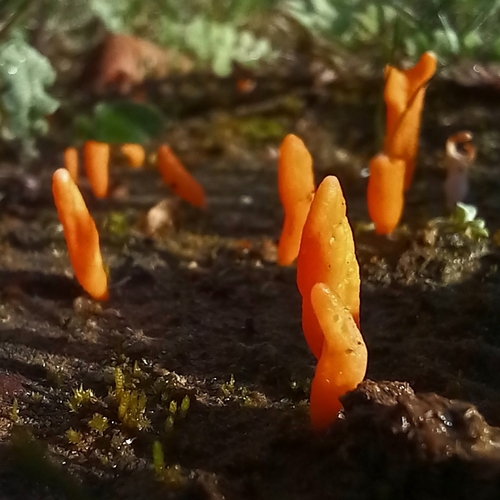
Lepidostroma is a genus in the family Lepidostromataceae (the only family within the fungal order Lepidostromatales). The genus is distinguished from all other lichenized clavarioid fungi (Multiclavula (Cantharellales), Ertzia (Lepidostromatales), and Sulzbacheromyces (Lepidostromatales)) by having a distinctly thallus (similar to a 'Coriscium-type' thallus) with scattered to dense rounded to squamules. Four species are known from the tropics of Africa and the Americas.
Pseudopeltula
Pseudopeltula is a genus of lichen-forming fungi in the family Lichinaceae. Established in 1995 by the lichenologist Aino Henssen, the genus currently includes four recognised species. These small cyanolichens are characterised by their (scaly) to (shield-shaped) thalli, which lack a lower and are attached to the by rhizines. A key feature of Pseudopeltula is its complex apothecia (fruiting bodies), which have hymenia that often become divided by sterile tissue as they mature. The genus is primarily found in arid and semi-arid regions of North America, Mexico, and the Caribbean, where species

Thelidiopsis
Thelidiopsis is a genus of fungi in the family Verrucariaceae.
Redingeria
Redingeria is a genus of lichen-forming fungi in the family Graphidaceae. Established in 2006 and named after the Austrian botanist Karl Martin Redinger, the genus contains ten species that grow as bark-dwelling lichens in tropical forests worldwide. These lichens are distinguished by their script-like, elongated fruiting structures with thick black borders and are sensitive to forest disturbance, serving as indicators of undisturbed woodland habitats.
Bapalmuia
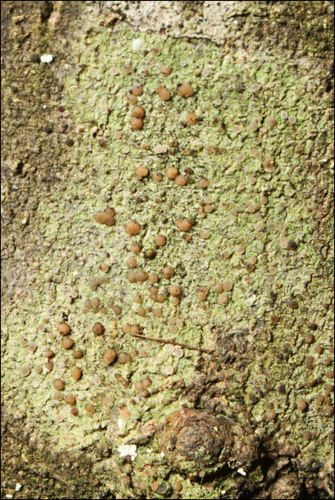
Bapalmuia is a genus of lichen-forming fungi in the family Ectolechiaceae.

Arctomia
Arctomia is a genus of lichen-forming fungi in the family Arctomiaceae. The genus was established in 1860 by the Swedish lichenologist Theodor Magnus Fries, and species of Arctomia are mainly distributed in circumpolar regions of the Northern Hemisphere. A comprehensive molecular study published in 2025 confirmed that the genus forms a distinct evolutionary lineage within its family. Species typically grow as thin, reddish-brown to blackish crusts on plant debris, mosses, or tree bark in cold northern regions, with their distribution ranging from the Arctic tundra to boreal forests and alpine
Thermutis
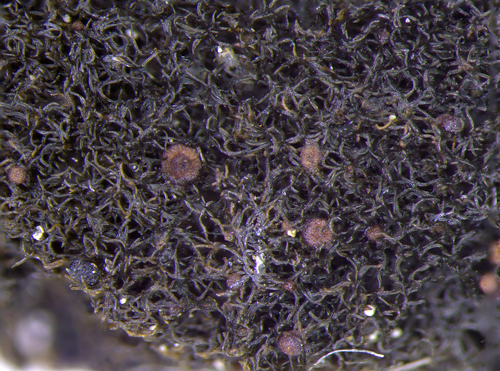
Thermutis is a small genus of cyanolichens in the family Porocyphaceae. It was formerly treated in Lichinaceae, but a 2024 multilocus re-classification of the class Lichinomycetes emended Porocyphaceae and included Thermutis there. Species are minute, dark lichens with , often gelatinous to thalli that occur on rock or soil in open, periodically wet microhabitats. Their sexual structures commonly develop as ; the asci are and the ascospores and colourless.

Gassicurtia
Gassicurtia is a genus of lichenized fungi in the family Caliciaceae.
Mixtoconidium
Mixtoconidium is a small genus of lichenicolous (lichen-dwelling) fungi in the division Ascomycota. Its relationship to other genera is unclear (incertae sedis), and it has not been assigned to any family, order or class.

Massalongia
genus of fungi
Stephanocyclos
Stephanocyclos is a genus of lichen-forming fungi in the family Lecideaceae. It is a monotypic genus, containing the single species Stephanocyclos henssenianus. This crustose lichen was formally described as a new species in 1983 by German lichenologist Hannes Hertel as part of a set of exsiccata (dried herbarium specimens). The type specimen was collected from volcanic rock found on Marion Island, one of the two Prince Edward Islands in the southern Indian Ocean. The specific epithet henssenianus honours lichenologist Aino Henssen.

Enchylium
Enchylium is a genus of lichen-forming fungi in the family Collemataceae. The genus was originally established as a section of the related genus Collema in 1810, but molecular studies have since confirmed it forms a distinct evolutionary lineage. These lichens are characterised by their gelatinous, water-absorbing thalli that swell noticeably after rain and typically colonise bare soil or rock surfaces in well-lit environments. Most species are pioneers that help stabilise loose substrates before other plants and lichens become established.
Clavascidium
Clavascidium is a genus of lichens in the family Verrucariaceae. The genus was circumscribed in 1996 by Austrian lichenologist Othmar Breuss. Because the type species of the genus, Clavascidium umbrinum, has been shown using molecular phylogenetics to belong to genus Placidium, Cécile Gueidan and colleagues proposed to unite Clavascidium with Placidium in a 2009 publication. Despite this, the genus has been retained in recent publications of fungal classification.
Austrella
Austrella is a small genus of lichen-forming fungi in the family Pannariaceae.

Koerberia
Koerberia is a genus of lichen-forming fungi in the family Koerberiaceae.

Solenopsora
Solenopsora is a genus of lichen-forming fungi in the family Catillariaceae. It has 15 species, with a mostly Northern Hemisphere distribution.

Myeloconis
Myeloconis is a genus of corticolous (bark-dwelling), crustose lichens in the family Porinaceae. It has four species. The genus was circumscribed in 1996 by Patrick M. McCarthy and John Elix, with M. fecunda assigned as the type species. The genus name, derived from the Greek ("marrow", or "pith") and ("dust"), refers to the powdery yellow-orange pigments in the medulla.

Leprocaulon
Leprocaulon is a genus of lichen-forming fungi in the family Leprocaulaceae. Members of the genus Leprocaulon are commonly called cottonthread lichens. These small lichens typically form soft, powdery coatings on their growing surfaces, sometimes developing tiny white thread-like structures that create a cottony appearance. The genus contains eleven recognised species found primarily in North America and Europe.
Barubria
Barubria is a fungal genus in the family Ectolechiaceae. It contain a single species Barubria fuscorubra, a leaf-dwelling lichen. The genus was established in 1986 by the Czech lichenologist Antonín Vězda, based on material collected from Guinea (West Africa). It is characterised by dark blue, sharply pointed (asexual spore-producing structures) and by asci (spore sacs) whose tip stains blue in iodine. The species forms a thin, smooth crust on leaf surfaces and produces brown fruiting bodies (apothecia) that narrow where they meet the crust.

Glyphis
genus of fungi

Leucodecton
Leucodecton is a genus of lichen-forming fungi in the family Graphidaceae. These lichens form thin, cream to pale brown crusts on bark or rock surfaces and reproduce through flask-shaped fruiting bodies that often appear in small, wart-like clusters. The genus currently includes more than 30 species found worldwide, with many recently described from tropical regions such as Sri Lanka and Costa Rica.

Thamnolecania
Thamnolecania is a genus of lichenized fungi in the family Ramalinaceae.

Loxospora
Loxospora is a genus of lichen-forming fungi in the family Sarrameanaceae. The genus was established in 1852 by the Italian lichenologist Abramo Bartolommeo Massalongo and originally included species now placed in other genera. Molecular phylogenetics studies have revealed that several species previously assigned to Loxospora actually belong to a separate lineage, leading to the creation of the new genus Chicitaea in 2024. These lichens form crusty growths on bark and rock surfaces, with some species producing powdery reproductive structures whilst others develop disc-shaped fruiting bodies.

Crustospathula
Crustospathula is a genus of five species of crustose lichens in the family Malmideaceae. They are characterized by their stalked and sometimes branched cartilaginous soredia and Bacidia-like apothecia.
Streimannia
Streimannia is a genus of lichenized fungi in the family Roccellaceae. A monotypic genus, it contains the single species Streimannia varieseptata. The genus was circumscribed by Göran Thor in Opera Bot. vol.103 on page 84 in 1990.
Kroswia
Kroswia is a genus of lichens in the family Pannariaceae. It consists of four paleotropical species: K. epispora, K. gemmascens, K. polydactyla, and the type, K. crystallifera. Species in the genus are characterized by their gelatinous, homoiomerous (uniform in structure, without differentiation into distinct tissues), and ecorticate (without a cortex) thallus. The ascocarps contain terpenoids and fatty acids. The genus was circumscribed by Norwegian lichenologist Per Magnus Jørgensen in 2002.
Heppsora
Heppsora is a genus of lichenized fungi in the family Ramalinaceae.

Phaeospora
Phaeospora is a genus of fungi in the class Dothideomycetes; its familial placement is uncertain.
Hypoflavia
Hypoflavia is a genus of lichenized fungi in the family Caliciaceae. The genus in found in South America, especially in tropical regions, and contains two species.